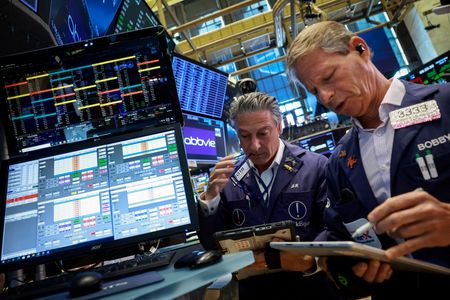

The Dow Jones Industrial Average climbed to a record high on Tuesday, but not all of Wall Street shared in the celebration. The Nasdaq Composite and the S&P 500 both lost ground as investors stepped back from technology stocks following a strong rally the day before.
Monday’s surge had been fueled by optimism surrounding a U.S.-Iran peace agreement, which sent the S&P 500 up 1.65% and the Nasdaq up more than 3%. On Tuesday, however, traders appeared content to pause and take stock of those gains — particularly with the U.S. Federal Reserve set to announce its latest policy decision on Wednesday afternoon.
“We had a big move yesterday in the market,” said Mark Luschini, chief investment strategist at Janney Montgomery Scott in Philadelphia. “We’re just digesting some of those gains and the setup in anticipation of the Fed meeting is always a little tentative.”
As of 2:17 p.m. ET, the Dow had gained 403.66 points, or 0.78%, reaching 52,074.69. The S&P 500 dropped 25.97 points, or 0.34%, to 7,528.32, while the Nasdaq fell 155.22 points, or 0.58%, to 26,528.72.
Among the S&P 500’s 11 major sectors, technology was the worst performer, dropping 1.7%. Financials led the gainers, rising 1.4%, followed by industrials, which advanced 1.2%. JPMorgan Chase shares climbed 3.4%, Wells Fargo added 1.8%, and Bank of America gained 1.6%.
SpaceX was a standout story of the day, with shares jumping more than 10%. The AI and rocket company’s market value overtook Amazon’s and briefly eclipsed Microsoft’s, continuing a remarkable run since its initial public offering. SpaceX is now ranked as the fifth-most valuable company in the United States.
Oil prices took a significant hit, with U.S. futures tumbling more than 6% after details of the U.S.-Iran interim agreement came to light. President Donald Trump said the deal would prevent Tehran from developing a nuclear weapon, while a U.S. official indicated Iran would be permitted to sell oil once the agreement is signed. The deal is expected to extend a fragile ceasefire — first announced in April — by an additional 60 days and reopen the Strait of Hormuz, which Iran has effectively closed since the U.S. and Israel launched attacks on Iran in February.
The conflict had previously driven oil prices higher and raised concerns about persistent inflation. Markets widely anticipate the Fed will keep interest rates steady in the 3.50% to 3.75% range on Wednesday. Investors will be watching closely for comments from new Fed Chairman Kevin Warsh on inflation, unemployment, and the broader economic picture.
According to CME Group’s FedWatch tool, traders currently see roughly a 42% chance of a 25-basis-point rate increase in December, with rates expected to hold steady for much of the year.
In corporate news, chemical producer Olin saw its shares fall 6.4% after announcing an all-stock deal to acquire Huntsman, valued at $2.43 billion. Huntsman shares plunged 16.7% since the offer came in below the stock’s recent trading price.
Fast-food giant Yum Brands rose 1.9% after announcing plans to sell its Pizza Hut chain for $2.7 billion, citing fierce competition and cautious consumer spending habits.
On the broader market, advancing stocks outnumbered decliners by a 1.21-to-1 ratio on the NYSE, which recorded 280 new highs and 69 new lows. On the Nasdaq, declining stocks edged out advancers by a 1.22-to-1 ratio, with 2,143 stocks rising and 2,610 falling. The S&P 500 posted 22 new 52-week highs and three new lows, while the Nasdaq Composite logged 73 new highs and 102 new lows.