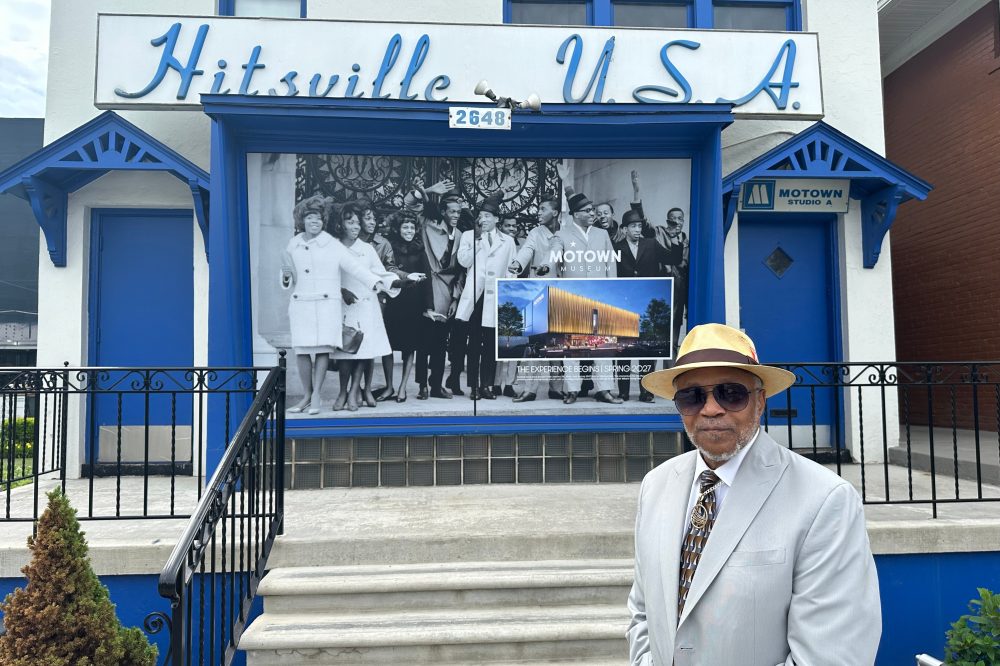

DETROIT — The sounds echoing around the Motown Museum these days are a far cry from the smooth soul hits that made it famous. Construction trucks, power drills, and hammering have taken over the Hitsville USA campus as the historic site undergoes a $75 million donor-funded transformation in preparation for its grand reopening in 2027.
The expansion of the campus — where legendary artists like Stevie Wonder, Marvin Gaye, and Diana Ross and The Supremes wrote, rehearsed, and recorded some of the biggest hits in music history — is designed to celebrate Detroit’s musical heritage while also strengthening the city’s reputation as a destination for education and tourism.
Former Motown music arranger Paul Riser Sr. believes the museum deserves the same level of national recognition as other major American landmarks, drawing a comparison to one of New York City’s most iconic locations.
“The city can really benefit by further marketing this whole concept here,” Riser said. “We need to see more pageantry of Motown. Every time I think Motown, I think Times Square.”
American cities have long used their musical roots to draw visitors, conventions, and business events. The Rock and Roll Hall of Fame pulls in roughly 500,000 visitors each year to Cleveland, while Nashville’s rich musical history — spanning country, gospel, and beyond — attracts around 17 million people annually.
Currently, the Motown Museum welcomes more than 100,000 visitors per year. After the expansion is complete, officials expect that number to climb to at least 325,000 annually.
“Motown for many, many decades has been just a magical source of pride and inspiration,” said Robin Terry, the museum’s chair and chief executive. “Visitors come to the little house that’s Hitsville USA — what used to be the headquarters of Motown — just to touch the magical space where so many of their musical icons … got their start.”
Berry Gordy founded Motown in 1959 in one of three homes on West Grand Boulevard, just north of downtown Detroit, that now make up the museum’s campus. Within a year, The Marvelettes’ “Please Mr. Postman” had climbed to the top of the Billboard Hot 100. Classics like “I Heard it Through the Grapevine,” “Baby Love,” “My Girl,” and “The Tracks of My Tears” quickly spread the Motown sound worldwide.
Gordy relocated the label to Los Angeles in 1972 and sold it to MCA Records in 1988. His late sister, Esther Gordy Edwards, established the museum in 1985.
The new 40,000-square-foot addition will be built around the original Hitsville USA house and is set to include a theater, a recording studio, retail space, a cafe, immersive exhibits, and a searchable archive of music and interviews.
Riser, who joined Motown at age 17 and went on to win a Grammy in 1973 for best R&B instrumental performance on The Temptations’ “Papa Was a Rollin’ Stone,” called the project a landmark moment for Detroit.
“I would hope to see the legacies and the historical content preserved,” Riser said. “It’s OK to having buildings … but if we don’t keep the legacies of these people who built this masterpiece, keep them in mind, we’ve lost something.”
Jennifer Ollinger, senior director of tourism for Visit Detroit, described the museum as an essential stop for both domestic and international travelers. Detroit, which emerged from bankruptcy in 2014, has experienced a notable resurgence in recent years. Ollinger noted that Motown is a key part of the pitch when attracting businesses to hold conventions and conferences in the city.
“We are the only place in the world that can claim Motown music as our own,” Ollinger said.
In Cleveland, rock ‘n’ roll plays a central role in the city’s identity, according to Emily Lauer, vice president of Public Relations and Communications at Destination Cleveland.
“Out-of-town visitors and the Rock & Roll Hall of Fame are very important for Cleveland,” Lauer said. “They are likely to stay overnight and spend money on hotel rooms, in our restaurants and in our stores. They get to see Cleveland and that strengthens the likelihood to come back.”
Nashville’s music scene, which includes country, gospel, and the historic Grand Ole Opry, generates more than $11 billion in tourist revenue each year. Deana Ivey, president and chief executive of the Nashville Convention & Visitors Corp., said music has been the primary reason tourists flock to Nashville for the past three decades.
Tennessee’s Department of Tourist Development echoed that sentiment. “We’re the second fastest growing state in America and we’ve done that without a beach or casinos,” said department commissioner Mark Ezell. “Music is our draw to Tennessee.”