
WASHINGTON – Democratic lawmakers are experiencing internal disagreement about whether efforts to remove President Trump from office should become a central theme in their midterm election campaigns.
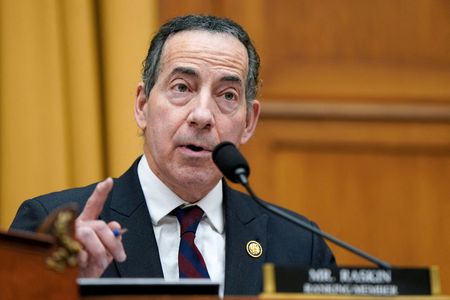
Following Trump’s recent controversial statements and social media posts, including comparisons of himself to religious figures and criticism of the pope, 84 House Democrats have endorsed legislation by Representative Jamie Raskin aimed at strengthening the 25th Amendment through a presidential assessment commission.
“I think the Raskin effort is matching where people (voters) are at,” said Representative Mark Pocan of Wisconsin, in an interview. “They can’t believe what Donald Trump’s saying.”
However, many Democratic colleagues express concern that emphasizing Trump’s removal could weaken their election messaging focused on economic affordability and potentially alienate voters who witnessed two previous impeachment attempts that resulted in Senate acquittals and Trump’s 2024 reelection.
Democrats have achieved notable success in recent special elections, and polling data shows 77% of registered voters hold Trump significantly responsible for increased gas prices following the U.S.-Israel military action against Iran. Surveys consistently indicate voters trust Democrats more on cost-of-living matters.
“I doubt, for instance, that Mary Peltola and Sherrod Brown are going to be talking a lot about impeaching Trump,” said Kyle Kondik, managing editor of “Sabato’s Crystal Ball” at the University of Virginia, referring to two Democrats running in red states Alaska and Ohio, respectively.
Republican strategist Alex Conant, formerly an aide to current Secretary of State Marco Rubio during his Senate tenure, believes GOP candidates would welcome Democrats focusing on Trump removal efforts. “They will say that Trump is focused on the economy and Democrats are focused on Donald Trump,” he said.
Representative Rosa DeLauro of Connecticut, despite acknowledging “there is something unbelievably wrong” with Trump, has declined to support Raskin’s proposal.
“Let’s get to what the needs are of the country. The economy, healthcare, grocery prices, that’s where I concentrate,” said DeLauro, who is seeking a 19th term in Congress.
Centrist Democrat Henry Cuellar of Texas emphasized district-specific concerns. “I think we need to focus on what’s important to our districts: the affordability, the ICE raids,” Cuellar told Reuters.
The Trump administration has deployed thousands of Immigration and Customs Enforcement officers nationwide for intensified deportation operations, potentially damaging Republican support among Hispanic communities. Cuellar represents a border district adjacent to Mexico.
“I don’t think we need to vote down impeachment again. It’s already happened. We know what’s going to happen in the Senate,” Cuellar said.
Progressive leader Senator Elizabeth Warren of Massachusetts has also distanced herself from Raskin’s initiative.
“It is appropriate to look at the 25th Amendment,” she said in an interview. “But it’s going to take Republicans standing up and doing that. The Democrats cannot do it by themselves.”
Constitutional procedures require the vice president and Cabinet members to jointly initiate any temporary presidential power removal under the 25th Amendment.
Some Democrats facing reelection pressure from younger progressive voters may need to embrace impeachment discussions. Representative John Larson of Connecticut, age 77, introduced 13 impeachment articles against Trump on April 6 while facing primary challenges from candidates over three decades younger.
Larson’s charges span from unauthorized war powers and alleged war crimes to violations of constitutional emoluments provisions preventing presidents from self-enrichment through their office.
House Speaker Mike Johnson issued an April 10 statement attacking Democratic motives: “Democrats are Once Again Gearing Up For Impeachment, and Other Than Trump Derangement Syndrome, They Can’t Articulate Why.”
Such criticism could influence voters in competitive states like Ohio, Alaska and North Carolina, where Democrats seek to defeat Republican incumbents by appealing to independent voters.
Former Senator Sherrod Brown, attempting to reclaim his Ohio seat lost in 2024 despite years of blue-collar support, has largely avoided Washington discussions about Trump removal. Instead, his campaign emphasizes affordability issues and argues workers face “a rigged system” affecting everyone from laborers to farmers, proposing utility rate caps rather than presidential removal.
Economic concerns and consumer prices top voter priority lists, even as Trump defends higher gasoline costs from the Iran conflict as beneficial investment. Trump’s 2024 campaign promised price reductions, yet March inflation reached 3.3% year-over-year, rising from February’s 2.4%.
Only 25% of respondents in a late March Reuters/Ipsos survey approved of Trump’s cost-of-living management.
Such polling data encourages Democratic midterm prospects, particularly given historical patterns favoring opposition parties in non-presidential elections.
Regardless of whether “impeachment” or “25th Amendment” language appears in campaign messaging, Democrats agree that connecting the Iran conflict with affordability concerns presents a winning strategy.
“I had 11 town halls with (constituents’) tremendous frustration around gas prices” during Congress’ spring break, Democratic Senator Ron Wyden of Oregon said in an interview. “What I’m focused on now is showing that we’re involved in concrete results.”