
JOHANNESBURG (AP) — A holiday morning email would launch South African disease expert Lucille Blumberg into a medical mystery spanning thousands of miles across the Atlantic Ocean.
On May 1, while South Africa observed Labor Day, Blumberg received an urgent message from a colleague in the United Kingdom. The message detailed a cruise ship passenger who had been airlifted to a Johannesburg hospital with what appeared to be pneumonia, while additional passengers aboard the vessel were falling ill.
The colleague, responsible for monitoring diseases in remote British territories across the South Atlantic, requested Blumberg’s assistance with the patient, who had been removed from the ship at Ascension Island.
This urgent request thrust Blumberg and her team at South Africa’s National Institute for Communicable Diseases into a race against time to solve an outbreak mystery aboard the Dutch cruise vessel MV Hondius.
“Even though it was a public holiday, we moved, we moved really fast,” Blumberg told The Associated Press. “It was busy. There were many conversations. There were online discussions, and there was laboratory testing happening at the time.”
In just 24 hours, the team successfully identified the culprit: hantavirus, an uncommon virus transmitted by rodents.
The elderly British passenger had reached the private Johannesburg medical facility several days prior in critical condition, leaving healthcare providers puzzled about the root cause of his illness.
When he was removed from the vessel, two elderly Dutch travelers aboard the MV Hondius had already perished, though this initially raised minimal concern. Health officials on Ascension Island had notified the World Health Organization about a group of pneumonia-like cases on the ship.
Initially, Blumberg and her team suspected Legionella, the bacteria responsible for Legionnaires’ disease, a severe pneumonia type. Bird flu was another possibility they considered.
“I called my infectious disease colleagues, and we had a caucus, and we discussed the usual ones,” Blumberg said. “Legionella is well described in outbreaks in hotels and on cruise ships, and influenza certainly is. These people had visited islands where avian influenza is well documented.”
However, tests for these conditions returned negative results. The specialists conducted comprehensive testing for various respiratory illnesses, all yielding negative outcomes.
The investigation team then focused on the ship’s origin point — Argentina — and learned that passengers were enthusiastic birdwatchers who had reportedly visited South American regions populated by both birds and rodents.
This information steered the South African disease specialists toward a different possibility: the uncommon hantavirus infection carried by rodents, which occurs in certain South American areas.
“It’s a well-described, not common, but it’s a well-described virus in Chile and Argentina,” Blumberg said. She noted that their investigation benefited from partnerships with hantavirus specialists from South America and the United States, coordinated through the WHO, the U.N. health agency.
“You can get onto a Zoom (call) online and ask your questions and get advice. This is not something every day. So that was quite extraordinary,” Blumberg said.
By Saturday morning, Blumberg contacted the director of South Africa’s sole laboratory capable of hantavirus testing.
“I said, we want to do hanta, and she said, ‘yeah, I’m coming.’”
Laboratory analysis of the patient’s blood specimens confirmed hantavirus that same afternoon. The team conducted additional testing for verification, Blumberg explained.
These positive results, which also pinpointed the Andes variant of hantavirus, enabled the WHO to notify the cruise ship about the outbreak and make a public announcement. Although hantavirus typically doesn’t spread easily between people, the WHO notes that the Andes strain can transmit from person to person.
The laboratory findings also prompted Blumberg to urgently obtain blood samples from a Dutch woman — among the initial two cruise passengers who died — who had left the ship with her deceased husband’s remains on St. Helena island and traveled to South Africa, where she also passed away.
Postmortem hantavirus testing on her also returned positive.
“It was a bit of a wow moment,” Blumberg said. “And at least once you know what you’re dealing with, it’s much easier to respond.”
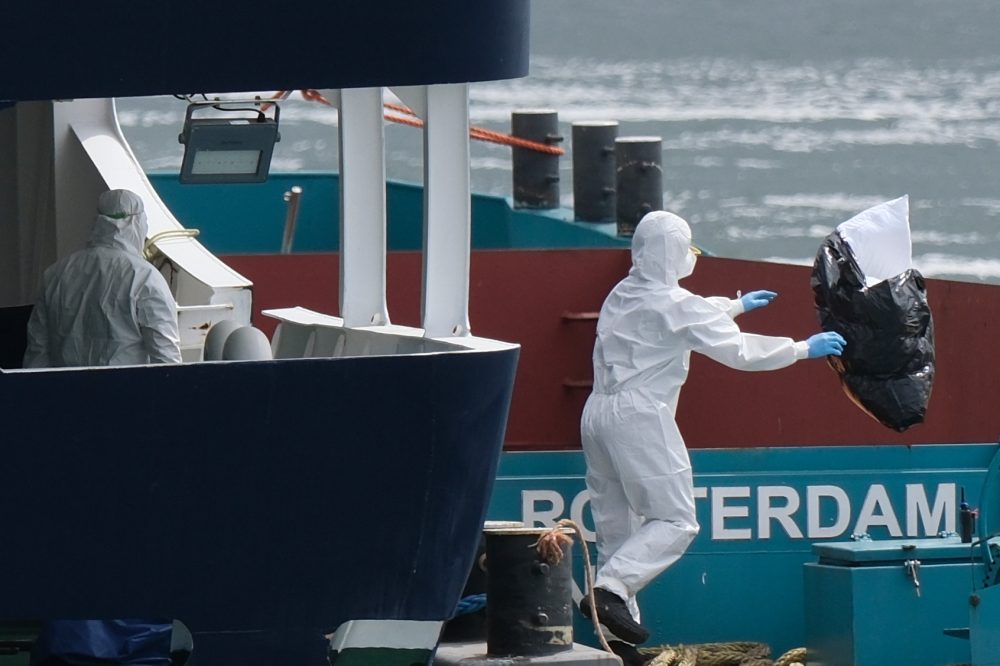
The British passenger who became the first confirmed hantavirus case from the cruise is recovering in the hospital, according to South Africa’s health ministry. The vessel has since reached Rotterdam’s Dutch port, where it underwent disinfection and remaining crew members departed.
“I’ve been doing outbreaks for 25 years. That’s what we do. We do them every day,” she said. “I think the important thing was to respond immediately to a question that clearly was urgent and then to take it from there.”