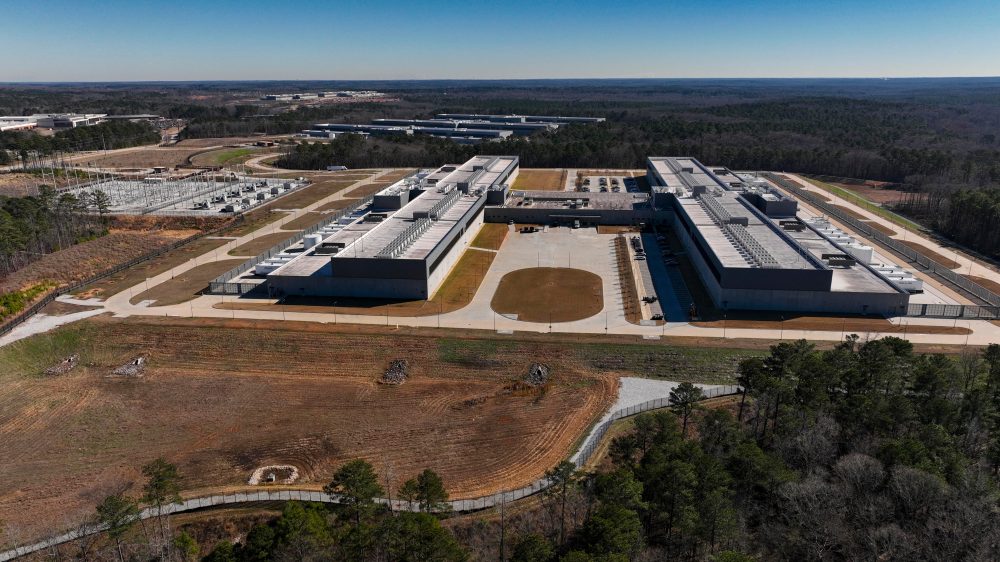

A new United Nations University study shows that data centers worldwide now consume electricity at levels comparable to entire nations, and researchers warn this massive energy appetite will double within six years due to expanding artificial intelligence applications.
The research, released Wednesday, found that data centers globally consumed 448 trillion watt-hours of electricity during the past year – exceeding the power usage of all countries except the top 10. This enormous energy consumption generated approximately 208 million tons of carbon dioxide emissions, matching Argentina’s output, while requiring roughly 1.2 trillion gallons of water for power generation.
Projections indicate data centers will consume nearly 3% of global electricity by 2030, reaching 935 trillion watt-hours. If these facilities formed their own nation, they would rank sixth worldwide for power consumption by decade’s end. The associated carbon emissions would climb to nearly 440 million tons, researchers calculated.
“If you look at these numbers, we’re seeing scales comparable to nations,” explained study co-author Kaveh Madani, a water scientist and director of the United Nations University Institute for Water, Environment and Health in Canada. “The demand is enormous.”
Artificial intelligence drives much of this growth. Currently, AI applications account for about 20% of data center energy use, but this proportion should reach 40% by 2030, according to the findings.
The study carries weight due to the United Nations’ credibility and comprehensive approach, noted Fengqi You, a Cornell University energy engineering professor who leads the institution’s AI sustainability research.
“Its value is that a U.N. institution is putting carbon, water, land, life-cycle impacts and environmental justice into one frame” for an issue often hidden by secrecy and incomplete information sharing, said You, who did not participate in the research.
“The general public should be concerned, but not panicked,” he added.
Jean Su, director of the Energy Justice Program at the Center for Biological Diversity, called the research significant as the first United Nations or global analysis “that shines a light on the environmental harms of AI.”
Industry representatives defended their sector’s value and efficiency improvements. National Artificial Intelligence Association President Caleb Max highlighted AI’s growing benefits: “AI is rapidly becoming part of our everyday lives and adding benefits that improve safety, live longer, work more efficiently, enhance food production, and reduce poverty. The evidence is growing daily that the energy return on investment of AI development is transformative for our world and therefore more than worth it.”
Josh Levi, president the Data Center Coalition, emphasized the industry’s environmental awareness.
“We remain committed to working with policymakers, local communities, and industry partners to ensure that as data centers grow, they do so responsibly, transparently, and in ways that reflect the best available practices,” he stated.
Madani, who recently won the Stockholm Water Prize, stressed that AI’s environmental costs often remain hidden compared to obviously polluting devices like vehicles and heating systems.
“AI is not just a virtual thing. We’re talking about something that has physics, something that has real impacts. There is infrastructure there. There is energy that is being used,” Madani explained. “A lot of hardware is behind all these operations that to us seem very, very clean because we don’t see smoke out of our devices. On our cellphone, there is no visible smoke or out of our computer or something. But somewhere else someone is suffering.”
Users can help reduce AI’s energy consumption by writing shorter, more direct queries, Madani suggested. The study determined that reducing word count in requests by 30% cuts AI energy use by 25% – saving electricity equivalent to what roughly 700,000 people in Africa consume annually.
“If you’re too polite, then that extra ‘please’ you put there can make a huge difference,” Madani said. “You’ve got to be very precise and be short.”
Standard ChatGPT-style queries consume about 200 times more energy than basic text classification systems like email spam filters. AI-created images or videos require significantly more power.
More sophisticated AI systems demand exponentially more training energy. The report noted GPT-3 required approximately 1.3 billion watt-hours for training, while the subsequent version needed 50 to 70 billion watt-hours.
However, training represents a small fraction of total power consumption, explained study co-author Miriam Aczel, a United National University environmental policy researcher. Roughly 90% of AI energy use comes from operational requests, she noted. GPT alone processes 2.5 billion prompts daily.
Despite technology advocates arguing for improved efficiency, a common paradox emerges where greater efficiency leads to increased usage, causing total energy consumption to rise even as individual operations become more efficient, Madani observed. While some companies promote renewable energy for data centers, Madani warned this depletes clean electricity supplies, forcing other users toward dirtier energy sources.
Research challenges included widespread lack of transparency about data center and AI consumption, locations, and sizes, both Aczel and Madani reported.
“We cannot manage what companies do not disclose,” Cornell’s You concluded.