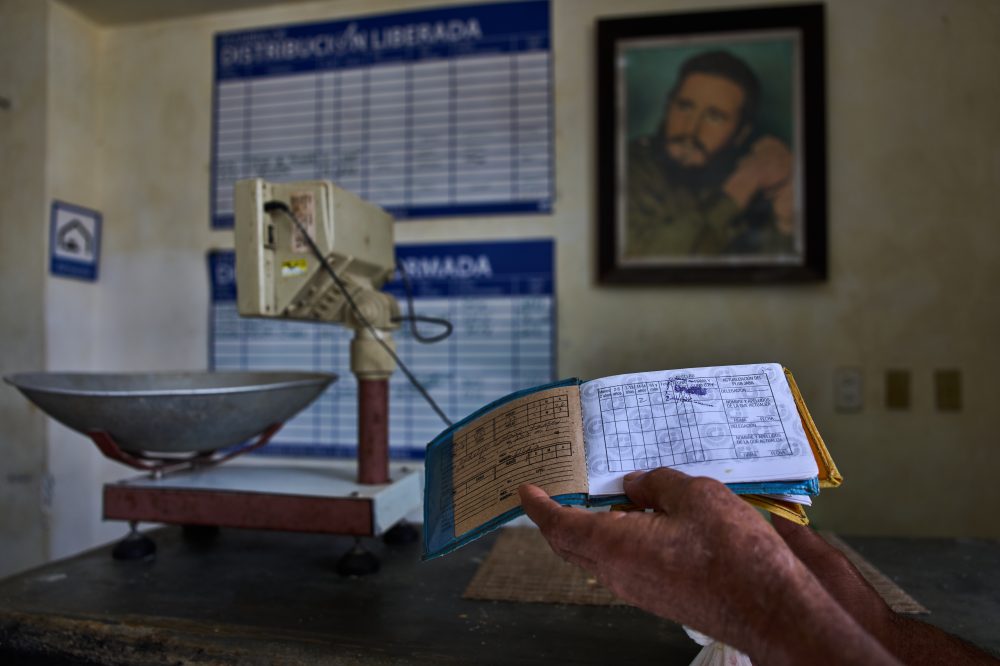

HAVANA — Store worker José Luis Amate López hasn’t seen a customer in nearly two weeks at his government-operated food store in central Havana, aside from a thin brown cat that wanders through the empty aisles.
The shelves that were packed with merchandise during his youth now stand virtually bare, offering little to the 5,000 customers who rely on this state-operated store for affordable groceries.
The government’s food allocation system that previously ensured adequate nutrition and kept families well-fed throughout the month continues to deteriorate.
With Cuba’s economy in freefall and costs skyrocketing, increasing numbers of residents cannot afford to shop elsewhere and must survive on minimal wages in this socialist nation of almost 10 million people, where essential items are increasingly priced in American dollars.
“No Cuban can truly survive on the products from the ration book anymore,” Amate López said.
Former leader Fidel Castro created the food allocation system — known as “la libreta” — during the early 1960s. The program provided deeply discounted items from dairy products to seafood and tobacco. Residents could count on their designated store being fully stocked with necessities by each month’s beginning.
The allocation system diminished during Cuba’s “Special Period” in the 1990s when Soviet assistance disappeared and widespread hardship struck the island. Research published in medical journals showed Cubans lost between 5% and 25% of their body weight during that era, as staples like bread, dairy, eggs and poultry became extremely limited.
However, many Cubans who experienced that difficult time say today’s circumstances are more severe.
Amate López remembered when his designated store was so crowded with goods “you could barely walk.”
Today it’s a vacant space with faded advertisements listing prices for nearly two dozen unavailable products, including yogurt, noodles and soap bars. Two large freezers that once held meat and poultry now only chill Amate López’s water bottle. During April, his only available merchandise was rice, sugar and split peas.
Cuban teenagers celebrating their 15th birthday, a significant milestone in Latin American culture, previously received cake and multiple cases of beer. Currently they receive only 3 kilograms of ground beef. The government recently began marking 65th birthdays with gifts of sardines, soap and toilet paper. However, Amate López said those items aren’t available either.
Havana resident Ana Enamorado, 68, said she could only purchase split peas and 1 kilogram of sugar from her assigned store during April.
She struggles to buy remaining essentials at small private shops called “mipymes” with her combined salary and pension totaling approximately 8,000 Cuban pesos ($16) monthly.
Thirty eggs cost about 3,000 pesos ($125), 2 pounds of ground meat costs nearly 900 pesos ($37) and 1 pound of cornmeal runs roughly 200 pesos ($8).
“There’s hardly anything in the ration book,” she said. “We’re practically living off air.”
Her meals consist of rice, seasoned ground meat and cornmeal, or sometimes nothing. She remembers when she could enjoy pork, lamb, stew, fried plantains and beans with rice.
“Now we have to cut back, have one meal a day and live on memories,” Enamorado said.
The island imports approximately 80% of its food supply, including items sold at government stores that are increasingly unavailable due to insufficient state resources.
“They just don’t have the money to do it anymore,” said William LeoGrande, an American University professor who has studied Cuba extensively, regarding the government’s funding shortfall. “Things come in an ad hoc way.”
LeoGrande said officials “bungled” the 2021 consolidation of Cuba’s dual currency system, and the resulting inflation continues because the state spends far more than it collects.
The government must stop printing currency and balance its budget without severely reducing social programs, which is challenging since most state funds support healthcare, education, welfare and food imports, he explained.
“Any major cuts in state spending are going to have a profound social impact, which is why they haven’t done it,” LeoGrande said, noting that government tourism investment is “way higher” than actual tourism demand, which has dropped significantly.
Recently, Cuban officials have discussed subsidizing needy individuals rather than products. This approach would free funds for importing fuel, medicine and other necessities, LeoGrande explained.
However, many Cubans still depend on their allocation books while the island’s problems worsen amid severe electrical outages, fuel shortages and ongoing U.S. trade restrictions.
Cuban comedians have mocked the ration system, creating a character called “Pánfilo” who sings in a recent online video: “Place the notebook in a cemetery, because it’s ready to be buried.”
On a recent afternoon, Lázaro Cuesta, 56, waited in line for his daily allowance of two small bread rolls for himself and his wife.
“Before it was 80 grams and cost 5 (Cuban) cents. Now it’s 40 grams and costs 75 cents,” he said. “And the quality is worse.”
Cuesta works in food service earning 6,000 Cuban pesos ($250) monthly. His wife, a retired nurse, receives 4,800 pesos in pension. They also get $200 monthly from her brother and daughter living overseas.
The money from abroad allows them to eat avocados, eggs and beans with rice, Cuesta said.
“If not for the remittances,” he said while gesturing to his throat, “hang yourself.”
About 60% of Cubans receive money from relatives abroad, but Havana’s Rosa Rodríguez, 54, is not among them.
“Everything is scarce here — everything — even that wretched bread they give us,” Rodríguez said. She earns 4,000 Cuban pesos ($8) monthly, which she considers decent for Cuba, but “no matter how hard you work, it’s simply not enough.”
Rodríguez said the only item she obtained from her assigned store in April was a charitable donation of 1.8 kilograms of rice, while she struggles to purchase other basics.
“If you buy beans, then you can’t buy sugar,” she said, explaining that most of her salary goes toward a large carton of eggs. “If I retire, I die.”