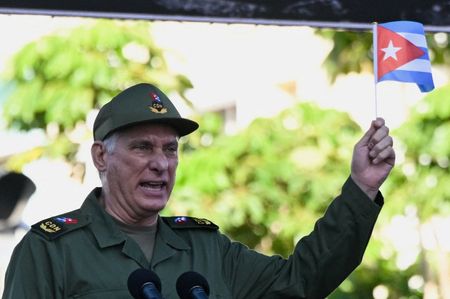

Cuban President Miguel Diaz-Canel issued a stark warning Monday, stating that any American military intervention against his nation would result in a “bloodbath” with devastating effects on regional peace and stability.
“Cuba does not represent a threat,” Diaz-Canel wrote in a message posted to X.
His remarks came in response to a Sunday Axios report that referenced classified intelligence sources. The report claimed Cuba has obtained more than 300 military drones and has considered using them against the U.S. naval base at Guantanamo Bay, American military ships, and Key West, Florida. Cuban officials dismissed the report as American fabrication designed to justify possible military intervention.
In Havana’s streets, residents expressed willingness to fight back against any attack, despite facing severe economic difficulties.
“I know Cuba is a strong country. Cubans are very brave and they are not going to find us unprepared,” said Sandra Roseaux, 57. “If they come, they will have to fight, because Cuba will respond. My country, hungry or however it may be, will respond. It is better that they do not come because there will be a fight.”
The communist nation, which has been at odds with Washington for decades, faces mounting pressure after the United States severed energy supplies following the arrest of the president of its former ally Venezuela in January. Recent weeks have brought fuel shortages and electricity blackouts lasting all but one or two hours daily.
Relations between the nations have deteriorated rapidly in recent days. Reuters previously reported that U.S. Department of Justice prosecutors are preparing to charge former Cuban leader Raul Castro in connection with Cuba’s 1996 downing of two aircraft operated by a humanitarian organization, according to a Justice Department source.
Foreign Minister Bruno Rodriguez posted on social media that Cuba, “like every nation in the world,” possesses the right to defend itself against external threats under the U.N. Charter and international law.
Havana resident Ulises Medina, 58, called for diplomatic solutions. “It would not be right for the United States to invade Cuba, nor for Cuba to invade the United States,” he said. “They must reach an agreement and talk and negotiate. Cuba, in any case, will defend itself because the country will not be surrendered.”
Charging Castro, 94 — the brother of late former leader Fidel Castro and a hero of the 1959 Cuban Revolution — would represent a significant escalation in pressure on Cuba by the Trump administration.
“The Cuban people do not let anyone interfere with their land,” said Jorge Villalobos, 87. “Cubans know how to defend themselves, even with sticks and stones.”