
HAVANA — Cuba’s leader Miguel Díaz-Canel delivered a defiant message Thursday, declaring his nation stands ready to defend itself against potential U.S. military action while emphasizing Cuba has no desire for armed conflict.
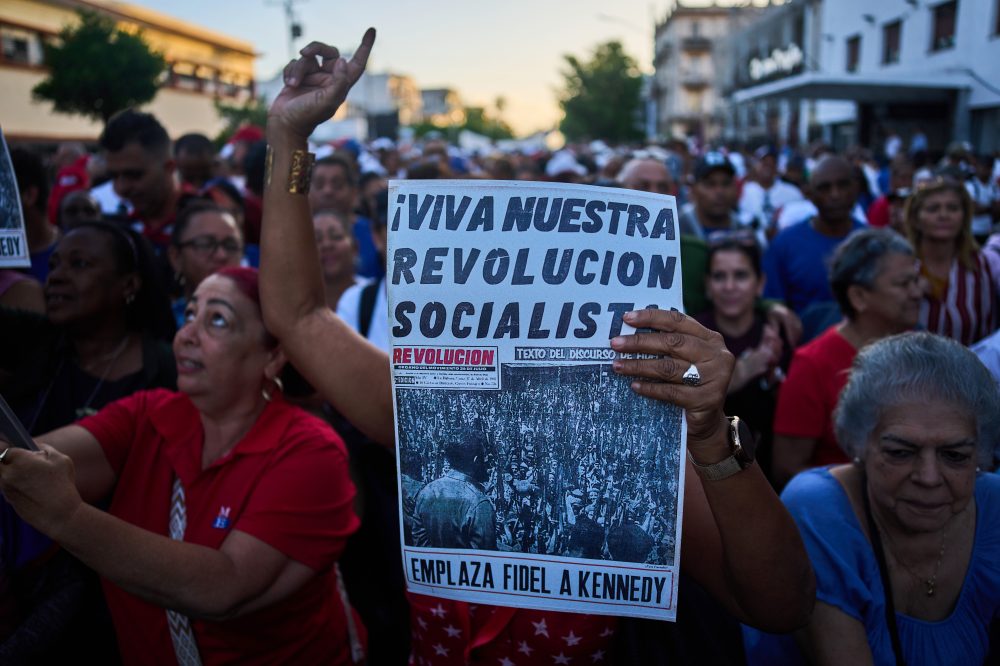
Speaking to hundreds gathered for a rally marking the 65th anniversary of when the Cuban Revolution declared its socialist principles, Díaz-Canel addressed mounting tensions between the two nations.
“The moment is extremely challenging and calls upon us once again, as on April 16, 1961, to be ready to confront serious threats, including military aggression. We do not want it, but it is our duty to prepare to avoid it and, if it becomes inevitable, to defeat it,” Díaz-Canel said.
His remarks come as relations between Washington and Havana have deteriorated, with Cuba facing severe hardships due to what officials call a U.S. energy embargo.
President Trump recently suggested his administration might turn its attention to Cuba following the conclusion of military operations in Iran.
“We may stop by Cuba after we finish with this,” he said.
Trump characterized the island as a “failing nation” and claimed it has “been a terribly run country for a long time.”
The former president has previously issued threats regarding Cuba, similar to his actions in early January when U.S. forces struck Venezuela and disrupted crucial oil deliveries from that nation.
Subsequently, Trump warned of imposing tariffs on any nation that sells or supplies oil to Cuba.
Trump and Secretary of State Marco Rubio — whose family left Cuba in the 1950s prior to the revolution — have both criticized the island’s leadership as incompetent and oppressive.
Díaz-Canel dismissed their statements as attempts to create a false “narrative” without basis.
“Cuba is not a failed state. Cuba is a besieged state. Cuba is a state facing multidimensional aggression: economic warfare, an intensified blockade and an energy blockade,” said Díaz-Canel, who served as the primary speaker at Thursday’s event.
“Cuba is a threatened state that does not surrender. And despite everything. And thanks to socialism. Cuba is a state that resists, creates, and make no mistake, a state that will prevail,” Díaz-Canel added.
Officials from both nations have confirmed discussions are underway to address the escalating tensions, though specific details remain confidential.
The Cuban leader highlighted accomplishments stemming from the revolution and its social programs, including universal education that has produced thousands of skilled professionals, many of whom have been compelled to leave the country due to current difficulties.
Trump’s oil restrictions have intensified already severe conditions caused by a five-year economic downturn that began with the COVID-19 pandemic and increased U.S. sanctions designed to force political changes on the island.
Analysts have raised concerns about a potential humanitarian emergency.
Policies preventing Cuba from obtaining petroleum from Venezuelan, Mexican and Russian sources are worsening the population’s difficult circumstances, including extended power outages and fuel shortages.
Thursday’s gathering honored the 65th anniversary of a significant address by former leader Fidel Castro during a previous standoff with the United States. That pivotal moment established the ideological direction the Caribbean island would follow and its resistance to Washington’s regional influence.