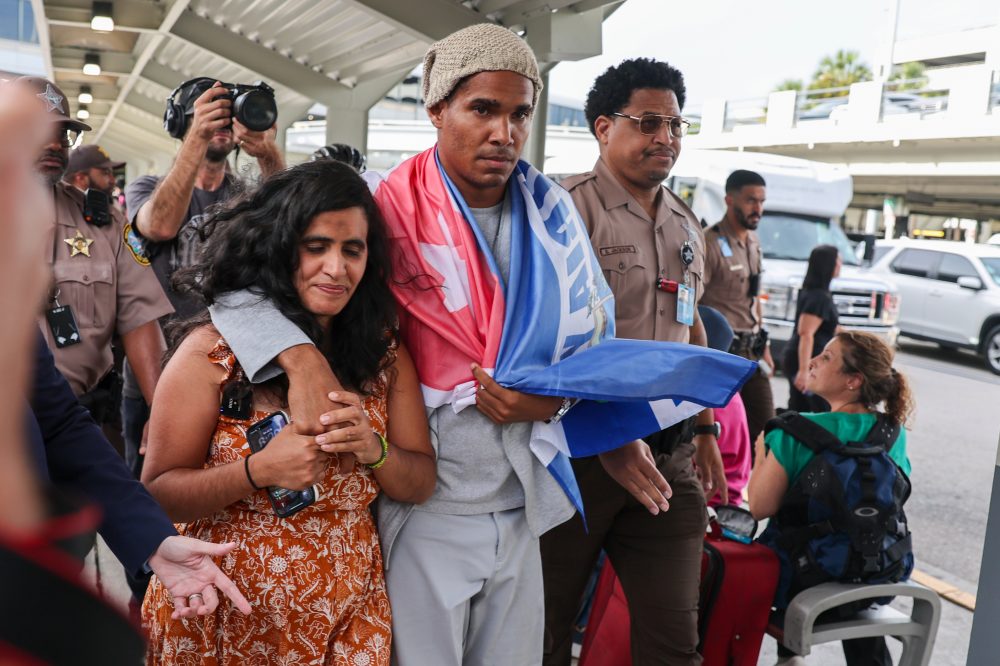

MIAMI (AP) — Celebrated Cuban artist, musician, and dissident Luis Manuel Otero Alcántara landed in Miami on Saturday following his release from a five-year prison term — a freedom that came with a steep price: permanent exile from his homeland.
The 38-year-old was welcomed at the airport by an enthusiastic crowd of supporters who cheered, sang, and held up their phones to capture the moment. Supporters wrapped him in a Cuban flag emblazoned with the phrase “Patria y Vida” — meaning “Homeland and Life” — the name of a song he co-wrote that earned him a Grammy and became a rallying anthem for those opposing political repression in Cuba.
Earlier in the week, the United States had approved his parole into the country, according to a social media page run by his friends and supporters. They noted that Alcántara accepted exile as the only path available to escape ongoing persecution and to continue his work as an artist and activist.
Alcántara helped establish a collective of artists, writers, and musicians based in Havana known as the San Isidro Movement, named after the neighborhood where he lived.
He was taken into custody on July 11, 2021, during a public demonstration. The following year, in 2022, a Cuban court found him guilty of public disorder, contempt, and disrespecting national symbols, handing down a five-year prison sentence.
His imprisonment drew condemnation from human rights groups and the U.S. government alike. Organizations such as Amnesty International labeled him a political prisoner — a characterization the Cuban government denied.
Alcántara was held in a maximum-security facility. Although he had been expected to walk free the previous week, his advocates spent several days unable to reach him or confirm his whereabouts. In response, the organization Cubalex — which provides legal support to dissidents and documents human rights abuses from abroad — filed a habeas corpus petition on his behalf on Monday.
His supporters remained uncertain of his location and whether he was truly free right up until the moment he boarded a plane Saturday.
Upon arriving on American soil, Alcántara said his first destination would be the Shrine of Our Lady of Charity, where he planned to make an offering.
His advocates noted that other political prisoners remain behind bars in Cuba, including fellow artist Maykel “Osorbo” Castillo Pérez. They expressed hope that Alcántara’s release would increase pressure on Cuban authorities to free Pérez as well.
Alcántara carried with him from Cuba a broken statue of the Virgin Mary, which he described as a symbol of hope and healing — representing the possibility of making something whole again from broken pieces.