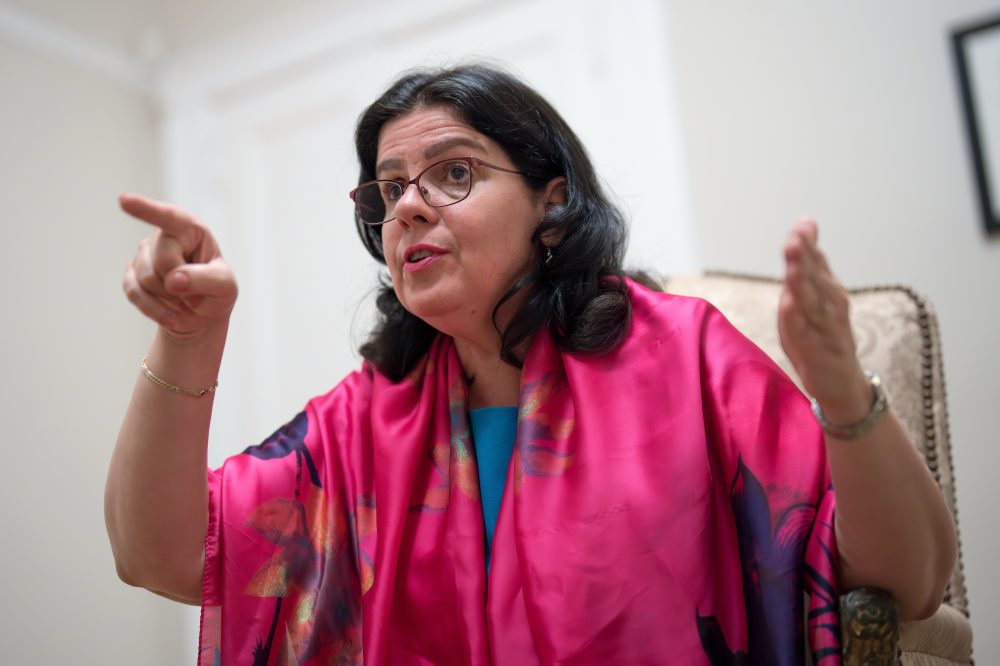

WASHINGTON (AP) — Cuba’s highest-ranking diplomatic representative in the United States claims that new American sanctions against the island nation’s leadership and criminal charges filed against former President Raúl Castro serve as justification for the Trump administration to build public support for potential military intervention, according to statements made to The Associated Press.
During a Tuesday interview, Ambassador Lianys Torres Rivera echoed criticisms previously voiced by other Cuban government officials, including the foreign minister and the president, while expressing strong objections to America’s longstanding trade embargo and recent energy blockade affecting the Caribbean nation.
“The sanctions against our leaders, we see as a pretext to make the American people think we are a threat,” she said at Cuba’s embassy in Washington. “We are not a threat to the U.S., and we don’t want confrontation.”
Torres Rivera, whose official designation is chargé d’affaires, characterized the current circumstances as “a war without bombs.” She warned that any attempts to overthrow Cuba’s government through pressure or military force would face determined opposition.
“Raúl is sacred,” she stated regarding last month’s federal grand jury charges against Castro. The 95-year-old former leader has been indicted on conspiracy and murder allegations connected to the 1996 downing of two civilian aircraft flown by the Miami-based exile organization Brothers to the Rescue during his tenure as Cuba’s defense minister.
“Raúl is a sacred symbol of the revolution, and we will defend Raúl — as we will the country — until the end,” Torres Rivera said. “If we are attacked, we are going to respond, and we are prepared for that. But we don’t want it.”
Her statements mirror widespread sentiment among Cubans and Cuba experts who view the criminal charges against Castro and penalties imposed on other socialist government officials as comparable to justifications the Trump administration promoted before January’s military intervention in Venezuela that removed then-President Nicolás Maduro.
Last Thursday, coinciding with the U.S. Treasury Department’s announcement of sanctions targeting Cuban President Miguel Díaz-Canel, Castro’s son and grandson, and additional officials, U.S. President Donald Trump declared regarding Cuba: “We’re going to handle that as soon as we’ve finished” military operations in Iran.
Trump has maintained threats of military action against Cuba following Maduro’s removal and the implementation of an energy blockade that has severely restricted fuel deliveries to the island. These measures have triggered widespread power outages, food scarcity, and economic devastation throughout Cuba.
Torres Rivera explained that the Trump administration’s efforts to intensify pressure on Cuba’s already struggling economy have caused tremendous hardship for ordinary citizens who face daily survival challenges including power outages lasting up to 20 hours and dramatically increased prices for gasoline, kerosene, and essential items such as food and medicine.
“What is happening now is tough,” she said. “It is heartbreaking.”
Trump, Secretary of State Marco Rubio and other administration representatives have consistently rejected claims that Cuba’s economic difficulties stem from American policies, instead attributing responsibility to the Cuban government’s socialist economic approach. While not eliminating the possibility of military action against the island, they have indicated willingness to allow Cuban leadership time to implement changes.
Torres Rivera described recent conversations between high-level U.S. and Cuban representatives in Havana and other locations as “professional and respectful.” However, she emphasized that Cuba will not accept changes imposed externally and insists any reforms must originate internally without external pressure.
Drawing on her previous experience as Cuban ambassador to Vietnam, another socialist nation maintaining long-established relationships with Cuba, she observed that Washington and Hanoi have developed positive diplomatic ties over four decades, but only because Vietnamese leaders implemented changes according to their own timeline. She argued Cuba deserves similar consideration.
“We want to make sure that the only changes to the system are done by us,” she said.
Rubio, however, has characterized Cuba as presenting a significant national security risk to America due to its security and intelligence connections with China and Russia, as well as cordial relationships with U.S. adversaries throughout Latin America.
“I really don’t believe this system is capable of reform unless new people take over or a new mindset takes hold,” he told lawmakers at a congressional hearing last week.
The State Department didn’t immediately respond to a request for comment on the Cuban ambassador’s comments.