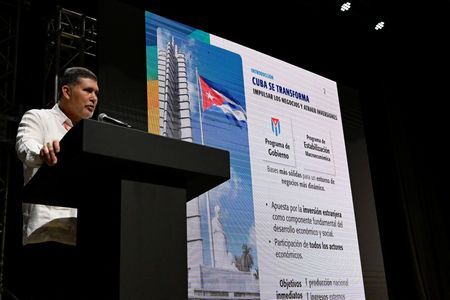

The Cuban government made a surprising announcement Monday, welcoming Cuban Americans and other exiles to invest in and own businesses on the Communist-controlled island, despite decades of hostility between the two sides.
Cuban Deputy Prime Minister Oscar Perez-Oliva Fraga, who leads the foreign commerce ministry, declared on state television that “there are no limitations” for Cuban exiles seeking to invest in their homeland.
This represents a dramatic reversal for Cuba, which has historically viewed the exile community with deep mistrust, particularly since many Cuban Americans have long supported the U.S. trade embargo against the island nation.
The announcement comes as Cuba faces a severe economic crisis, worsened by U.S.-imposed oil restrictions and sanctions that have resulted in widespread power outages and shortages of essential goods including fuel, food, and medical supplies.
While Cuban nationals living on the island have been permitted to establish private businesses since 2021, those residing outside the country were previously barred from such opportunities.
“We have reiterated on several occasions that Cuba’s doors are open to investment from the Cuban community residing abroad. And when we say that, we’re not just referring to small ventures. We’re also referring to the possibility of investing in larger projects,” Perez-Oliva Fraga stated.
The deputy prime minister indicated that exiles could “participate fully in the various areas of the country’s development,” with the scope depending on the size of their business ventures.
Cuban officials expressed particular interest in agricultural investments, similar to arrangements with Vietnamese companies that produce rice on the island under agreements where the government retains land ownership.
The timing of this policy change is notable, occurring just days after Cuba confirmed it had initiated discussions with the United States, while Trump administration officials have privately indicated they would seek economic opportunities as part of any future agreement.
More than one million Cubans have left the island since 2021, creating the largest migration wave since Fidel Castro’s 1959 revolution and representing a significant pool of potential investors that remains largely unused.
Cuba also announced it was eliminating barriers for U.S. companies seeking to invest, though officials acknowledged that American laws still prohibit such trade and investment under the ongoing economic embargo designed to pressure the Havana government.
President Donald Trump has recently intensified pressure on Cuba by cutting off Venezuelan oil shipments and threatening tariffs on any nation that sells oil to the island, further damaging Cuba’s already struggling economy.
Trump escalated his statements Monday, claiming he expected to have the “honor” of “taking Cuba in some form” and asserting that “I can do anything I want” regarding the neighboring country.