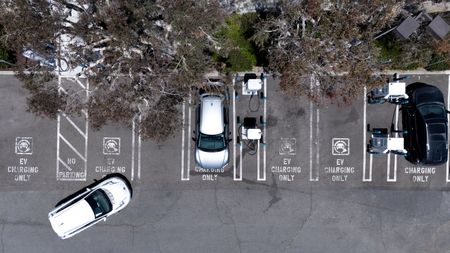

Congressional representatives have introduced bipartisan legislation that would impose annual charges on electric vehicle owners to help fund highway maintenance across the country.
The proposed measure would require electric vehicle drivers to pay $130 each year, while owners of certain plug-in hybrid models would face a $35 annual charge. These fees are designed to address the funding gap created as more drivers switch to vehicles that don’t contribute to gas tax revenues traditionally used for road repairs.
The legislation is part of a comprehensive five-year highway funding package worth $580 billion, which lawmakers must pass before the current authorization expires on September 30. Currently, most federal road repair funding comes from taxes on diesel fuel and gasoline, which electric vehicles don’t use.
Under the proposal, these annual charges would increase by $5 yearly beginning in 2029, eventually reaching $150 for electric vehicles and $50 for plug-in models.
The transportation committee is scheduled to consider the bill on Thursday. The legislation was jointly introduced by the committee’s Republican chair, Sam Graves, and top Democratic member, Rick Larsen.
Several states have already implemented similar fee structures for electric vehicles to ensure these drivers contribute to road maintenance costs. Federal lawmakers have avoided raising fuel taxes for three decades despite increasing infrastructure repair expenses. Earlier this year, some Republican senators proposed a much higher $1,000 charge on electric vehicles for highway funding.
The Sierra Club has voiced opposition to the legislation, stating it would reduce funding for electric vehicle charging infrastructure and “includes an irresponsible tax for EV and plug-in hybrid drivers.”
The bill also addresses autonomous vehicle regulations, directing federal transportation officials to create performance-based safety standards for self-driving buses, trucks, and commercial vehicles within two years. These rules would not cover passenger cars and would override state regulations.
Additionally, the legislation would mandate that autonomous school buses transporting children must have a human operator present.
An electric vehicle advocacy organization, the Electrification Coalition, previously argued that a $250 fee for electric vehicles would be excessive, noting that typical gas-powered vehicles contribute only $88 annually through federal fuel taxes.
Since 2008, more than $275 billion has been transferred from general government funds to cover road repairs, including $118 billion from the 2021 infrastructure legislation.
With congressional elections approaching in November, some lawmakers express concern about reaching an agreement on highway funding before the September 30 deadline.