
LOLA YA BONOBO, Congo — In the forested area surrounding Congo’s capital city of Kinshasa, Micheline Nzonzi holds a drowsy one-year-old bonobo, an orphaned primate whose survival depends on her dedicated care over the coming years.
The young ape has promising prospects for recovery through nurturing human care, bottle feeding, and regular interaction with other infant bonobos.
“They survive thanks to human affection,” explained Nzonzi, who has served as a surrogate mother to bonobos for two and a half decades. “Without me, without us, these bonobos cannot survive.”
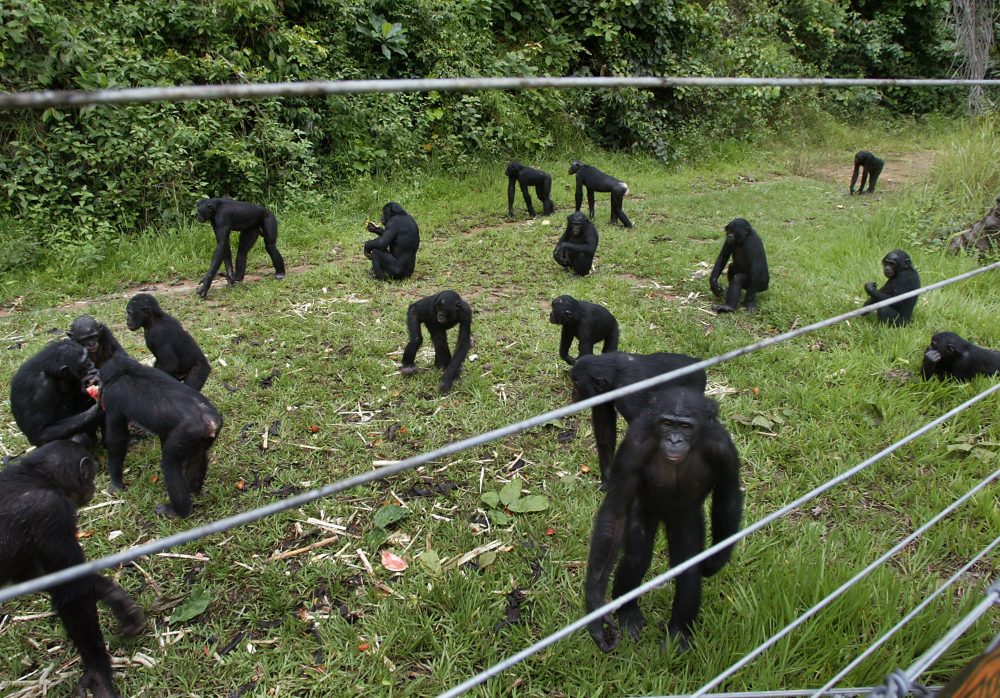
Located in the jungle surrounding Kinshasa, this facility represents the globe’s singular refuge for bonobo orphans, typically saved from illegal hunters or discovered in local residences where people keep them as a food source.
Despite legal protections for these endangered great apes, hunters continue pursuing them to meet bushmeat demand across regions extending well past the Congo Basin rainforest, often referred to as the planet’s secondary lung. While the illegal meat trade encompasses various animals from small rodents to large antelopes, symbolic species like bonobos command premium prices.
Arsène Madimba, who works in education at the Lola ya Bonobo facility, stated: “The bonobos are in danger. We are educating people to not kill the bonobos. We can’t kill them, we can’t put them at home as pets, we can’t eat them. Because of poaching, we can find big trading of orphaned bonobos across the country.”
These primates care for their offspring during extended four-to-five-year periods. Their slow breeding patterns make them particularly susceptible to environmental threats. Congolese officials proposed a “bonobo credits” system last year, modeled after carbon offset programs, to incentivize forest conservation by local communities, though implementation remains pending.
Primatologist Gladys Kalema-Zikusoka, who established the Uganda-based Conservation Through Public Health organization, noted cultural distinctions between countries. “There is a cultural difference between Congo and neighboring Uganda, where apes are not hunted for meat,” she explained. “In Congo, they believe that you can become as strong as (the primate eaten).”
The Lola ya Bonobo sanctuary houses numerous adult bonobos, with some residents living there since the facility’s 2002 opening under Les Amis des Bonobos du Congo, a French conservation organization.
Currently, eleven young bonobos live in the nursery section, including the most recent arrival from earlier this year. Each infant receives assignment to a human caregiver who provides years of care before the animal transitions to adult groups that welcome public visits.
Occasionally, sanctuary residents undergo extensive preparation for eventual release back into their natural environment, though this process requires years of conditioning.
These primates share approximately 99% genetic similarity with humans and rank as our closest living relatives alongside chimpanzees.
Scientists estimated roughly 100,000 wild bonobos existed during the 1980s. Current population estimates suggest only 20,000 remain, representing a dramatic decrease. Commercial bushmeat hunting poses the primary threat to bonobo survival, according to International Union for Conservation of Nature assessments.
Wild bonobos inhabit dense tropical forests located south of the Congo River. Researchers rarely study these animals in their natural environment, with most knowledge coming from observations in international zoos and studies conducted by foreign scientists attracted to these remarkable creatures.
German anatomist Ernst Schwarz first identified bonobos as potentially distinct from chimpanzees in 1929 after examining a skull specimen with unusually small proportions. American zoologist Harold Coolidge later provided comprehensive descriptions that enabled official species classification in 1933.
American audiences recognize bonobos largely due to their reputation as highly intelligent, peaceful, and emotionally sensitive animals. Recent 2025 research from Johns Hopkins University suggests these primates may possess imaginative capabilities.
Female bonobos lead their social groups and demonstrate remarkable absence of sexual competition. When different groups encounter each other, females may join opposing sides without triggering conflicts, contrasting sharply with chimpanzee and gorilla behavior. Their frequent and varied mating practices have earned them the nickname “hippie apes.”
Primate meat commerce in Kinshasa now operates secretly. While traders can obtain permits for hunting antelopes and similar species, “les macaques” trading faces prohibition partly to prevent zoonotic disease transmission like Ebola.
Charles Ntanga, a merchant at Masina market, explained: “I used to sell monkeys before, but now we cannot sell monkeys, any type of moneys.” He used a fly whisk to clear insects from a decomposing giant rodent carcass, priced at approximately $17 per kilogram. Adjacent vendor Guyva Mputu offered python meat that began steaming in the tropical humidity.
According to Madimba, poachers use captured baby bonobos as bait to attract adult animals, shooting the adults when they approach to investigate the distressed infant’s calls.
Zookeeper Frank Lutete, responsible for animal feeding, explained how orphaned bonobos form strong relationships with their human caregivers, who can identify each individual by name. He travels by boat to distribute papaya while the bonobos create loud vocalizations and descend from trees to collect food.
According to Lutete, some bonobos express appreciation by tapping their chests in what appears to be a thankful gesture.