
BUNIA, Congo (AP) — Motorcycle taxi drivers in eastern Congo organized a public awareness campaign Tuesday to educate communities about Ebola prevention as distrust and violence against medical personnel continue to obstruct efforts to control the deadly outbreak.
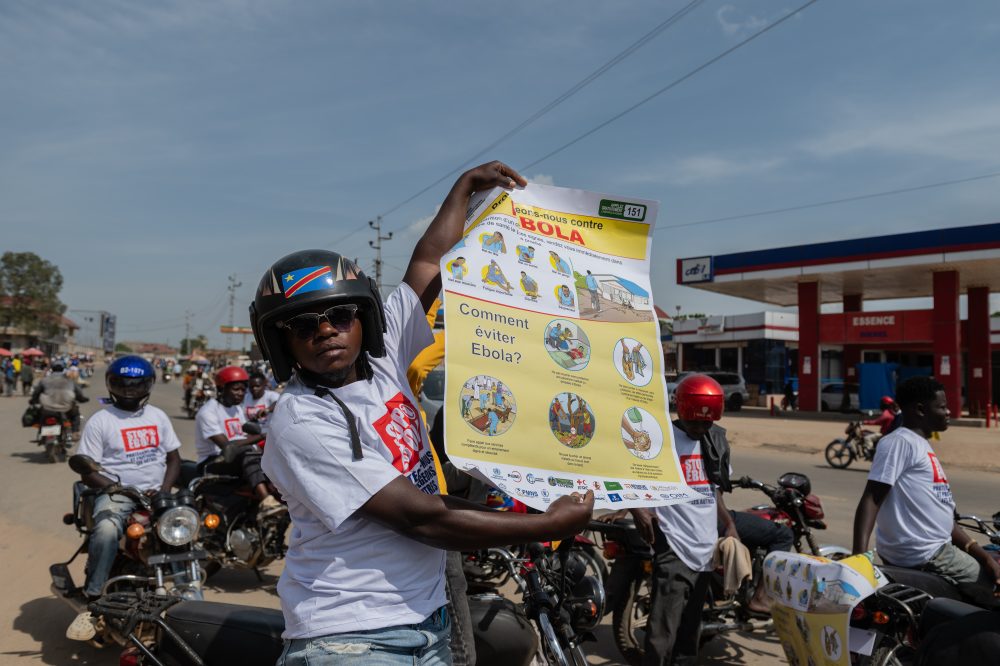
The drivers donned white shirts reading “Stop Ebola” and carried educational materials and visual guides about disease prevention while traveling through Bunia and Rwampara, communities located in Congo’s eastern Ituri province where the outbreak is concentrated.
Ituri province represents over 90% of all recorded cases. Additional cases have been documented in North Kivu and South Kivu provinces, plus several instances reported across the border in Uganda.
Congolese officials reported late Tuesday that 115 people have died from confirmed cases of the disease among at least 598 total confirmed infections.
However, the outbreak response continues to face community doubt and false information, with some residents questioning the existence of the outbreak or strongly resisting strict burial protocols implemented by medical teams to limit disease transmission.
Ituri province residents have conducted no fewer than three assaults on medical facilities while demanding the return of deceased patients’ remains. In total, more than 520 incidents affecting healthcare workers have been documented, according to Marie Roseline Darnycka Belizaire, WHO’s emergency director for Africa.
Motorcycle taxi operators can help communicate that healthcare workers are simply working to prevent disease spread, explained Jacques Maliro, the World Health Organization’s Risk Communication and Community Engagement Officer, who helped organize the caravan.
“Response teams have been attacked in some areas, and that is one reason why we chose to involve motorcycle taxi drivers. They are an important group because they transport both sick and healthy people, so they too need to be informed and engaged,” Maliro said.
False information circulating throughout Ituri communities has prevented residents from following health guidance or getting medical treatment, according to health officials. When the outbreak began, certain churches informed their members that the outbreak was fabricated and that religious faith eliminated the need for medical intervention.
“Those who do not believe in it need to understand that it is real,” said Josue Mbabona, a motorcycle taxi driver from the caravan, adding that he has already lost three family members to Ebola.
Healthcare workers on the front lines, working with minimal compensation or rest periods, have also been prevented from accessing certain communities isolated by fighting with armed rebel groups.
Eastern Congo has experienced years of violence from numerous separate rebel and militant organizations, some connected to neighboring Rwanda or the extremist Islamic State group.
Supply shortages have also complicated response efforts. Bunia residents and local leaders cited Wednesday a lack of water necessary for the regular handwashing protocols recommended to reduce virus transmission.
This Ebola outbreak stems from the uncommon Bundibugyo virus, which lacks approved vaccines or treatments unlike the “Zaire virus,” which caused most of Congo’s previous 16 disease outbreaks.
“The vaccine needs to be available so that we can protect ourselves, move forward, and return to normal life,” David Kasimwa, a student participating in the caravan said. “This disease has disrupted many activities: We are no longer able to travel freely because we are afraid,” he added.
Three potential vaccines are currently under development. Africa’s leading public health organization announced last month it plans to make a vaccine and treatment for Bundibugyo virus available before year’s end.
At the same time, multiple nations have established travel limitations or increased screening protocols for passengers arriving from Ebola-affected regions, although WHO has not recommended widespread travel prohibitions.
Secretary of State Marco Rubio on Tuesday urged European countries to tighten travel restrictions on people arriving from Ebola-affected countries in Africa, warning that failure to do so could lead to stricter U.S. travel measures for arrivals from Europe, including during the World Cup.
There are relatively few direct flights between Africa and the United State per day but more than 300 direct daily flights between Europe and the United States.