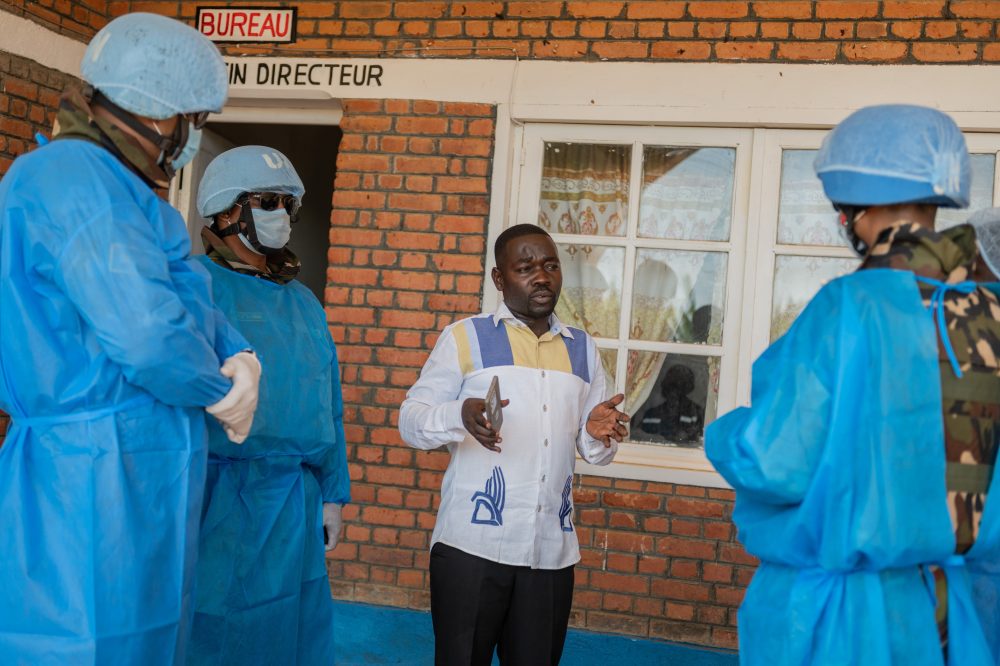

MONGBWALU, Congo (AP) — The medical director of Mongbwalu General Referral Hospital, Dr. Richard Lokudu, has barely received any payment for treating patients during one of Congo’s most devastating Ebola virus outbreaks.
Lokudu works alongside his fellow medical staff throughout the day caring for a surge of patients. Alerts about potential cases arrive even during late evening hours.
“I have not received my allowance (and) what happened to others could happen to me as well,” Lokudu said to The Associated Press. “Despite all the infection prevention and control measures we are implementing, we do not know what may happen.”
Medical officials believe this outbreak caught eastern Congo off guard after it spread undetected for several weeks, beginning in the busy mining community of Mongbwalu in Ituri province.
Mongbwalu has become the center of the unusual Bundibugyo strain. The community draws numerous workers to its extensive gold mining operations featuring muddy gold deposit pools, tight shafts and underground chambers. These workers reside in poor neighborhoods including overcrowded camps with limited access to adequate health measures.
These circumstances heighten the risk of disease transmission, as the virus spreads through direct contact with infected bodily fluids including perspiration, blood, waste and vomit.
Additionally, there has been significant doubt about the disease among residents, complicating medical treatment efforts for Lokudu and his team, while some healthcare personnel and emergency responders have lost their lives to the virus.
“It is one thing to be far away and hear statistics being reported, but what is happening on the ground is enormous,” Lokudu stated. “People are sacrificing their rest and comfort for this cause. There should be recognition that they deserve compensation. These workers should receive their salaries regularly.”
The Congolese government did not respond to a request for comment from the AP.
Congo’s health officials have verified 452 cases with 82 fatalities. On Thursday, the Central African country documented 71 new infections in one day, which officials describe as evidence of “active community transmission.”
The uncommon Bundibugyo strain lacks approved immunizations or treatments, leaving healthcare workers to address symptoms. Government officials report that at least five individuals have recovered from Ebola since Congo’s Ministry of Health officially acknowledged the outbreak on May 15.
The illness “had a big head start,” stated World Health Organization Director-General Tedros Adhanom Ghebreyesus. Regional hospitals lacked the ability to test for the specific Ebola variant that had been circulating weeks before official confirmation.
Medical personnel are managing the disease with limited supplies as organizations work urgently to deliver assistance to the area. Protective masks, gloves, boots and medicines were all scarce initially.
“There has been an erosion of the health system,” explained Heather Kerr, country director for the International Rescue Committee in Congo. “There has not been investment in the health system, and this has been going on for years.”
“During the first week, we did not even have time to go home and eat. The second week was the same. We only eat once a day, what amounts to breakfast in the evening,” stated Alice Bamuhinga, a nurse at the Mongbwalu hospital.
Despite continued skepticism and neglect of health guidelines, many residents are beginning to understand the outbreak’s serious nature.
Asero Jeanne was a mother of five children. Two passed away from the illness within a two-week period. When her daughter fell ill, the family believed it was malaria and community members urged them to stay away from the hospital, claiming “anyone who went there would die immediately,” Jeanne, 52, recalled.
The daughter passed away after three weeks of shuttling between medical facilities and home, followed by a son who died days later. Then Jeanne fell sick.
“I saw about 20 people die,” Jeanne recalled. “I watched them being taken to the morgue, yet God is allowing me to leave here alive. I thank the doctors.”
Tedros, the WHO director-general, announced a $518 million response plan on Friday to fight the outbreak, stating “containing Ebola depends on political commitment, sustained financing, and the trust and engagement of communities.”
Disease containment efforts have also been complicated by fighting between the government and Rwanda-backed M23 rebel group, along with attacks by Islamist militants.
For medical workers battling Congo’s Ebola outbreak on the front lines, their work has grown more challenging as the disease spreads beyond their current treatment capabilities.
“Despite the alerts we receive and the teams we have on site, we lack the means to travel into the field,” Lokudu explained. “As a result, there are alerts we are unable to investigate.”