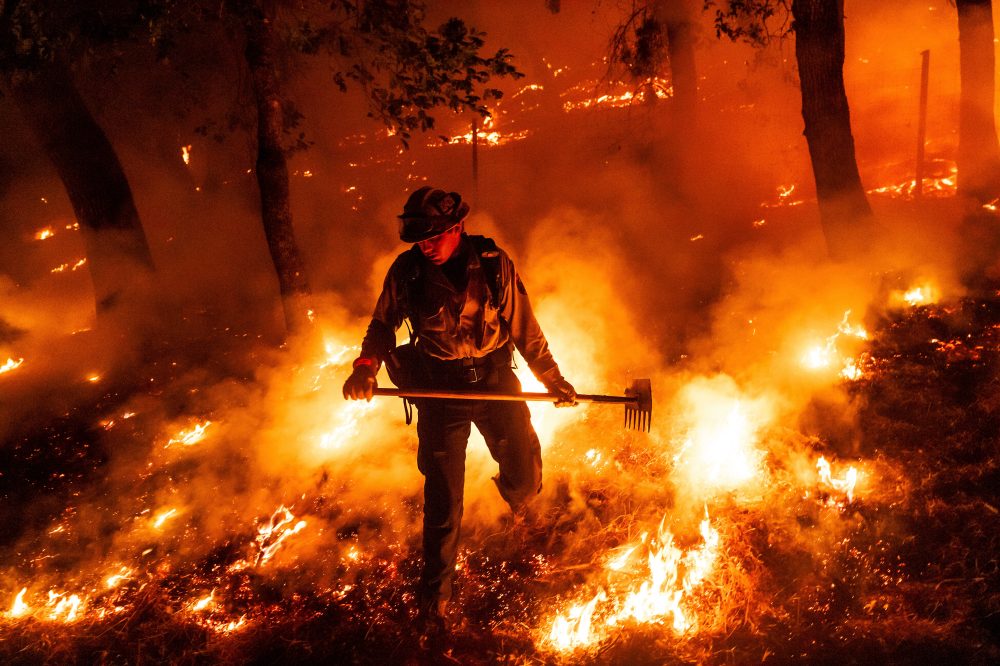

A groundbreaking study shows that wildfires across North America are now burning far longer each day than they did decades ago, with flames staying active through nighttime hours when they previously would have subsided.
Research published Friday in Science Advances reveals that weather conditions favorable to wildfire activity now last 36% longer than they did five decades ago. This dramatic change means fires that once naturally slowed or stopped during cooler evening hours are now burning continuously.
California experiences approximately 550 additional hours of fire-prone weather annually compared to the mid-1970s. The most dramatic increases occur in southwestern New Mexico and central Arizona, where conditions suitable for wildfire activity have expanded by up to 2,000 hours per year.
Recent devastating blazes that burned aggressively during nighttime hours include the 2023 Lahaina fire in Hawaii, which started at 12:22 a.m., the 2024 Jasper fire in Alberta, and the current Los Angeles fires, according to researchers.
The extended burning window affects more than just daily hours. Fire-prone weather days have increased by 44%, effectively adding 26 additional high-risk days each year over the past half-century.
“Fires normally slow down during the night, or they just stop,” explained study co-author Xianli Wang from the Canadian Forest Service. “But under extreme fire hazard conditions, fire actually burns through the night or later into the night.”
Wang warned that Earth’s warming climate will likely worsen these conditions in the future.
University of California Merced fire scientist John Abatzoglou, who did not participate in the research, noted that fires maintaining their intensity overnight gain momentum for the following day, making suppression efforts significantly more challenging.
“Nights aren’t what they used to be — that is, more reliable breaks for wildfire,” Abatzoglou stated. “Widespread warming and lack of humidity is keeping fires up at night.”
Fighting fires during darkness presents unique dangers, according to wildland firefighter Nicholai Allen, who also operates a company producing home fire prevention equipment.
“You have to understand that you have snakes and bears and mountain lions and all the stuff you have in daytime,” Allen explained, mentioning that a colleague was attacked by a bear. “But at night, they’re really scared and they’re running away from the fire.”
Canadian researchers examined nearly 9,000 major fires between 2017 and 2023, using weather satellites and additional instruments to track hourly atmospheric data including humidity, temperature, wind patterns, precipitation, and fuel moisture content. They developed a computer model linking weather patterns to fire behavior and applied it to historical information from Canada and the United States spanning 1975 to 2106.
Climate scientists have long understood that heat-trapping emissions from burning fossil fuels cause nighttime temperatures to rise more rapidly than daytime temperatures due to increased cloud cover that traps and redirects heat back to Earth’s surface. Since 1975, summer nighttime minimum temperatures in the continental United States have risen 2.6 degrees Fahrenheit, while daytime maximums have increased 2.2 degrees, according to the National Oceanic and Atmospheric Administration.
Nighttime humidity levels no longer recover from daytime dryness as they historically did, said lead researcher Kaiwei Luo from the University of Alberta.
Wildfires frequently occur alongside drought conditions, particularly severe droughts, creating not only drier air but hotter, drier air that extracts additional moisture from soil and vegetation, making fire fuel more combustible, Wang noted. During drought periods, a destructive cycle develops where increasingly dry conditions allow the warmer atmosphere to draw even more moisture from potential fuel sources.
Similar to how warmer nights during heat waves prevent human bodies from recovering, these elevated nighttime temperatures prevent forests from recuperating, Wang observed. Dead vegetation can require weeks to regain lost moisture and become less fire-prone.
“It’s just a stress to the plants,” Wang said. “That also increases fuel load and make fire-burning more easily.”
Between 2016 and 2025, American wildfires burned an average area equivalent to Massachusetts annually, covering slightly more than 11,000 square miles. This represents 2.6 times the average burned area during the 1980s, based on National Interagency Fire Center data. Canada’s average burned acreage over the past decade is 2.8 times greater than during the 1980s, according to the Canadian Interagency Forest Fire Centre.
Syracuse University fire scientist Jacob Bendix, who was not involved in the study, described the research as a stark warning about climate change’s impact in driving “increased fire potential across almost all of the fire-prone environments of North America.”