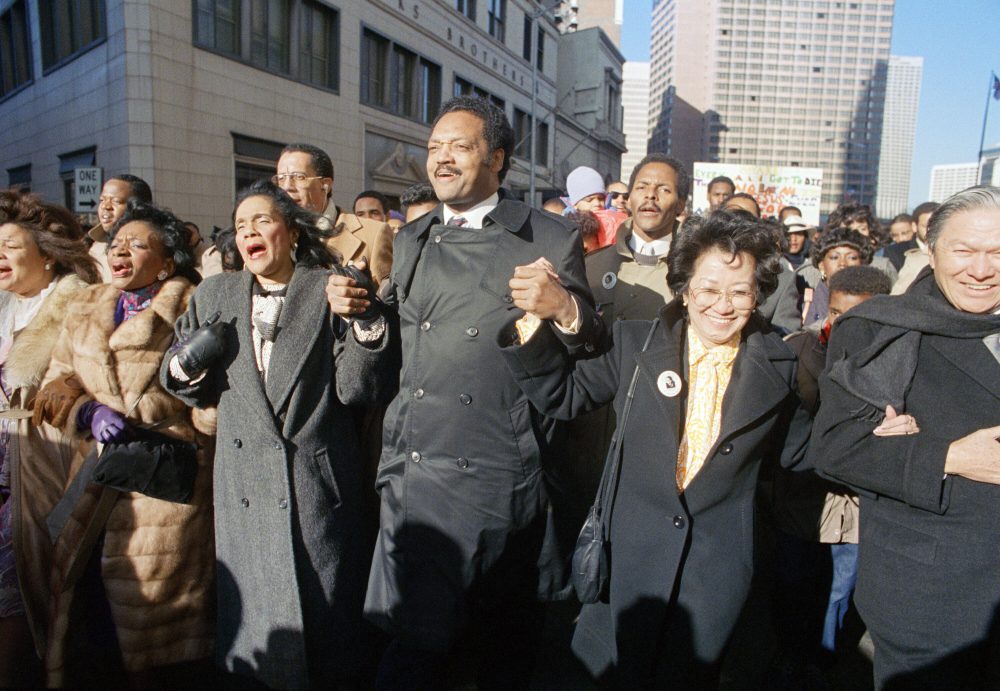

The nation mourns the passing of Rev. Jesse L. Jackson, a towering civil rights leader who dedicated his life to fighting for justice and equality. The 84-year-old activist, who served as a protégé to Dr. Martin Luther King Jr. and made two historic runs for president, died Tuesday at his Chicago residence with loved ones by his side.
Throughout his remarkable career, Jackson championed causes for America’s most vulnerable populations, tackling everything from voting access and employment discrimination to educational reform and healthcare disparities. His work extended far beyond U.S. borders, where he secured notable diplomatic achievements with international leaders. Through his Rainbow/PUSH Coalition, Jackson transformed calls for Black empowerment and self-reliance into concrete corporate reforms, compelling business leaders to create a more inclusive and fair society.
Jackson became synonymous with his empowering message delivered through a poem he frequently shared: “I am Somebody.” His words resonated across racial lines as he declared, “I may be poor, but I am Somebody; I may be young; but I am Somebody; I may be on welfare, but I am Somebody,” establishing himself as the most prominent civil rights voice following King’s legacy.
His daughter Santita Jackson verified that her father passed peacefully at his Chicago home with family members present.
Tributes have flooded in from across the political and social spectrum. Kristen Clarke, who served as Assistant Attorney General for Civil Rights under President Biden, emphasized that Jackson’s influence “can be felt in virtually every aspect of American life.”
“A tireless and extraordinary public servant, his charge to all of us was to stay hopeful, keep up the good fight and respect the dignity and humanity of all people,” Clarke said in an emailed statement on Tuesday. “Jackson has been, and will always be, a central part of the story regarding America’s ongoing quest for justice and equality.”
Martin Luther King III and his spouse Andrea King described Jackson’s unique role in American history. “Jackson was more than a civil rights advocate—he was a living bridge between generations, carrying forward the unfinished work and sacred promise of the Civil Rights Movement,” they stated.
“He walked with courage when the road was uncertain, spoke with conviction when the truth was inconvenient, and stood with the poor, the marginalized, and the forgotten when it was not popular to do so. His life was a testament to the power of faith in action—faith that justice could be won, that dignity belongs to every person, and that love must always have the final word.”
“May his memory be a wellspring of strength and courage for all who continue the sacred work to which he gave his life. As he so often reminded us, ‘Keep hope alive.’”
Bishop William J. Barber II, co-founder of the Poor People’s Campaign, reflected on Jackson’s spiritual impact and personal mentorship. “Jesse Jackson was a gift from God and a witness that God exists in the ways he cared for and lifted all people, the way he called forth a rainbow coalition of people to challenge economic and social inequality from the pulpit to a historic presidential run, the way he dared to keep hope alive whenever the nation struggled with being who she says she is and yet ought to be,” Barber said.
“When I was a college student, he was a gift to me as a mentor, and it has been my great privilege to have him walk alongside me through my whole public ministry,” Barber continued. “May we all take up his hope for the America that has never yet been but nevertheless must be.”
Senator Raphael Warnock of Georgia, who also serves as senior pastor at Ebenezer Baptist Church where the King family worshipped, praised Jackson’s moral leadership. “America has lost one of its great moral voices. Reverend Jesse Jackson spent his life working to ensure our nation lives up to its highest ideals. From his early days as a young staffer with Dr. King onto the national stage, he fought for freedom, racial justice, equality, and for the human dignity of the marginalized and the poor,” Warnock said.
“With an eloquence and rhythmic rhetoric all his own, Jesse Jackson reminded America that equal justice is not inevitable; it requires vigilance and commitment, and for freedom fighters, sacrifice. His ministry was poetry and spiritual power in the public square. He advanced King’s dream and bent the arc of history closer to justice,” Warnock added.
Jackson’s international activism also drew recognition, particularly his work opposing South African apartheid. After visiting South Africa in July 1979 following Steve Biko’s death, Jackson became a fierce advocate for American sanctions against the apartheid government while supporting Nelson Mandela’s freedom movement.
South African President Cyril Ramaphosa acknowledged Jackson’s global impact, stating: “His campaigns for an end to apartheid included disinvestment from the apartheid economy and challenging the support the regime enjoyed in certain circles and institutions internationally. We are deeply indebted to the energy, principled clarity and personal risk with which he supported our struggle and campaigned for freedom and equality in other parts of the world.”
Rev. Al Sharpton, who considered Jackson a mentor, shared deeply personal reflections on their relationship. “Today, I lost the man who first called me into purpose when I was just twelve years old. And our nation lost one of its greatest moral voices. The Reverend Jesse Louis Jackson was not simply a civil rights leader; he was a movement unto himself. He carried history in his footsteps and hope in his voice,” Sharpton said.
“One of the greatest honors of my life was learning at his side. He reminded me that faith without action is just noise. He taught me that protest must have purpose, that faith must have feet, and that justice is not seasonal, it is daily work.”
Rev. Bernice King, daughter of Dr. Martin Luther King Jr., highlighted Jackson’s skills as a peacemaker. “He was a gifted negotiator and a courageous bridge‑builder, serving humanity by bringing calm into tense rooms and creating pathways where none existed,” she said.
“My family shares a long and meaningful history with him, rooted in a shared commitment to justice and love. As we grieve, we give thanks for a life that pushed hope into weary places.”
Even President Trump offered his condolences through social media, calling Jackson “a good man, with lots of personality, grit, and ‘street smarts.’” The Republican president described Jackson as “very gregarious -Someone who truly loved people!”
“He loved his family greatly, and to them I send my deepest sympathies and condolences. Jesse will be missed!” Trump wrote.