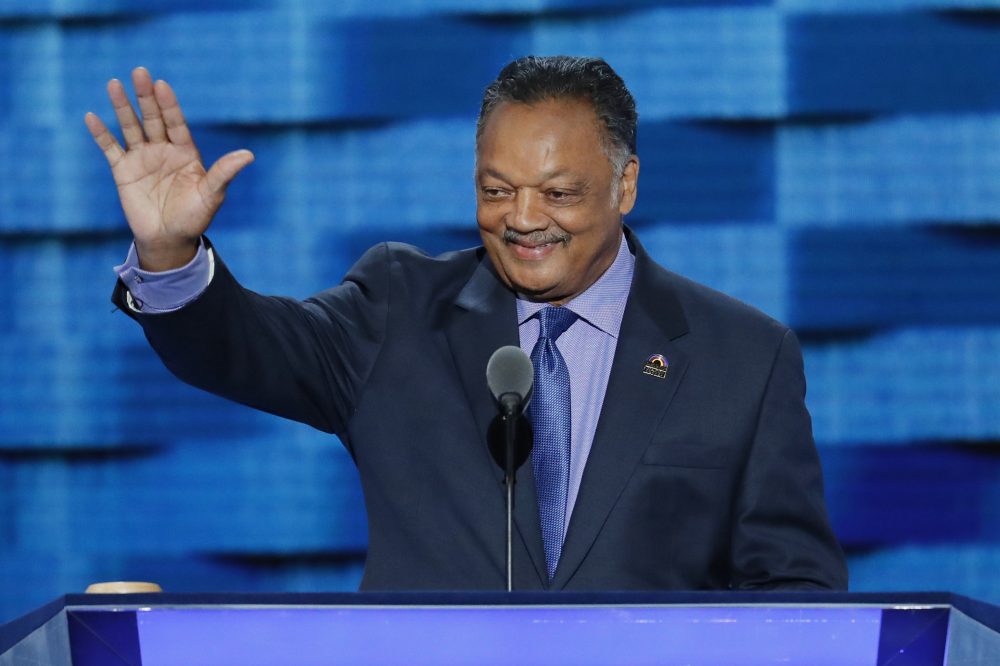

CHICAGO (AP) — When the Rev. Jesse Jackson emerged as a leading voice in what began as primarily a Southern civil rights movement — a cause with significant work still ahead — he became a vital connection between eras.
Jackson built connections spanning from the South’s struggle against Jim Crow laws to the North’s fight against institutional racism, linking the formal, traditional generation surrounding King with the dashiki-clad Black Power movement leaders and today’s hip-hop era activists. He successfully connected seemingly impossible aspirations with real political influence.
“From Martin Luther King to Barack Obama, there’s a bridge called Jesse Jackson,” the Rev. Al Sharpton said.
The civil rights leader, who served as a student of the Rev. Martin Luther King Jr. and continued leading the movement for decades following the beloved leader’s murder, passed away Tuesday according to his family. Jackson was 84 years old.
For more than fifty years, Jackson maintained his public fight for racial equality, economic and political participation, and civil and human rights, continuing even as a neurological condition in recent years impacted his mobility and speech capabilities.
Jackson remained active by commenting on political developments, standing with families of Black Americans killed by law enforcement, and joining COVID-19 vaccination campaigns to address hesitancy in Black communities. His career encompassed presidential campaigns, international diplomatic efforts, and reshaping America’s vocabulary around racial identity.
Though Jackson wasn’t the powerful force he once was in his final years, his participation in racial justice demonstrations and COVID-19 advocacy events, plus his arrest near the U.S. Capitol while demanding Congress eliminate the filibuster to safeguard voting rights, showed he remained determined to fight.
“We’ve always had a place for him,” said the Rev. William Barber II, co-chair of the Poor People’s Campaign and among many activists who followed his example. Jackson encouraged them to “live life so that it’s not your alarm clock that awakes you in the morning, but a purpose. … A purpose will get you up when you want to stay down.”
During George Floyd’s memorial service, Jackson’s anguished cry of “I can’t breathe!” cut through the quiet atmosphere of a Minneapolis cathedral. He repeated the phrase two more times as minutes passed, representing the duration Floyd endured with a police officer’s knee on his neck.
This wasn’t simply Jackson expressing his personal sorrow over Floyd’s killing, which triggered worldwide protests against racial injustice. It demonstrated that his voice maintained the unique power that made him an international symbol for civil and human rights for decades.
Jackson returned to energize protesters marching through Minneapolis streets and stood alongside Floyd’s family when a jury found former Minneapolis police officer Derek Chauvin guilty of murder in Floyd’s death. “Even if we win,” he told the demonstrators, “it’s relief, not victory. They’re still killing our people. Stop the violence, save the children. Keep hope alive.”
“I think the fact that he came and then came back for the judge’s verdict, suffering with Parkinson’s, shows the determination that Jesse Jackson had all the way to the end,” Sharpton said about his longtime mentor. “He once said to me, years before he was diagnosed with Parkinson’s, ‘I’m not going to stop until I drop. I’m going to die on the battlefield.’”
During the early COVID-19 pandemic period, Jackson received his vaccination and encouraged others to do the same. He highlighted racial inequalities in healthcare and worked with the National Medical Association, representing Black doctors and patients, on a public health initiative to enhance testing and treatment information and recruit more African Americans into medicine.
“It’s America’s unfinished business — we’re free, but not equal,” Jackson told The Associated Press in a 2020 interview. “There’s a reality check that has been brought by the coronavirus, that exposes the weakness and the opportunity.”
Jackson faced criticism from both inside and outside the Black community. Some viewed him as someone who sought attention, too eager to find the spotlight.
Jackson became widely recognized for appearing in photographs captured shortly after King’s assassination on a Memphis hotel balcony on April 4, 1968. For two days following, Jackson wore a turtleneck he claimed was stained with the respected civil rights leader’s blood, including during a King memorial service where he addressed the Chicago City Council: “I come here with a heavy heart because on my chest is the stain of blood from Dr. King’s head.”
Twenty years later, Jackson created history with his White House campaigns. Before Barack Obama’s 2008 victory, Jackson represented the most successful Black presidential candidate in U.S. history, capturing 13 primaries and caucuses for the Democratic nomination in 1988, four years following his initial unsuccessful bid.
“I was able to run for the presidency twice and redefine what was possible; it raised the lid for women and other people of color,” he told the AP in 2011. “Part of my job was to sow seeds of the possibilities.”
Jackson’s influence on American culture included changing the nation’s language around race and identity. In 1988, he joined other leaders in advocating that Black people should be called “African Americans,” creating an identity that recognized both the population’s heritage and their American citizenship.
Through founding and leading Operation PUSH, which later became the Rainbow/PUSH Coalition, Jackson transformed demands for Black pride and self-determination into corporate boardroom pressure, pushing executives to create a more inclusive and fair society. His notable diplomatic achievements included securing the release of American civilians overseas during international conflicts.
Jesse Louis Jackson Sr. was born Oct. 8, 1941, in Greenville, South Carolina, to Helen Burns, an unmarried high school student, and Noah Louis Robinson, a married neighbor. Jackson was subsequently adopted by Charles Henry Jackson, who wed his mother.
Jackson served as quarterback at Sterling High School in Greenville and received a football scholarship to the University of Illinois, but said he was informed Black people couldn’t play quarterback. He then transferred to North Carolina A&T in Greensboro, arriving shortly after students there began the sit-in movement to integrate Southern restaurants. He became starting quarterback, student body president, and an honor student in sociology and economics.
Jackson quickly began organizing demonstrations and traveled to Alabama to meet King during the 1965 voting rights march from Selma to Montgomery. Since he was moving to Chicago for theological studies, King’s Southern Christian Leadership Conference gave him responsibility for starting Operation Breadbasket, an effort to pressure companies into hiring more Black employees.
He later described his time with King as “a phenomenal four years of work,” learning how to push for social change within legal boundaries.
The continuous campaigns often meant his college sweetheart, whom he married in 1963, Jacqueline Lavinia Brown, took primary responsibility for raising their five children: Santita Jackson, Yusef DuBois Jackson, Jacqueline Lavinia Jackson Jr., and two future congressmen, former Rep. Jesse L. Jackson Jr., and Rep. Jonathan Luther Jackson. A regular houseguest was Santita’s friend Michelle Robinson, the future first lady.
Jackson, ordained as a Baptist minister in 1968 and earning his Master of Divinity in 2000, also admitted to fathering a child, Ashley Jackson, with Rainbow/PUSH employee Karen L. Stanford. He said he understood the experience of being born outside marriage and was providing her emotional and financial support.
After the Southern Christian Leadership Conference and Jackson separated in 1971, Jackson established his own comprehensive civil rights organization on Chicago’s South Side, with goals ranging from community social services to convincing corporate leaders to hire more minorities. He created the Rainbow Coalition following his first presidential campaign, then combined the political and social justice organizations into the Rainbow PUSH Coalition in 1996.
While Jackson was recognized for his compelling voice, his statements sometimes created problems. In 1984, he apologized for referring to New York City as “Hymietown,” a slur against the city’s substantial Jewish population, in what he said he thought were private remarks to a journalist.
In July 2008, he made news when an open microphone captured him criticizing that Obama was “talking down to Black people.” Despite this, tears flowed down his face when he joined the massive crowd in Chicago’s Grant Park celebrating Obama’s 2008 election victory.
“I wish for a moment that Dr. King or (assassinated civil rights leader) Medgar Evers … could’ve just been there for 30 seconds to see the fruits of their labor,” he told the AP years later. “I became overwhelmed. It was the joy and the journey.”