
A Chinese industrial empire that grew from a failing textile factory into one of the world’s largest petrochemical companies now finds itself caught in an international sanctions battle between Washington and Beijing.
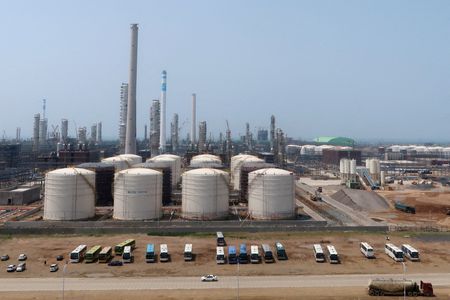
The Hengli Group’s petrochemical division, which operates a massive 400,000 barrel-per-day oil refinery in Dalian, was sanctioned by the United States last month over allegations of purchasing Iranian crude oil. The company has denied these accusations.
The sanctions targeted Hengli along with approximately 40 shipping companies and vessels as the US seeks to pressure China into helping broker a resolution to Middle East conflicts that began when America and Israel launched attacks on Iran in February. This occurred as the presidents of both nations were preparing for diplomatic meetings.
Hengli represents the largest Chinese refining operation to face US sanctions to date.
China, which has consistently opposed such unilateral actions, quickly moved to protect the company by implementing for the first time a 2021 law designed to prevent businesses from complying with foreign sanctions.
In the past, Washington had primarily focused on smaller players, including independent Chinese refiners called “teapots” that were the primary buyers of Iranian crude since sanctions were reimposed in 2018.
“Hengli is no teapot refinery. It is a world-class, world-scale plant that is representative of the large integrated refining and petrochemical facilities in which Beijing increasingly wants to consolidate its refining capacity,” said Erica Downs, senior research scholar at Columbia University’s Center on Global Energy Policy.
“This is probably why Beijing felt compelled to use its anti-sanctions law for the first time,” she said.
The company’s billionaire co-founders, Chen Jianhua and his wife Fan Hongwei, have not responded to requests for comment.
SWIFT CONSEQUENCES
The financial penalties produced immediate results across Hengli’s international operations.
The company’s Singapore trading division, which had employed roughly 100 workers, is scheduled to close this month according to reports. Additionally, China’s Wanhua Chemical has halted a long-standing contract to purchase benzene from Hengli Petrochemical.
Industry experts suggest the sanctions could threaten a tentative 2024 agreement with Saudi Aramco for the oil giant to acquire a 10% ownership stake in Hengli Petrochemical. Aramco has declined to provide comment on the matter.
Despite these setbacks, Hengli’s primary focus on domestic markets and support from Beijing allows the company to maintain most operations. Management has stated they continue purchasing oil using Chinese yuan, avoiding the dollar-based settlement system.
A similar situation occurred last year when competitor Shandong Yulong Petrochemical faced British and European sanctions for Russian oil transactions, ultimately becoming even more dependent on Russian crude supplies.
Industry analysts expect Hengli will likewise increase its reliance on sanctioned oil sources while redirecting petrochemical sales to Chinese customers.
When asked during his Friday flight from Beijing about potentially removing sanctions on Chinese companies buying Iranian oil, the former president said he would consider the option.
“We talked about that and I’m going to make a decision over the next few days,” he said.
As of Thursday, no changes had been announced.
ANTICIPATING CHALLENGES
Nine days before the sanctions took effect, Fan, who leads Hengli’s publicly-traded Shanghai division, expressed caution in a letter to shareholders following Hengli Petrochemical’s 2025 earnings report showing profits of 7.07 billion yuan ($1.04 billion) on revenues of 201 billion yuan.
“Great-power competition continues to evolve and intertwine, and geopolitical turbulence has never ceased,” she wrote. “We are well aware that the road ahead may not be smooth.”
The company has overcome significant obstacles throughout its history.
Chen, now 55, grew up in Suzhou’s Wujiang district, an area where most families traditionally raised silkworms. He left school before age 14 and built his initial wealth through scrap silk trading.
During a speech to the National Young Entrepreneurs Conference last year, Chen Jianhua, whose name translates to “build China,” described purchasing a bankrupt textile facility with 27 workers when he was 23 years old.
This occurred in 1994 as China’s economic transformation was accelerating under Deng Xiaoping’s reforms.
To support China’s efforts to challenge foreign dominance in synthetic fiber manufacturing, Chen expanded Hengli’s operations upstream, eventually entering the state-controlled refining industry to create a fully integrated petrochemical operation.
Hengli established a model for a new generation of large, private petrochemical manufacturers producing materials for plastics and other products serving China’s rapidly expanding industrial sector.
In a bold move, Hengli constructed what became an $11 billion facility on the then-isolated Changxing island near Dalian, directly competing with state-owned China National Petroleum Corp’s nearby refinery.
“There was no electricity, no water, and no mobile signal – just a mountain, a stretch of sea and a small road. For a full four years, I lived and ate on the construction site,” Chen recalled.
CURRENT OPERATIONS
Hengli now holds the position as the world’s top producer of purified terephthalic acid (PTA), a key component in synthetic fiber manufacturing.
In 2022, responding to Beijing’s infrastructure investment initiatives aimed at stimulating the pandemic-affected economy, Hengli acquired an unused shipyard on Changxing island.
“At the start, all the shipowners didn’t trust us and wouldn’t place orders, so we placed our own orders,” building two 300,000-ton very large crude carriers and an 82,000-ton bulk carrier, he said.
Hengli Heavy Industry secured contracts for 115 ships valued at over 100 billion yuan last year, with customers including Greek, Norwegian and Japanese shipping companies.
In February 2025, Chen attended a private sector leadership meeting with Xi, who encouraged participants to support China’s technological independence and supply chain security objectives.
Chen remembered Xi’s message: “Show your talent, the time is now.”
($1 = 6.8012 Chinese yuan renminbi)