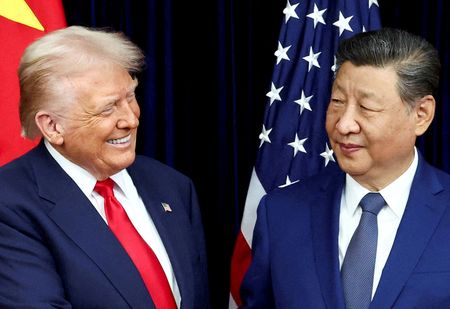

Chinese manufacturers say they’ve grown indifferent to former President Donald Trump’s trade threats as he prepares for a visit to Beijing this month, with many companies maintaining their American business relationships despite ongoing tensions.
Yu Yangxian, who sells electric lockers and vending machines largely to U.S. customers, dismisses Trump’s upcoming trip as irrelevant to her operations. “As long as the United States continues to trade, it will have to do business with us,” Yu explained, noting her company handles increased costs by shifting some expenses to American buyers. “China’s supply chains and the product quality are strong.”
Yu’s company weathered the challenging period of 2025, when trade penalties temporarily reached triple-digit levels, while keeping most of its American customers and securing new international clients. She credits China’s decades-long focus on building comprehensive domestic manufacturing networks for this resilience.
“Whether he comes to negotiate or to declare a fight, it does not pose a major threat to us,” Yu said regarding Trump’s visit.
GLOBAL MARKET EXPANSION
Yu’s business strategy mirrors China’s national approach: diversifying into Europe, South America, Southeast Asia and Africa to offset Trump’s trade policies and rising raw material costs from the Iran conflict.
China concluded 2025 with an unprecedented trade surplus of $1.2 trillion – equivalent to the Netherlands’ entire economy – by penetrating new markets with competitive pricing.
While Chinese shipments to America dropped 20%, exports surged 25.8% to Africa, 7.4% to Latin America, 13.4% to Southeast Asia and 8.4% to the European Union.
Beijing successfully pressured Washington to reduce tariffs by restricting exports of rare earth elements, which China produces almost exclusively and are essential for semiconductors and defense applications.
“The rare earth thing really is just the ultimate trump card,” explained Cameron Johnson, a senior partner at supply chain consultancy Tidalwave Solutions.
Johnson noted Beijing could also limit supplies of pharmaceuticals, industrial equipment, or electrical transformers needed for America’s power grid expansion. While the Iran war gives Trump short-term leverage through U.S. energy exports, China’s manufacturing diversity provides long-term advantages if tensions escalate.
“That’s why they’re playing nice,” Johnson said of Washington’s approach.
REDUCED PRESSURE TO RELOCATE
With tariffs becoming less central to U.S.-China relations, Chinese manufacturers feel less urgency to move production elsewhere.
Jonathan Chitayat, who heads Asian operations for contract manufacturer Genimex Group, developed supplier networks in Vietnam, Thailand, India and Indonesia during Trump’s first presidency. However, 75% of his 500 suppliers remain in China, with many canceling relocation plans after the U.S. reduced levies on Chinese goods while raising them elsewhere.
“We’ve all learned not to take drastic action,” Chitayat observed. “Everyone who waited feels pretty good about waiting now.”
Mike Sagan, sourcing vice-president at Pride Mobility Products, which manufactures wheelchairs and mobility scooters, said his company’s 100-supplier network remains 70% to 80% dependent on China.
“De-risking and diversification aren’t going to go away, but it doesn’t have to be as rushed,” Sagan noted. “The panic has worn off and people have grown a little tougher skin when it comes to Trump making statements.”
BUSINESSES SEEK STABILITY
Companies have stopped overreacting to Trump’s announcements, becoming “numb” to his threats, according to Ren Yanlin, an executive at a Chinese firm handling international factory projects.
“The mindset is that it doesn’t matter anymore,” Ren said.
Eric Zheng, president of the American Chamber of Commerce in Shanghai, said the organization’s nearly 3,000 members have modest expectations for Trump’s visit but welcome potential dialogue.
Members would appreciate an extended pause on tariffs and export restrictions, possibly combined with Chinese commitments to purchase Boeing aircraft, soybeans, or American energy, Zheng explained.
However, few expect permanent solutions. “A truce is great, better than a trade war, but a truce is temporary,” Zheng said. “We need some certainty. Companies need to plan for the long term, not the next 90 days, not even six months. It has to be several years.”