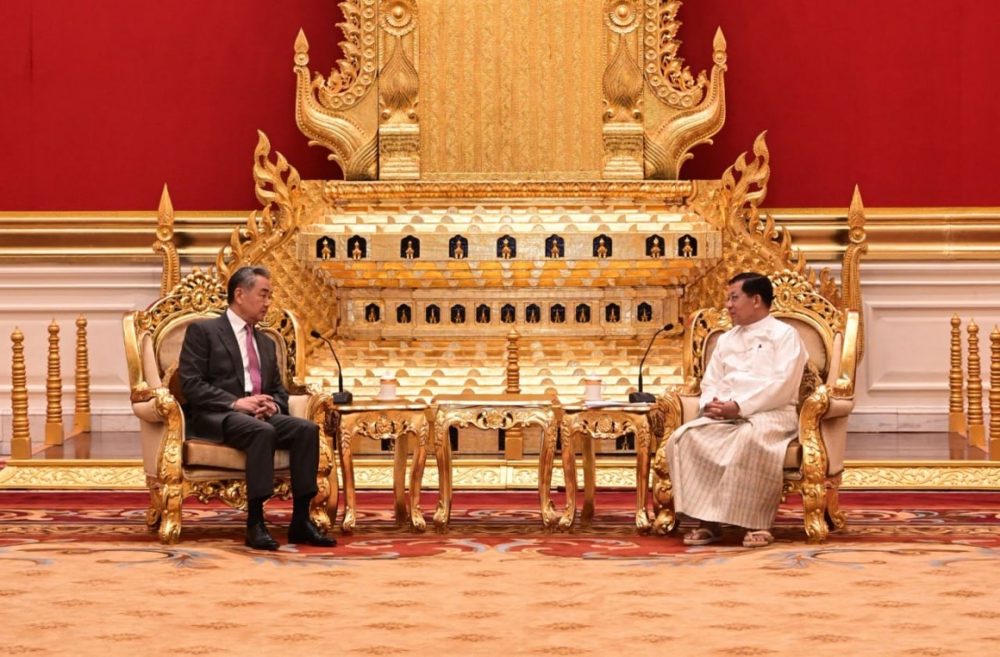

China’s Foreign Minister made a diplomatic visit to Myanmar’s capital on Saturday, meeting with the nation’s newly-installed military-backed president as Beijing works to expand its influence across Southeast Asia.
According to Myanmar’s state television network MRTV, Foreign Minister Wang Yi held discussions with President Min Aung Hlaing focusing on improving Myanmar’s international standing and collaboration within the Association of Southeast Asian Nations.
The diplomatic meeting in Naypyitaw occurred weeks after Min Aung Hlaing took the presidential oath on April 10, following elections that international observers criticized as unfair and orchestrated to preserve military control five years after the armed forces removed Aung San Suu Kyi’s civilian administration.
During their talks, Min Aung Hlaing expressed gratitude that Chinese President Xi Jinping sent congratulations just hours after his electoral victory, according to the state media report.
Beijing maintains significant economic and strategic interests in Myanmar, serving as the country’s largest trade partner and longtime supporter. Chinese companies have poured billions into Myanmar’s mining operations, energy pipelines, and infrastructure projects, while China ranks as a primary weapons supplier alongside Russia.
Among the limited number of nations backing Myanmar’s recent elections, China quickly sent congratulatory messages to Min Aung Hlaing following his presidential appointment.
The Association of Southeast Asian Nations, which counts Myanmar among its 11 members, refused to recognize the elections due to the exclusion of most opposition groups and severe restrictions on dissent. Violence from Myanmar’s ongoing civil conflict also prevented voting in certain regions.
ASEAN previously excluded Myanmar’s leadership from meetings after the military government failed to follow through on a peace agreement from April 2021 that demanded an immediate halt to violence, inclusive dialogue, and humanitarian assistance.
The former military administration under Min Aung Hlaing permitted only limited humanitarian aid under strict conditions and ignored other provisions of the peace plan.
During his April 10 swearing-in ceremony, Min Aung Hlaing identified rebuilding ASEAN relationships as a key objective.
Saturday’s discussions also covered border security issues, trade relations, joint efforts against cybercrime, and Myanmar’s domestic peace initiatives, according to the report.
China simultaneously maintains relationships with ethnic armed groups along its border, including the influential “Three Brotherhood Alliance” that has fought for decades seeking greater independence from Myanmar’s central authority.
This alliance seized substantial territory near China’s border and in western Myanmar from late 2023 through 2024, encouraging other resistance movements opposing military rule to expand their campaigns nationwide.
Nevertheless, multiple China-mediated ceasefires in the past year slowed their progress, enabling the army to reclaim strategic areas and regain military advantage since mid-2025.