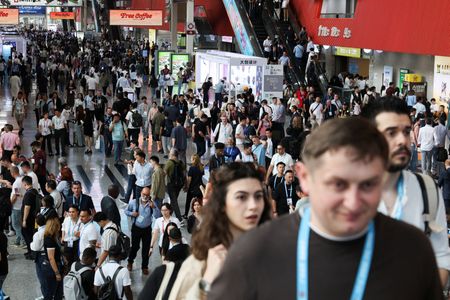

Chinese manufacturers are feeling the economic pinch from the ongoing conflict in Iran, with many reporting significant increases in production costs and declining profit margins at the country’s premier trade showcase.
At the Canton Fair in Guangzhou, China’s most significant trade exhibition, factory owners described the challenging business environment they now face. Shao Haixia, who runs Xiatao Plastic Industry, said her company has experienced a 20% spike in raw material expenses since the Iran conflict began, costs she hasn’t been able to fully transfer to international clients.
Her 27-year-old manufacturing operation, which produces electrical appliance components exclusively for overseas markets using materials from domestic refiners, has seen profit margins cut in half to just 5%-6%.
“We’ve had to re-quote prices and clients are still considering it,” Shao explained. “For foreign trade companies like us, things are difficult. We just hope the war will end as soon as possible.”
The Canton Fair features 32,000 exhibiting companies displaying their products to international buyers across a space exceeding 200 football fields in size.
Prior to the conflict, China’s export industry had been celebrating its resilience, having successfully navigated President Trump’s tariff increases by expanding into new markets and achieving a record trade surplus last year equivalent to the Netherlands’ entire GDP.
However, the energy crisis and elevated commodity prices are now increasing manufacturing costs across China, the world’s largest production hub, putting pressure on already narrow profit margins at factories that employ hundreds of millions of workers.
Simultaneously, global purchasing power is declining, as recent trade statistics from Beijing demonstrated, highlighting China’s heavy dependence on exports for economic expansion.
Among the most concerned exhibitors was Liang Su, who oversees operations at rice cooker and kettle manufacturer Weking. His production has dropped by half due to slower order volumes and surging costs for plastic, copper, and aluminum materials. Despite implementing a 15% price increase, Liang is currently operating at a loss.
“If the fighting keeps going, it’s not just us — Europe’s economy is in bad shape. Southeast Asia’s economy was already weak to begin with. Now the U.S. dollar has fallen as well,” Liang stated.
Should the conflict continue, his next step would be to “cut everything that can be cut,” including workforce reductions, he indicated.
Steven Shen, who operates a company manufacturing industrial blowers, vacuums, and hair dryers, expressed more optimism since he’s successfully transferred higher costs for fibers, metals, and plastics to customers. Without these price adjustments, rising material expenses and a strengthening yuan would have eliminated his company’s entire profit margin.
“It’s not just us, our competitors are also raising prices — so I think it’s okay,” Shen commented.
Taimu Electrical, which produces low-voltage circuit breakers and related products, faces more direct consequences as it had projected first-half Middle East sales reaching 30 million yuan ($4.4 million), according to sales director Wang Yuqing.
“Since the war, our sales in the Middle East have basically been on hold,” Wang reported.
Jojo Lei, home appliances unit manager at Golden Field Industrial, which manufactures ovens and computer accessories, said overall input costs have risen 7%-8%. However, his company plans to absorb these increases for at least six months to maintain orders and customer relationships.
Lei doesn’t anticipate a complete collapse in global demand, but if that scenario occurs, his backup plan involves accelerating production relocation to Southeast Asia, where U.S. tariffs are lower and labor costs are cheaper than in China.
Golden Field currently faces nearly 40% tariffs on U.S. sales, following a turbulent 2025 when Trump increased tariffs above 100% before Beijing responded with retaliatory measures and he partially reversed them.
Lei remains hopeful that Trump’s planned visit to China next month might indicate “somewhat lower” tariffs, though he acknowledges that “the U.S. side is full of uncertainty.”
Shao, the plastics factory manager, believes a Trump visit would signal improving stability in Washington-Beijing relations.
“If he really comes to China, for foreign trade companies like ours it would be a welcome sign, almost like the arrival of spring,” Shao said.