
Electric vehicles from China’s Lotus brand are expected to land in Canada next month, according to China’s ambassador to Canada, Wang Di, who spoke exclusively with Reuters on Friday.
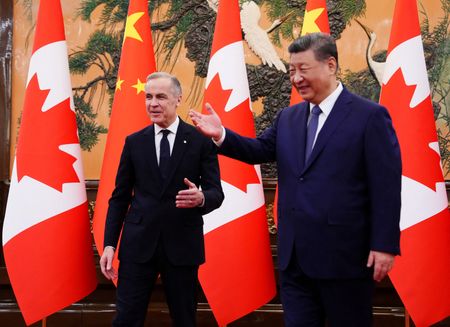
The Lotus vehicles, manufactured and owned by Geely Holding Group, will be the first Chinese-made cars to enter Canada for sale under a newly established agreement between Prime Minister Mark Carney and Chinese President Xi Jinping. That deal permits as many as 49,000 Chinese electric vehicles to enter Canada each year at a lower tariff rate, as Carney works to shift Canada’s trade focus away from its reliance on the United States.
“Geely EVs will be arriving in Canada next month and they will be holding a ceremony when the cars are delivered in Montreal,” Ambassador Wang said.
Lotus Cars did not respond to a request for comment, and Canada’s Global Affairs department was also unable to immediately provide details about the anticipated arrival.
Wang noted that other Chinese automakers, including Chery and BYD, are currently working through the required steps with Canadian government agencies before they can begin shipping vehicles to Canada. Canadian officials have previously indicated that some vehicles arrived earlier so manufacturers could test them under Canadian driving conditions.
“I hope in autumn this year, the truly, genuinely other Chinese brand EVs will complete the procedures and get into the Canadian market,” Wang said through an interpreter.
BYD Executive Vice President Stella Li recently told Reuters that her company would likely begin sales in Canada next year. U.S.-based Tesla has already been importing Chinese-manufactured vehicles into Canada.
Beyond vehicle sales, Canada is also looking to draw joint ventures and investment into its domestic electric vehicle supply chain. Wang said Chinese EV manufacturers are open to forming joint ventures, but plan to first establish sales and assess market demand before making such commitments.
Carney’s move to open the door to Chinese EV imports has drawn criticism from some U.S. officials and members of Congress.
TRADE GROWTH EXPECTED TO SURGE
During a visit to China in January, Carney announced that Canada would aim to grow its exports to China by 50% by the year 2030. However, China’s Foreign Affairs Minister Wang Yi suggested last month that exports could actually double — a 100% increase.
To achieve that doubling, Canadian exports would need to grow at roughly 15% per year over the next five years, Ambassador Wang explained. He added that Canadian exports have already climbed 27.5% in the five months since Carney’s January visit.
“As we continue to move forward, our economic and trade cooperation continues to unleash the potential in our economies and continues to leverage the complementarities that we have, I think maybe we can go beyond the 100%, maybe, we can reach 200%,” Wang said.
On energy, Wang said Canada could potentially supply China with nearly 22 million metric tons of crude oil annually, up from 15.5 million tons last year. He also expressed strong interest in Canada’s liquefied natural gas, though he did not elaborate further.
Wang also highlighted that despite Canada being a major exporter of canola, peas, and beef, it currently accounts for just 2% of China’s agricultural imports — pointing to significant untapped market potential.
“As long as we keep to the right track, at the right pace, towards the right direction, there will be a lot of potential for us to increase our trade,” he said.
China reduced tariffs on certain Canadian products back in March, but maintained a 100% duty on canola oil and a 25% tariff on pork. Tariff relief covering products such as canola meal, peas, and lobster is set to expire at the end of this year, leaving exporters facing uncertainty.
When asked whether China would extend the tariff suspension or lower duties on pork and canola oil, Wang declined to give a direct answer.
“As long as the two countries uphold the principle of mutual respect, equality, reciprocity … there will be nothing that we cannot resolve,” he said.
At the same time, Wang cautioned that the Canadian government must adhere to principles of mutual respect, find common ground, and pursue outcomes that benefit both nations.
“Whenever these principles are not followed, of course, there will be a negative impact,” he warned.