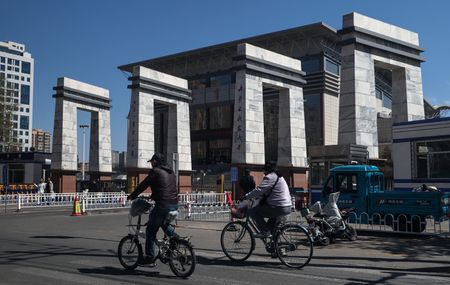

Hundreds of young students travel annually to northern China’s steppes to study rare earth minerals at institutions like the Inner Mongolia University of Science and Technology.
Upon finishing their undergraduate education, these graduates can walk just a few kilometers down the six-lane Rare Earths Street in Baotou to find employment with government-owned refineries. These facilities transform essential minerals into magnets that drive jet engines, electric cars, and wind turbines. Alternatively, graduates may continue their education at the nearby Baotou Rare Earth Research Institute, situated roughly 150 kilometers from the globe’s largest rare earth mining operation.
While former U.S. President Donald Trump and other Western officials have committed billions in funding to challenge China’s dominance over rare earth processing—a strategic weapon Beijing has used in its trade disputes with Washington—China maintains a substantial edge through its talent development system built over many decades in locations like Baotou.
China has established a network of over 40 specialized rare earth laboratories conducting advanced research, supported by no fewer than 11 universities and technical schools that together admit more than 500 students each year to rare earth degree programs, according to a Reuters investigation. This accumulated knowledge base reinforces Beijing’s control over global refined rare earth supplies.
Some American institutions have started integrating more rare earth focus into their academic programs, though Reuters found no school outside China offering a dedicated undergraduate degree in the field. The Ames National Laboratory in Iowa, which covers areas beyond mineral sciences, is also recognized for its rare earth research.
However, the mining sector has traditionally attracted few American students, who often view it as unclean and outdated, according to industry leaders and educators. American institutions granted slightly more than 200 general undergraduate mining and metallurgical engineering degrees in 2023, the most recent year with complete national statistics, based on data from the Colorado-based Society for Mining, Metallurgy and Exploration.
Reuters has compiled the first comprehensive assessment of China’s rare earth research and educational infrastructure, using research publications, academic materials, and conversations with 11 Western mining executives and researchers with extensive China experience. This analysis shows a tight connection between academic institutions and industry that enables Chinese companies to manufacture rare earths efficiently and affordably.
“In China, I used to hire kids right out of university and they’re immediately productive,” said Constantine Karayannopoulos, former chief executive of rare earths companies Neo Performance Materials and Molycorp. “Anywhere else I need to train them for three years.”
Beijing now strictly protects this knowledge base: It has progressively tightened restrictions on rare earth technology and equipment exports. China has also reduced interactions between industry professionals and foreigners, with some technicians ordered to surrender their passports, according to three sources familiar with the situation. They did not identify the government entity that confiscated the travel documents but said the crackdown intensified after Trump’s “Liberation Day” tariffs in April 2025.
The National Development and Reform Commission, which handles macroeconomic planning, and China’s industry ministry did not respond to questions about the crackdown and how the country develops rare earth specialists. None of the Chinese research institutes mentioned in this story responded to comment requests.
U.S. Department of Energy spokesperson Olivia Tinari said in response to questions about Washington’s rare earth competition with Beijing that the agency was “investing in American workers, scaling innovation, and expanding domestic production of critical materials.”
Billions in federal funding have poured into American mining schools, research programs and related areas since 2024 as the nation attempts to rebuild mining knowledge. The U.S. Congress is also reviewing legislation that would finance international cooperation with allies for mining education.
Rare earths present difficult and expensive processing challenges. Refineries must handle 17 different rare earth elements with nearly identical chemical characteristics, a complexity that makes separating them from each other extremely challenging.
Isolating neodymium and praseodymium for electric vehicle use, for instance, requires first eliminating the less-valuable lanthanum and cerium that exist in greater quantities in the Earth’s crust. This separation procedure involves a complex mixture of acids, bases and other chemicals.
Western nations controlled rare earth refining until the late 20th century. The process can cause environmental harm, creating byproducts that can contaminate soil and water without proper storage. Excessive contact with certain rare earth types can also damage respiratory and nervous systems.
Chinese researchers have recorded groundwater contamination around a major storage location in Baotou, situated near one of China’s major rivers. The government has also admitted that refining had caused “severe damage” to the environment.
China’s rare earth sector gained from generous tax benefits and plentiful cheap labor during the 1980s and 1990s. The government and related organizations continue funding research institutes, while state lenders have provided financing on favorable terms to companies mining critical minerals.
By the 1990s, the processing industry was “wiped out” in the West, said Ed Richardson, chief executive of U.S. magnet producer Thomas & Skinner. “Therefore, the schools have not been educating mining students for this task.”
In comparison, researchers, universities and industry maintain close collaboration in China. Scientists at the National Engineering Research Center for Rare Earths in Beijing created new technology, which state-owned Gansu Rare Earth New Materials implemented in 2023 at a refining facility capable of producing 50,000 metric tons of highly processed rare earths annually.
That represents five times what Australia’s Lynas Rare Earths, the largest rare earth company outside China, manufactured in the 2025 fiscal year.
China generates over 90% of the world’s processed rare earths and rare earth magnets.
Gansu Rare Earth New Materials did not return a request for comment.
A spokesperson for Lynas, which has previously employed Chinese consultants, said that China has “excellent facilities and research capability.” The company has since built its own technical knowledge, the spokesperson said.
Academic materials published by some universities and examined by Reuters also demonstrate a strong emphasis on serving industry requirements.
Students pursuing rare earth engineering at Inner Mongolia University complete more than 100 hours of instruction in subjects including rare earth chemistry and material science. One foundational course operates in partnership with rare earth laboratories and companies, with students having the opportunity to attend classes at corporate locations.
The 70 students that Jiangxi University of Science and Technology (JXUST) announced to state media will join its newly established rare earth degree program will examine the supply chain from processing and metallurgy to magnets. Prior to graduation, students will also participate in research projects with companies.
David Parker, a rare earth specialist at Britain’s Durham University who examined the Chinese institute’s course outline for Reuters, called it “highly specialized” and representative of the “pre-eminent position of China in rare earth science and engineering.”
The education offered at the school “ensures a supply of knowledgeable and informed young people, who are well placed to find employment,” he said.
Chinese rare earth engineering graduate students often focus more narrowly in their research areas than would occur elsewhere, said Portuguese physicist Luís Carlos, who has toured research institutes in the country for nearly 20 years.
“But if you think about people as small parts of a big machine, then this is good for the machine,” he said.
Some Chinese universities have openly recognized that they are developing geopolitical resources.
Rare earths are “core bargaining chips” in global politics, Li Chaozhong, dean of JXUST’s rare earth program, told state broadcaster CCTV in April.
The university’s new program serves not only scientific purposes, he said. It is “also to ensure that China continues to maintain its global leading position in the development of rare earth resources.”
There are some instances of innovative work in the West. Valor Metals, for example, is utilizing processes created by the University of Illinois at Urbana-Champaign that the company claims are potentially 10 times less expensive and faster than those used in China. The technology, however, has not been proven at large scale.
The Colorado School of Mines, widely considered one of the world’s premier mining schools, is building two new critical minerals research facilities with the Energy Department to supplement existing programs. It anticipates the first will open in 2027.
The school’s mining-related undergraduate programs have recently received more attention and enrollment.
“The U.S. minerals industry needs to be clear that we need the talent and that this is a great career path,” said Kunal Sinha, Valor’s CEO.