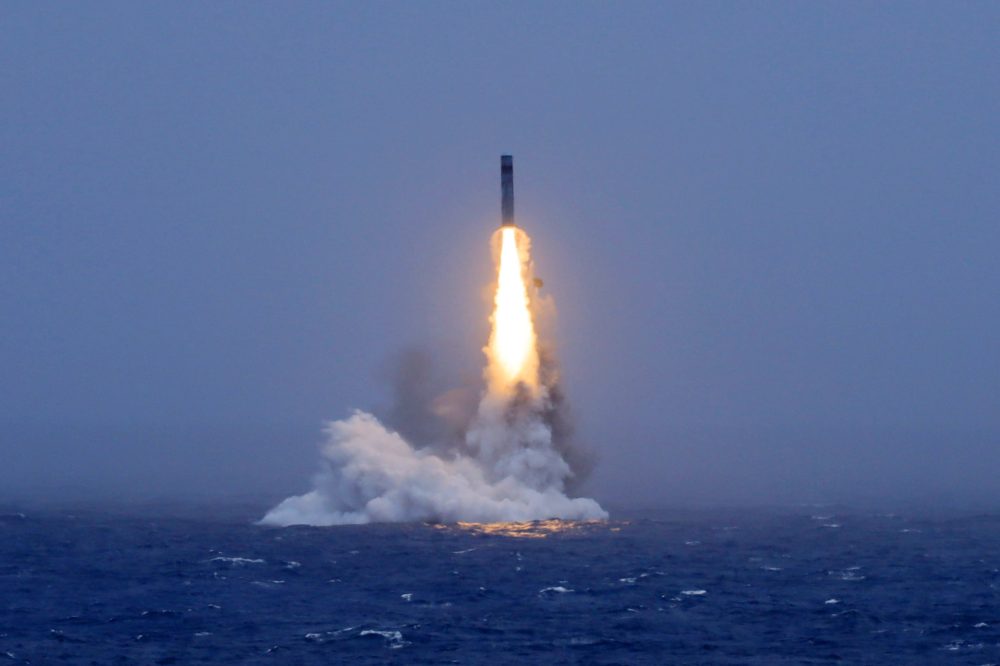

BANGKOK (AP) — China’s military fired a ballistic missile into the South Pacific Ocean on Monday in a rare demonstration of its nuclear-capable weapons systems, triggering international backlash and raising alarms across the region.
The test came two years after a similar launch in international Pacific waters and was carried out by the People’s Liberation Army. While small island nations in the area took notice — with their leaders increasingly pushing back against larger countries using the Pacific as an arena for power plays — analysts say the real audience for this display was Washington.
“The most important message is the PLA is becoming a powerful military with a very strong strategic nuclear capability,” said Tong Zhao, a senior fellow with the Nuclear Policy Program at the Carnegie Endowment for International Peace, a think tank.
The missile was fired from a nuclear-powered submarine, showcasing the sea-based component of China’s nuclear triad — a military term for having nuclear weapons deployable from land, sea, and air. Dominic Meagher, a research fellow at the Crawford School of Public Policy in Australia, noted that the test also proved China has what military experts call a second-strike capability, meaning the country could still retaliate even if it were attacked first, since its submarines can launch from anywhere in the ocean.
Beijing characterized the launch as part of routine annual exercises, hinting that similar tests could follow in the future.
“I would see this as a systematic move, not an isolated event,” said K. Tristan Tang, Nonresident Fellow at the National Bureau of Asian Research, in written comments.
The missile test is occurring alongside China’s rapid expansion of its nuclear-powered submarine fleet. Over the past five years, China has been constructing these vessels at a faster pace than the United States, according to a report from the International Institute for Strategic Studies, a think tank.
The choice of international waters — specifically waters shielded by treaty from nuclear testing — drew condemnation from countries throughout the region. The South Pacific is a contested space, valued for its strategic location and its abundant fisheries and mineral resources.
For Pacific island nations, nuclear activity in the region carries deep historical wounds. The United States, the United Kingdom, and France all conducted nuclear weapons detonations in the Pacific in decades past, leaving behind environmental damage and serious health consequences including cancers and birth defects that some island communities say are still being documented generations later.
“Those tests resulted in outrage and resulted in treaties to prevent future tests, and that includes the nuclear test ban treaty and the Treaty of Rarotonga,” Meagher said. “These kinds of missile tests haven’t been conducted since.”
Monday’s missile came down within the South Pacific Nuclear Free Zone, a region established under the 1986 Rarotonga accord, which bans nuclear weapons throughout the area. China ratified related protocols in 1987, committing not to test nuclear weapons within the zone or threaten to use them against nations with territory there.
Solomon Islands Prime Minister Matthew Wale, speaking to reporters in the Solomon capital Honiara on Tuesday, put it bluntly: “China is a good friend of Solomon Islands, but this is not something a friend does. This is not … good in our region.”
While the United States does carry out nuclear missile tests in the Pacific, it steers clear of the treaty-protected zone, according to Meagher.
Australia and New Zealand both said they received inadequate advance warning before the launch, and Japan criticized the lack of transparency. Both Australia and New Zealand are major powers in the South Pacific and have grown increasingly uneasy about China’s efforts to expand its influence across the region.
China’s bilateral agreements with leaders of smaller Pacific nations have prompted Australia’s Prime Minister Anthony Albanese to pursue his own diplomatic outreach, including defense and security agreements signed with Vanuatu, Fiji, and Papua New Guinea over the past year.
Speaking to reporters in Honiara on Tuesday, where he was holding talks with local officials, Albanese called the launch “a provocative act by China which does destabilize the region.” Australia and the Solomon Islands are currently working toward a comprehensive treaty of their own. “The fact that this test took place yesterday with very little notice is of real concern,” he added.
China pushed back against the criticism, insisting it gave proper advance notice to affected countries. “China informed the relevant countries in advance, which demonstrates the openness and transparency of the Chinese military,” its Defense Ministry stated on Tuesday.
Experts point to the Hague Code of Conduct as the closest thing to an international standard for ballistic missile use, requiring at least 24 hours of advance notice — though that code is not legally binding. Tang also noted that China is not a member of the Hague Code of Conduct.
Questions remain about the exact details of the launch. The People’s Liberation Army rarely releases information publicly, but Taiwan’s National Security Council secretary-general said Wednesday that the weapon was a JL-2 missile, an older submarine-launched ballistic missile, fired from waters near Guangdong, a province in southern China. Chinese state media, however, featured military experts suggesting it was more likely the newer JL-3, which can travel farther. “The JL-3’s range can strike a target on the east side of the Pacific from the west side,” said Shao Yonglin, a military expert interviewed by state broadcaster CCTV.
As China’s military continues to grow, analysts say it should expect greater international oversight. If “China wants to become a major military power, it should be put under the same standards” as countries like the United States, the United Kingdom, and France, said Zhao, the nuclear policy expert.