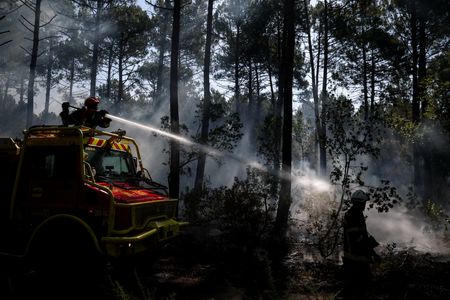

Firefighters across France and Spain pushed hard Tuesday to get the upper hand on massive wildfires that have driven tens of thousands of people from their homes, even as Western Europe prepared for yet another punishing round of extreme heat.
The blazes have swept through areas already weakened by an exceptionally hot and dry summer. Emergency crews were working to take advantage of briefly calmer conditions before temperatures were expected to climb again starting Wednesday.
Near Bordeaux in southwestern France, crews managed to contain a major forest fire overnight. In Spain, residents of nine out of 11 communities in the central Toledo province were permitted to return home. However, fires continued to burn out of control in and around Madrid and neighboring areas, keeping authorities on high alert.
One Spanish evacuee described the scene as a “red hell,” painting a vivid picture of residents fleeing with nothing but the clothes on their bodies.
Europe, which scientists identify as the fastest-warming continent on Earth, has been hit by a string of record-setting heatwaves this year. Researchers say that climate change driven by human activity is fueling the heat and dry conditions that allow wildfires to spread more rapidly, last longer, and cause greater destruction.
French President Emmanuel Macron described the gravity of the situation during a visit to emergency workers in Bordeaux late Monday. “The situation we are dealing with today is the most severe we have ever recorded, the toughest since the Second World War,” he said. “We are facing a completely unprecedented wildfire.”
France has now seen more land burned by wildfires this year than at the same point in any year going back to 2006.
Despite some gains in the firefighting effort, challenges remained. Nathalie Delattre, a senator representing the Gironde area, which includes Bordeaux, cautioned that the outcome was still uncertain. “Everything will depend on how the firefighters on the ground get on,” she said in an interview with BFM TV on Tuesday.
Campsites and vacation properties in Lacanau, a coastal community near Bordeaux along the Atlantic, were being cleared of residents Tuesday, according to a post on the local administration’s Facebook page.
Spain is now preparing for its fourth heatwave of the summer, set to begin Wednesday. Fire risk is expected to reach extreme levels due to high temperatures, dry air, and southerly winds. Crews are still fighting fires in the Madrid region and the neighboring provinces of Avila and Toledo. Overnight conditions in Madrid allowed firefighters to make progress against active fire fronts, reducing the immediate threat, though the fires remain uncontrolled, the Spanish government reported.
As of Tuesday, more than 73,000 people had been evacuated in Spain, with roughly 66,000 others under confinement orders.
According to the Reuters Climate Monitor, temperatures in Bordeaux were expected to reach 33 degrees Celsius — about 91 degrees Fahrenheit — on Tuesday, which is 7.1 degrees Celsius above the historical daily average for that date. In the Madrid region, temperatures of 37 degrees Celsius were forecast, running 5.5 degrees above average.
The new heatwave is expected to intensify quickly and reach its peak Wednesday. France’s national weather service, Meteo France, also projected peak heat on Wednesday, with Paris potentially hitting 38 degrees Celsius, though forecasters said the full duration of the event would become clearer in the days ahead. The UK Met Office described the coming conditions as “an increasingly warm, but relatively short-lived, spell of hot weather.”
The growing frequency and severity of heatwaves across Europe is contributing to thousands of additional deaths and disrupting daily life in numerous ways — from traffic and rail delays to reduced cargo shipping capacity caused by low water levels on major rivers. Agricultural output is also being affected, with the crop monitoring service MARS cutting all of its harvest forecasts for 2026 on Monday.
For many of those caught in the fires’ path, escape meant grabbing family members and pets and leaving everything else behind. At a French evacuation center, Sylvie Michel, 63, a consultant, sat on a camp bed stroking her cat. She credited authorities for their response. “In France we tend to be very critically-minded, to put it mildly. And honestly, hats-off to everyone involved,” she said.
Spanish evacuee Jose Miguel Encinas, 53, who fled from La Vall d’Uixo in eastern Spain, recalled scenes of “total chaos.” “It was like in the movies where hell cracked the ground open, and you see the red hell,” he said.