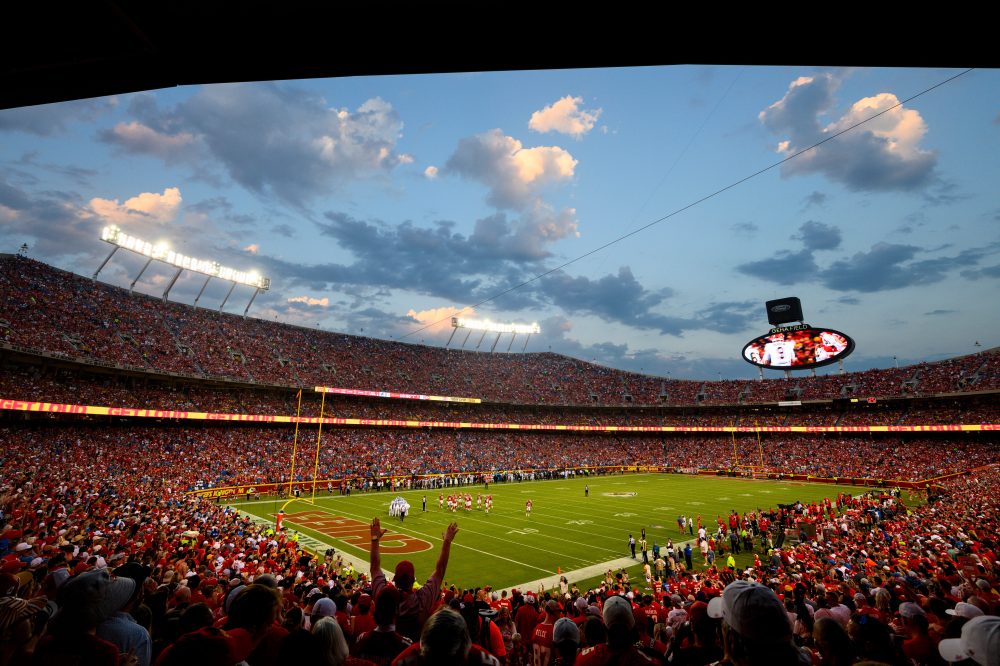

KANSAS CITY, Mo. — Over 30 years ago, team owner Lamar Hunt and his son Clark walked onto the turf at Arrowhead Stadium with a bold vision: convincing FIFA that their football venue could serve as a host site for the 1994 World Cup in America.
That 1990 proposal was unsuccessful, but the Hunt family’s ambition never faded.
Today, following a multi-million dollar transformation of the 53-year-old facility to meet international soccer field requirements, the Hunt family’s vision is finally becoming reality. Arrowhead will welcome six group stage matches next month, plus a round of 32 contest and a World Cup quarterfinal game.
“Clark has been keen on really living that legacy, finding a way for Kansas City and Arrowhead Stadium specifically to host World Cup matches,” said Matt Kenny, the Chiefs’ executive vice president of operations and events, during a Monday stadium walkthrough.
The opening match will showcase defending world champion Argentina taking on Algeria on June 16. Additional group stage games include Ecuador versus Curacao, Tunisia facing the Netherlands, and Algeria meeting Austria.
The elimination rounds are set for July 3 and July 11, after which the facility will return to its football configuration.
Kansas City’s first preseason game is expected approximately one month following the tournament’s conclusion.
While all American World Cup venues are NFL facilities — ranging from MetLife Stadium in New York to Levi’s Stadium near San Francisco and SoFi Stadium near Los Angeles — Arrowhead presents unique challenges. Constructed in 1972 during a different era of professional sports design, accommodating soccer was never part of the original blueprint.
To create space for the expanded playing field, multiple rows of fixed seating along the north sideline were eliminated and replaced with temporary seating units used during football season. These modular seats were subsequently removed as the venue prepared for its soccer transformation.
During World Cup competition, the facility will operate under the name Kansas City Stadium.
The most significant enhancement involved the playing surface itself. Team officials installed an underground air circulation system to improve the quality of the Bermuda grass field, which received new sod with modified crown shaping specifically for World Cup play.
“FIFA has some basic requirements in respect to playability. They want consistency with the way the ball bounces. Obviously, the width and the size of the pitch across venues,” Kenny explained. “It’s been the better part of 10 years from the bid to actually executing the matches here, and it’s been a massive collaboration.”
Construction activities continue despite teams arriving within weeks — Argentina, England, the Netherlands and Algeria will establish training bases locally. Crews worked Monday removing advertising displays to prevent sponsor conflicts while installing fan festival areas, pavilions and supporting infrastructure across the stadium’s extensive parking areas.
Traditional tailgating experiences will be limited during the tournament. Most spectators will arrive via shuttle buses from remote parking locations, with only several thousand on-site parking spaces available.
“The challenges were really tied to us understanding exactly what FIFA needed, what we could do to balance our unique situation,” Kenny noted. “We’re hosting a quarterfinal match, so that’s a testament to our planning and the work that’s been done.”