
NEW YORK — A national coalition of charitable foundations is urging its members to shine a light on the good they do for everyday Americans, launching a campaign tied to the country’s 250th anniversary in response to what the group describes as heightened scrutiny from both the federal government and populist movements.
The Council on Foundations, an advocacy organization representing around 1,000 nonprofits, says public misconceptions — that philanthropy is simply a playground for the ultra-rich to push political agendas or commit fraud — have left the sector open to political attacks that threaten critical community services. The group launched its “Generosity Builds” campaign on Monday, hoping to close what CEO Kathleen Enright describes as a “perception gap.”
Enright says most Americans don’t realize just how much they depend on nonprofit organizations. A 2023 report from the Indiana University Lilly Family School of Philanthropy found that only about 1 in 20 adults said they or a family member had used nonprofit services in the past year.
“This week, I got an MRI at Georgetown University Hospital, I participated in my church at St. Columba’s, my daughter was inducted into National Junior Honor Society. Four or five nonprofits have been instrumental in my life this week,” Enright said. “Folks just aren’t putting that tag on it.”
That recognition is becoming more critical, Enright noted. During last year’s debate over President Donald Trump’s tax and spending legislation, proposals surfaced that would have imposed new taxes on private foundations — measures Enright said could have drained resources away from communities had they become law.
The broader debate over what nonprofits actually do has intensified under the Trump administration, which has dismantled longstanding partnerships with nonprofit organizations. The White House froze, cut, or threatened a wide range of social service grants, characterizing them as “government largesse that’s often riddled with corruption, waste, fraud, and abuse.” More recently, the Department of Justice charged the Southern Poverty Law Center — a civil rights nonprofit that Republicans have accused of targeting conservatives through its extremist-tracking work — with defrauding donors via payments made to informants.
Vice President JD Vance, speaking as a U.S. Senate candidate in 2021, called the Ford Foundation, the Gates Foundation, and the Harvard University endowment “cancers on American society,” telling Tucker Carlson that “we are actively subsidizing the people who are destroying this country and they call it a charity.”
“All across our country, we have nonprofits — big foundations — that are effectively social-justice hedge funds,” Vance said that same year during a talk on “woke capital.”
Enright countered that stories portraying nonprofits as “overly politicized” or wasteful are “extreme minority stories” that don’t accurately represent how the philanthropic sector works.
Surveys consistently show that public trust in nonprofits remains higher than in most other sectors. Still, measuring and communicating their impact can be difficult. According to Kathryn Thomas, vice president of communications for the Charles Stewart Mott Foundation in Flint, Michigan, the sector hasn’t faced conditions this difficult in nearly 60 years.
Thomas pointed to congressional efforts to raise taxes on foundations’ investment income and acknowledged the impact of the Trump administration’s federal funding cuts.
“In an era when everything is under partisan attack and there’s so much polarization, we really have to do a better job of emphasizing why we exist,” Thomas said.
Enright pushed back on the idea that philanthropy is about a wealthy person riding in to “save the day.” She acknowledged growing unease about billionaires’ outsized influence, which she said is feeding skepticism about what motivates major donors. Some critics argue that the charitable sector lets wealthy interests determine how tax-exempt dollars are spent, bypassing elected officials.
The campaign will instead highlight that the majority of donors “have just a little bit more than they need and therefore want to give back,” Enright said, particularly at the local level.
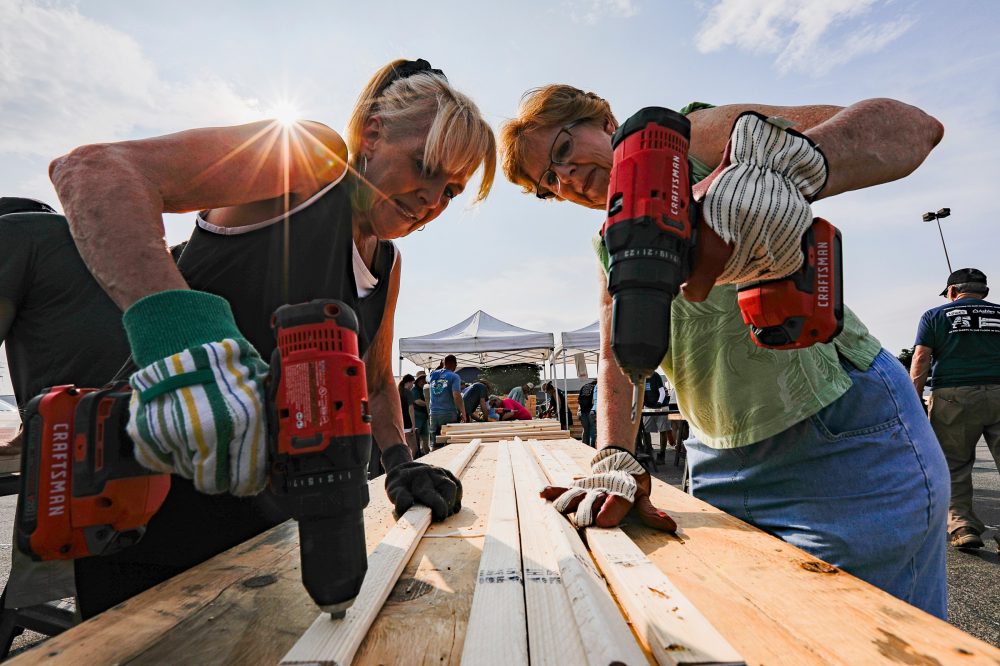
“Money does not solve problems. It’s a tool that creative people and institutions inside communities use to solve problems,” she said. “The real heroes of most of these stories are nonprofit leaders, religious leaders, civic leaders who just roll up their sleeves and get something done — but do it with some financial underpinning by charitable foundations.”
One example featured in the campaign comes from the Gulf Coast Community Foundation in Sarasota, Florida. Last year, the foundation helped open a 10-unit affordable housing complex specifically for military veterans.
Jon Thaxton, the foundation’s director of policy and advocacy, said the Sarasota area has an “embarrassingly high” number of unhoused veterans, many of whom have been priced out of a market that has increasingly become a luxury destination with steep real estate costs.
Local donors had been working toward a similar project when they came to the foundation for assistance in 2020. Thaxton helped secure land already designated for affordable housing, assembled $2.2 million in private donations, obtained $800,000 from the city, and gained support from their U.S. representatives.
Foundation leaders say their established reputation made that success possible. President and CEO Phillip Lanham noted the project was completed across multiple election cycles and through a pandemic, arguing that community foundations are uniquely positioned to “play the long game.”
“Most people think that foundations like us deal with money and donors. We really don’t. We deal with relationships and trust,” Thaxton said. “That’s our commodity. That’s what we earn. That’s what we save. And that’s what we contribute back to the community.”
As part of its broader case for philanthropy as a fundamental “part of the American story,” the Council on Foundations will also highlight early, ordinary givers from the nation’s history.
Enright pointed to an 18th century sailor who launched the country’s first charity hospital by leaving his estate to establish a Boston facility for sick and injured sailors. She also cited a formerly enslaved man who donated land in North Carolina that became an African Methodist Episcopal church — one that still serves as a cornerstone of its local community today.
Lillian Kuri, president and CEO of the Cleveland Foundation, welcomed the campaign’s focus on everyday philanthropists. The Cleveland Foundation is widely regarded as the nation’s first community foundation, established in 1914 by attorney Frederick Harris Goff as a vehicle for creating lasting change in the city.
The foundation is exploring new ways to broaden the circle of people committed to improving their communities. This week, it announced new investments in a fund aimed at converting vacant industrial land into job-ready work sites. It also launched a fund allowing donors to invest in major companies in Northeast Ohio, with the goal of growing those contributions into larger sums that can eventually be donated to nonprofits.
“Generosity cuts across everybody,” Kuri said, adding that community foundations provide “a way for everyday people — not just the largest, wealthiest people — to participate in the change they want to see in their communities.”