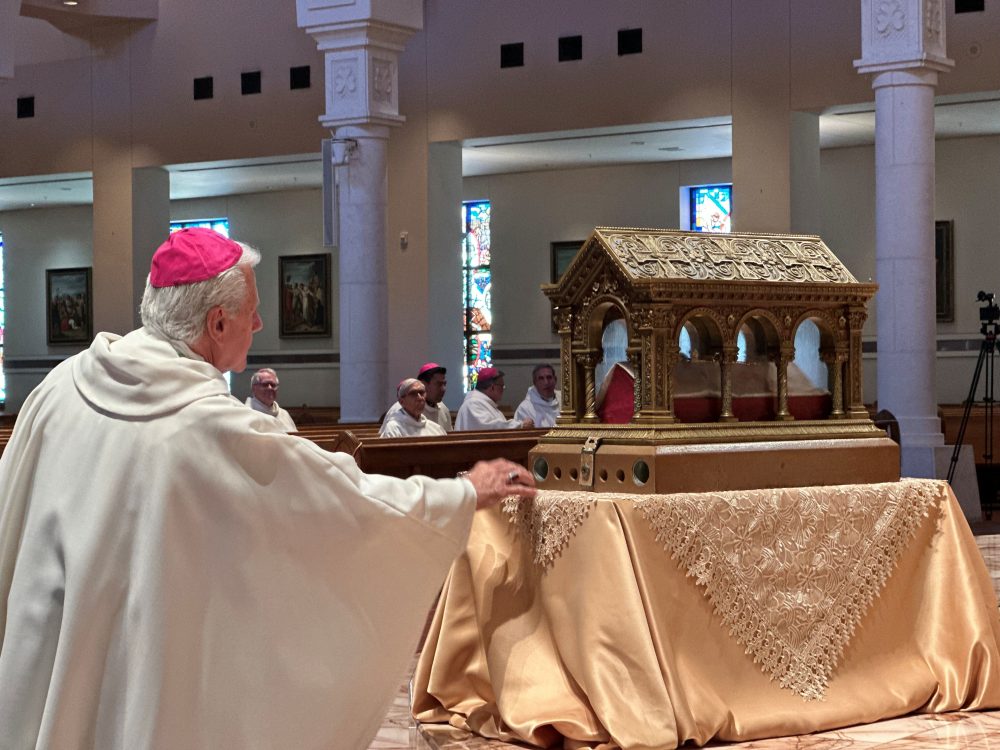

Catholic bishops from across America came together Thursday in Orlando for an unprecedented religious ceremony dedicating the United States to the Sacred Heart of Jesus, marking this historic devotion as part of America’s upcoming 250th anniversary celebration.
The solemn service filled a contemporary Orlando shrine with powerful organ music, brass instruments, and choir voices as bishops conducted this special liturgy during their spring U.S. Conference of Catholic Bishops meeting.
Before the ceremony began, religious leaders and attendees knelt in reverence before sacred relics of 17th century St. Mary Margaret Alacoque, a French religious sister whose reported divine visions of Jesus established the contemporary Sacred Heart devotion representing Christ’s compassionate love. This spiritual practice has since expanded globally, with numerous Catholic institutions and churches adopting the Sacred Heart designation and countless homes and businesses displaying its imagery.
The religious ceremony honored America’s founding principles, referencing the Declaration of Independence’s guarantee of “life, liberty and the pursuit of happiness.” However, it also incorporated prayers recognizing the nation’s moral shortcomings, including its “original sins of slavery and racism.” Oklahoma City Archbishop Paul Coakley, who leads the bishops conference, emphasized the importance of recognizing both achievements and failures.
“To consecrate ourselves to the Sacred Heart is ultimately to accept Jesus’ invitation to remain in his love and to allow that love to shape every aspect of our lives, public and private,” he stated. “If we are honest, we must acknowledge that neither our nation nor the church has always reflected that love.”
This marks the inaugural occasion for such a ceremony on American soil, though comparable services have occurred in multiple nations since the 1800s. These religious dedications, sometimes involving government officials, have occasionally taken on political dimensions and sparked debate when associated with Catholic nationalist causes.
In 1899, Pope Leo XIII, who shares his name with the current pope, dedicated the entire globe to the Sacred Heart.
Prior to the main service, bishops listened to spiritual presentations from fellow members, focusing on Pope Francis’ latest encyclical, or official teaching letter, which emphasized the Sacred Heart as motivation for service and social justice.
The sacred relics of St. Mary Margaret Alacoque were specially transported from their usual home in France and prominently displayed at the front of the church for this occasion. Although historians trace Sacred Heart devotion back to early Christianity, her reported visions are recognized as inspiring the contemporary imagery, prayers, and religious practices associated with it.
The Thursday ceremony occurred at the Basilica of the National Shrine of Mary, Queen of the Universe. Intense Florida afternoon sunlight streamed brilliantly through the colored glass windows surrounding the congregation.
Multiple rows of bishops wearing traditional purple caps and white vestments occupied seats near the altar area, while additional worshippers filled spaces throughout the sanctuary.
During their biannual conference earlier Thursday, the bishops voted to approve modest updates to their sexual abuse response protocols, incorporating additional details about fair treatment procedures for accused clergy while preserving the prohibition against any priest found guilty of child abuse returning to active ministry.
Several bishops requested postponing the adoption of these Charter for the Protection of Children and Young People revisions to allow for more extensive public input, but this proposal was defeated. The final approval vote counted 176 in favor and 22 opposed.
These modifications have been under development for five years. The original charter received approval in 2002 during the height of the Catholic clergy abuse scandal, when investigative reporting by the Boston Globe exposing abuse and institutional cover-ups in the Archdiocese of Boston sparked widespread similar disclosures across the country and internationally. The charter has undergone periodic updates since its initial creation.
The fundamental elements of the document remain unchanged, including the permanent removal of priests from active service for any verified instance of sexual abuse.
Bishop Barry Knestout, who leads the committee responsible for the revisions, explained the updates are “trying to do two things at the same time.”
“One is to retain and also reemphasize the commitment of bishops to address the issue of potential for abuse, safeguarding of our children and young people in a way that’s both transparent and accountable,” he explained. The second goal is to “recognize due process and presumption of innocence” for those facing accusations during investigations.
“We’re trying not to lose any of the commitment to victim survivors yet still recognize that there is in fairness a process that should be undertaken,” he added.
The advocacy organization BishopAccountability.org released a statement describing the approval as a “missed opportunity,” arguing that postponement would have enabled broader public participation in the document’s development and resulted in an improved and more “trauma-informed” charter. The group urged careful examination of the changes at individual diocese levels.