
OTTAWA, Ontario — A recent diplomatic visit by Canadian Prime Minister Mark Carney to India has helped establish a pathway for completely resetting relations between the two nations, according to India’s trade minister speaking on Monday. The diplomatic relationship had deteriorated under Carney’s predecessor following the 2023 death of a Sikh activist on Canadian soil.
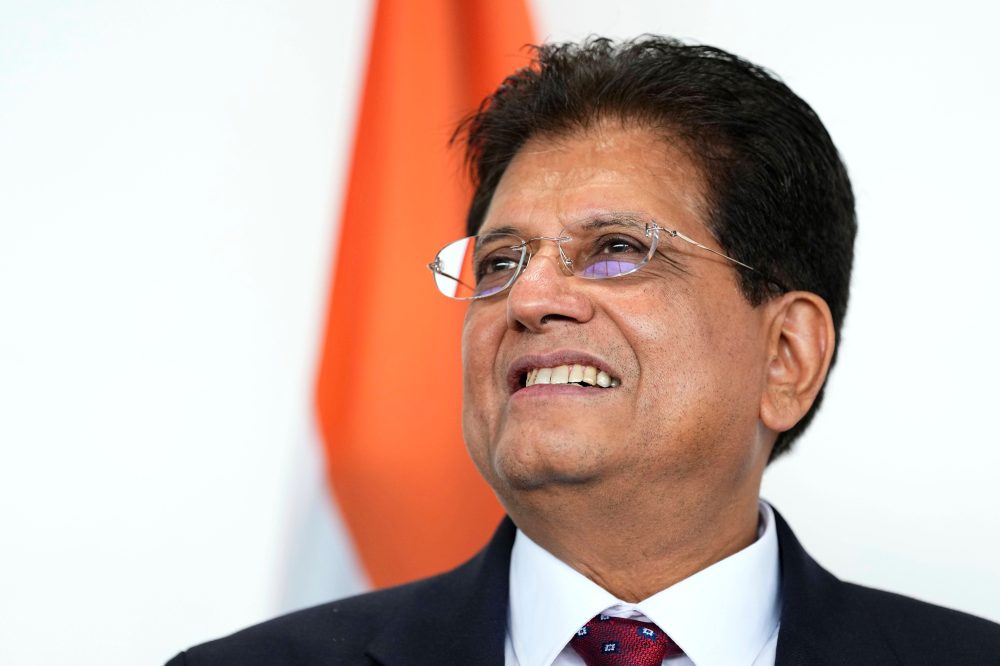
India’s Commerce and Industry Minister Piyush Goyal made these statements during his visit to Canada, where he held discussions with Canada’s International Trade Minister Maninder Sidhu.
Goyal arrived with more than 100 senior business leaders representing India’s mining, energy, automotive and aerospace industries, forming what New Delhi describes as its largest business delegation ever sent to Canada.
“This is a partnership that is being reset very, very rapidly,” Goyal stated on Monday.
According to Goyal, Carney’s late February visit — marking the first time a Canadian prime minister had traveled to India in eight years — “completely changed the way Canada and India looked at each other.”
“It has set in motion the pathway to a complete overhaul of this relationship, setting new agendas, new goals,” he explained.
Trade negotiations between the two countries began in 2010 but were suspended by Ottawa in 2023 when Canadian officials claimed India played a role in the death of Canadian Sikh activist Hareep Singh Nijjar, who was killed near Vancouver in June of that year.
New Delhi strongly rejected these claims and criticized former Canadian Prime Minister Justin Trudeau’s administration for providing refuge to Sikh extremists associated with the Khalistan movement. This movement seeks to establish an independent Sikh nation and is prohibited in India.
Prior to his meeting with Sidhu, Goyal expressed that both nations are eager to finalize a free-trade agreement within this year.
During Carney’s India trip, he held talks with Indian Prime Minister Narendra Modi, and the countries executed multiple agreements — including a 2.6 billion Canadian dollar ($1.9 billion) contract to provide approximately 22 million pounds of uranium to India for nuclear power production.
A Canadian trade delegation traveled to New Delhi earlier this month for negotiations, and another Indian delegation plans to visit Canada later this year to advance discussions.
Goyal also mentioned that both countries aim to increase their trade volume threefold to $50 billion by 2030.
While in Ottawa, Goyal held meetings with Carney and Foreign Affairs Minister Anita Anand. His itinerary also includes discussions with chief executives from major corporations, startups and pension funds.
Vina Nadjibulla, vice president of research and strategy at the Asia Pacific Foundation of Canada, noted that both nations seek to broaden their partnerships and decrease reliance on the United States, which some allies increasingly view as unpredictable.
India has recently completed trade agreements with the European Union, the United Kingdom and New Zealand.
“India is now pivoting to Europe as well as to other Western economies like Australia and Canada to be able to meet its needs for capital, technology and innovation,” Nadjibulla said.