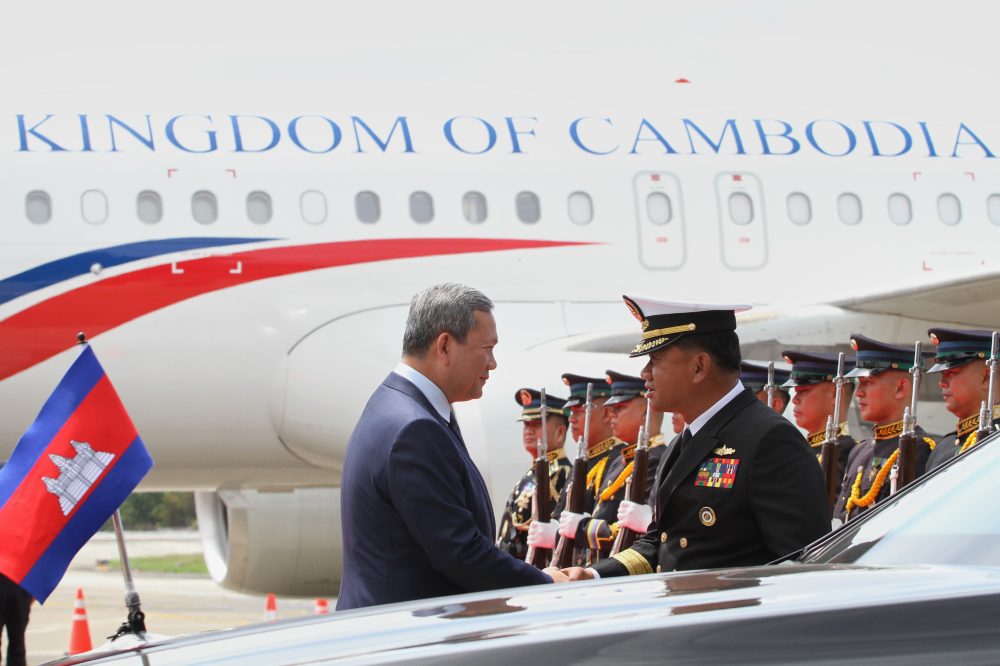

Cambodia’s leadership has submitted formal documentation to a United Nations maritime authority requesting mandatory mediation in a sea boundary conflict with Thailand, the country’s Prime Minister Hun Manet announced Tuesday.
The contested waters are thought to hold substantial reserves of natural gas and other valuable energy resources that both nations claim.
Cambodia’s move to involve the U.N. Convention on the Law of the Sea, known as UNCLOS, follows Thailand’s decision last month to cancel a 25-year-old agreement between the two countries designed to address competing maritime boundary claims.
Thailand withdrew from the pact unilaterally in May as diplomatic relations deteriorated following significant military confrontations along their shared land boundary last year.
The armed conflicts from the previous year generated nationalist sentiment, creating political demands for Thai Prime Minister Anutin Charnvirakul to end the maritime agreement.
During a live television appearance on TVK state broadcasting, Hun Manet announced that his administration had provided official notification to both Thailand and the U.N. secretary-general to initiate mandatory mediation procedures under UNCLOS protocols.
“Cambodia has never violated the sovereignty of other states,” he said.
“At the same time, we are unwaveringly determined to defend Cambodia’s sovereignty. Today, we continue to honor that responsibility, not through force, but through international law; not through unilateral action, but through peaceful engagement.”
The timeline for when the dispute might be resolved remains uncertain.
Anutin addressed the development by informing media representatives that Cambodia’s initiative did not pose concerns for Thailand. He had earlier stated that Thailand would pursue maritime boundary solutions following UNCLOS frameworks, though he disagreed with Cambodia’s approach of forcing mediation.
UNCLOS decisions do not legally bind participating nations, despite both countries having signed the international treaty.
Thailand has historically opposed allowing external parties to resolve territorial matters rather than handling them through direct bilateral negotiations. The country has maintained that a 1962 International Court of Justice decision granting Cambodia control of the mountaintop Preah Vihear temple near their border was unjust, contributing to persistent tensions between the neighboring nations.