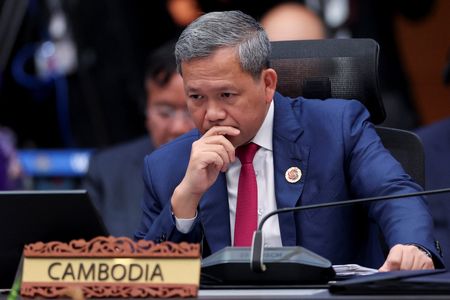

Cambodia’s Prime Minister Hun Manet accused Thailand of maintaining military occupation of Cambodian land during his first international media interview this week, despite a peace agreement facilitated by President Donald Trump.
Speaking with Reuters on Tuesday while visiting Washington for Trump’s Board of Peace meeting, Hun Manet said Thai military forces continue positioning themselves within Cambodian borders following last year’s violent clashes. The Cambodian leader urged Thailand to permit a joint boundary commission to address their contested border issues.
Hun Manet described the current border situation as “fragile” even after the December 27 ceasefire that halted renewed hostilities. He expressed hope that Trump’s newly established Board of Peace, originally designed to monitor the Gaza peace agreement, might help reduce tensions in the region.
Thai officials have maintained their troop deployments are part of de-escalation efforts and reject claims of territorial occupation.
The statements from Cambodia’s leadership highlight concerns that fighting could resume despite Trump’s continued promotion of the peace agreement’s effectiveness.
Last year’s border violence marked the most severe conflict in over ten years, beginning in July and forcing hundreds of thousands to flee their homes while disrupting commerce along the 508-mile frontier. A peace agreement signed in October with Trump and Malaysia’s leader collapsed within weeks before the current ceasefire took effect on December 27.
“We still have Thai forces occupy(ing) deep into Cambodian territory in many areas. This is further beyond even Thailand’s own unilateral claim… border line,” Hun Manet stated, explaining that Thai troops have installed shipping containers and barbed wire in areas Thailand previously acknowledged as Cambodian territory, preventing residents from returning home. “This is not an accusation but it’s a statement of the facts on the ground.”
The Prime Minister emphasized Cambodia cannot tolerate what he termed a “violation of our sovereignty or territorial integrity.”
“The only way to verify that is using the technical mechanism that we have, based on treaties, based on all the agreements we have. So we hope that Thailand will agree and start to allow the JBC (joint boundary commission) to work as early as possible,” Hun Manet explained, noting Thailand had cited its February 8 election as justification for delaying demarcation efforts. Thai Prime Minister Anutin Charnvirakul gained electoral support through nationalist rhetoric surrounding the border dispute.
“Now the election is done, we hope that Thailand can start, at least on a technical level, to start measuring, start demarcating in the hot zone, so that we can go back to life,” Hun Manet added.
Hun Manet, 48, assumed leadership after his father Hun Sen stepped down following 2023 elections where their Cambodian People’s Party faced minimal opposition.
The transition to Hun Manet, a West Point graduate, combined with Trump’s mediation in the territorial conflict, has improved relations between Washington and Phnom Penh after years of Cambodia moving closer to China.
Regarding international relationships, Hun Manet said ties with China and the United States were “not mutually exclusive” and stated Cambodia had “nothing to hide” concerning the Chinese-upgraded Ream naval facility.