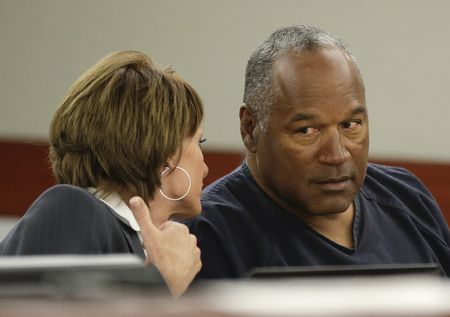

O.J. Simpson made history as the first player ever inducted into the Buffalo Bills’ Wall of Fame in 1980, but when the team’s brand-new Highmark Stadium opens its doors, his name and likeness will not be among those honored inside.
The Bills announced the decision to leave Simpson out of the new venue’s Wall of Fame. Simpson, a running back who played for Buffalo from 1969 to 1977, passed away in 2024 at the age of 76 after a battle with cancer. He was widely considered the franchise’s first true superstar.
Simpson’s legacy has long been shadowed by the 1994 stabbing deaths of his ex-wife, Nicole Brown Simpson, and waiter Ronald Goldman. Although he was acquitted in criminal court, he was later found liable in a civil wrongful death lawsuit and ordered to pay $33.5 million in damages to the victims’ families.
Bills president of business operations Pete Guelli addressed the decision in a formal statement, saying, “We have made an organizational decision that he is not a fit to display inside our new stadium and family circle.”
Simpson’s name had remained visible at the team’s previous stadium throughout its final years, even as public debate swirled over whether it was appropriate to keep it there. The first regular-season game at Highmark Stadium is set for September 17 against the Detroit Lions.
Before becoming a Bill, Simpson won the 1968 Heisman Trophy while playing college football at the University of Southern California. Buffalo then selected him with the very first overall pick in the 1969 NFL Draft. In 1973, he became the first running back in NFL history to surpass 2,000 rushing yards in a single season, finishing with 2,003 yards over just 14 games.
Simpson earned five first-team All-Pro honors and was selected to six Pro Bowls during his career. He totaled 10,183 rushing yards as a Bill, which stands second in franchise history behind Pro Football Hall of Famer Thurman Thomas, who accumulated 11,938 yards from 1988 to 1999.
A single-game franchise rushing record of 273 yards, set by Simpson in 1976, still ranks sixth in NFL history. At the time he set it, the mark was an NFL record.
Prior to the murders in 1994, Simpson had built a second career as a broadcaster and actor and was one of the most recognizable and well-liked former athletes in the country. His reputation collapsed in the aftermath of the killings, and he became one of the most controversial figures in American public life.
When Simpson died of cancer in 2024, neither the Bills nor his former college program at USC publicly acknowledged his passing.