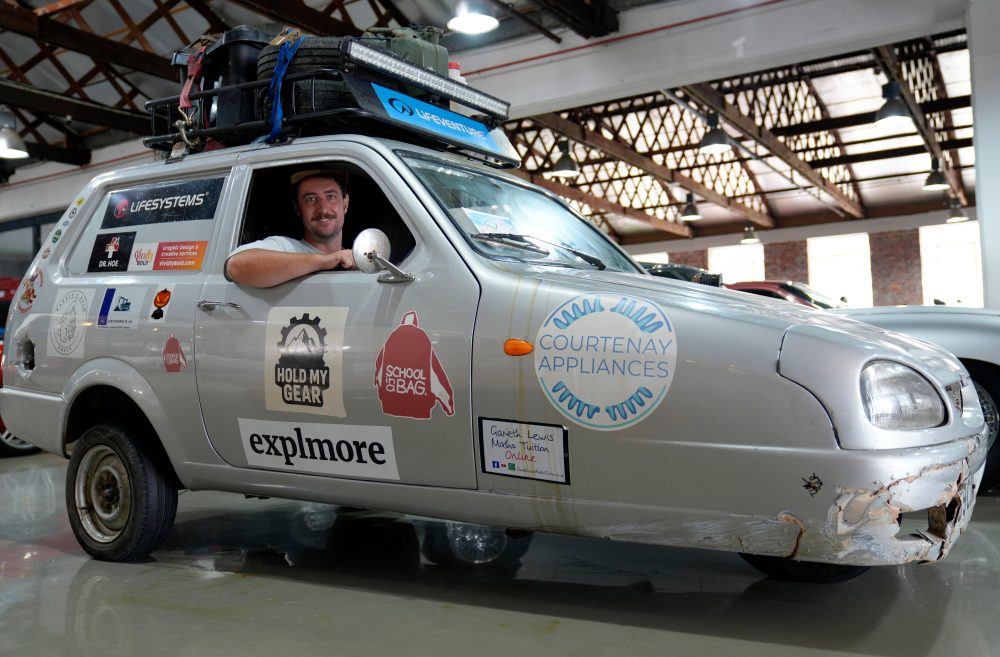

CAPE TOWN, South Africa — When Canadian Seth Scott first suggested the wild adventure to his English friend Ollie Jenks, the response was immediate.
“It was so ridiculous I couldn’t say no,” Jenks recalled.
Scott’s outrageous plan involved driving a vintage British Reliant Robin three-wheeler from London all the way to southern Africa — covering 14,000 miles across 22 nations to establish a world record for the longest journey ever completed in a three-wheeled automobile.
The Reliant Robin holds legendary status among British car enthusiasts as a modest three-wheeled vehicle that, according to Jenks, was originally built for simple grocery runs in 1970s Britain. Production ceased in the early 2000s, but these quirky cars remain beloved in British pop culture, particularly after featuring as the Trotter family’s dependable yet weathered yellow vehicle in the hit comedy series “Only Fools and Horses.”
However, you’d be hard-pressed to find a vehicle less equipped for traversing thousands of miles through African rainforests, mountain passes, and desert terrain. That impossible challenge is exactly what attracted Jenks to the outlandish scheme.
The duo purchased Sheila, a silver three-wheeler among the final Reliant Robins ever manufactured, exclusively for this expedition. In October, Jenks and Scott departed with a fuel container and basic supplies secured to Sheila’s compact roof, plus considerable faith that they would somehow reach Cape Town, South Africa, at the continent’s southern edge.
“No power steering, no air con, and it doesn’t do well up hills or down them. It is the most unsuitable car for probably any journey,” Jenks offered in a brutally honest evaluation of Sheila’s capabilities. “We made friends with the designer of this car, and he’s scared to take it any more than 20 miles.”
Despite all warnings, Jenks and Scott embarked on their extraordinary four-and-a-half-month odyssey, which required between $40,000 and $50,000 in funding, according to Jenks. Support came through sponsors and crowdfunding, while they chronicled their travels on Instagram, attracting nearly 100,000 followers with the tagline: “14,000 miles, 3 wheels, 0 common sense.”
Their timing coincided with an attempted coup in Benin. They navigated through northern Nigeria while U.S. forces conducted airstrikes against Islamic State positions. Military personnel provided escort protection for approximately 300 miles through a Cameroon region experiencing separatist conflicts.
“Imagine this car in a military convoy,” Jenks reflected.
Numerous close calls with traffic hazards occurred, including a terrifying moment when an overtaking bus nearly crushed Sheila against a cliff wall in Congo.
Living up to the Reliant’s reputation for mechanical issues, countless breakdowns plagued their journey on Africa’s challenging roadways.
Within the first two weeks, Sheila required new wheel springs. Ghana brought gearbox failure, leaving them stuck in fourth gear. Cameroon presented clutch and distributor troubles, followed by the ultimate disaster: complete engine failure.
Throughout every mechanical crisis, the generosity of local people and the determination of Jenks and Scott sustained their progress. A helpful stranger arranged gearbox shipment to Ghana. Reliant enthusiasts back in the U.K. located and sent replacement engine parts to Cameroon.
Following one breakdown, locals helped load Sheila onto a livestock transport truck for garage delivery. Mechanics throughout the continent bolted, hammered, and welded Sheila back together, often expressing bewilderment at the entire endeavor.
Yet the adventure also delivered spectacular moments that Jenks and Scott had hoped would justify their efforts.
Sheila traveled through breathtaking mountain landscapes and expansive desert regions — territories no Reliant Robin had likely explored before. She participated in safari experiences, keeping pace with running giraffes, observing endangered rhinoceros, and posing beside a massive elephant.
More than 120 days after departure, she limped into Cape Town last month running on an engine that had begun severe overheating in Namibia’s desert and remained questionable for roughly 1,000 miles.
“This is a great underdog story,” commented Graeme Hurst, a South African automotive enthusiast who tracked their Instagram journey and came to meet Sheila. “I see the farcical kind of comical nature of it … but also the sheer admiration. I mean, they have utter tenacity.”
In South Africa, Sheila received temporary exhibition space in a luxury automobile showroom, becoming the main attraction among gleaming Porsches and Mercedes while displaying her cracked side window, fuel-stained windshield, warped wheel rims, and numerous dents and scratches.
She will now receive proper rest and the comprehensive maintenance she has earned, Jenks explained. Eventually, she’ll travel to Kenya, board a ship bound for Turkey, then complete one final journey back to the U.K. for permanent display at the London Transport Museum.
Jenks described feeling victorious upon reaching Cape Town, but mostly relieved to have survived and finally escape the cramped two-seat cabin.
“It was like driving a motorized coffin,” he concluded.