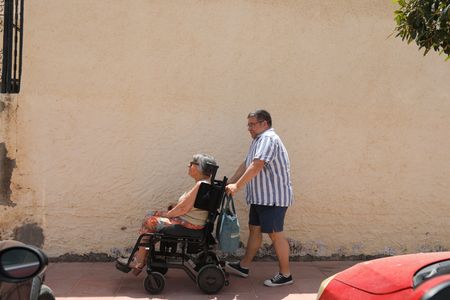

TURRE, Spain — This month marks ten years since Britain held its historic referendum on leaving the European Union, and for one Liverpool man, that anniversary came with a life-changing decision. Daniel Northover, 53, packed up his life and moved to Turre, a small Andalusian town of about 4,500 people in southern Spain, to live full-time with his 80-year-old mother Carole.
After Carole’s husband passed away last summer, Northover and his sister had been taking turns flying back and forth to Spain to look after her. Carole suffered multiple strokes and is no longer able to cook, clean, or dress herself without assistance.
The back-and-forth arrangement eventually became impossible to maintain. Under current rules, non-EU citizens are only permitted to stay within the EU for 90 days out of every 180 without a visa. Northover, who works as a project manager for local councils and charities, did not qualify for a work visa. And visas designed to allow someone to care for a dependent family member are only available when it is the British citizen themselves who requires the care — not the other way around.
A senior official with the European Commission told Reuters that cases where the absence of a family caregiver would force an elderly Withdrawal Agreement beneficiary out of their host country are reviewed individually. In all other situations, standard immigration rules apply.
Northover’s sister applied for a family reunification visa and was turned down. With no other options available, Northover and his partner sold their home to fund a so-called “non-lucrative” visa — a permit that allows them to live in Spain but prohibits them from holding a job. They are now Carole’s full-time caregivers.
“The way the withdrawal agreement was written means we’ve had to give up our lives and careers,” Northover said.
Carole, sitting in her wheelchair in the Spanish sunshine beside her son, expressed her frustration directly. “The agreement was terrible. They didn’t think it through,” she said, shaking her fist. “I’m so ashamed I’ve caused [my children] this stress.”
The Northover family’s experience is far from unique. Tens of thousands of British retirees living in Spain have aging or ill parents, and their families are scrambling to figure out how to provide care across international borders.
Britain voted 52% to 48% on June 23, 2016, to exit the EU after more than 40 years of membership. That decision ended the automatic right of British citizens to live and work freely across EU member states.
Spain is home to the largest British population in the EU — approximately 266,000 people according to official figures — and that community is growing older rapidly. Spanish data shows the number of British residents over the age of 75 climbed from 36,000 in July 2016 to more than 51,000 at the beginning of last year.
Sally Myburgh, a British resident of Malaga who runs a Facebook group helping people navigate life in Spain after Brexit, said she regularly sees families dealing with exactly this kind of situation. “This is a recurring problem that isn’t going to go away,” she said.
She noted that the common response — that these retirees should simply return to England — ignores a painful reality. “The attitude is they should just go back to England… but these people are at the end of their lives,” Myburgh said. “This is their home.”
The number of British residents in Spain has stayed relatively steady since the Brexit vote, with roughly a third of them being pensioners. Many are settled in towns along the Costa Blanca and Costa del Sol coastlines. Spain’s social care system does offer in-home assistance to qualifying residents, but even for those with the most severe needs — classified as having a “total loss of autonomy” — support is capped at 94 hours per month, or roughly three hours per day.
Neal Anderson, a welfare officer with the charity Help at Home Costa Blanca, which supports elderly British residents in the region, said returning to the UK is an unrealistic option for people who have spent decades building a life in Spain and have no community or property waiting for them back home.
Northover echoed that concern for his mother’s wellbeing. “My mum is 80. A major upheaval is distressing. Uprooting her to a place she doesn’t know with people she doesn’t know… it could kill her,” he said, adding that even if she made it through the move, getting her registered in Britain’s already-strained social care system could take months.
Carole, who voted to remain in the EU, put it simply: “I can’t imagine living [in the UK] now… I love Spain… This is home. Everyone knows me here.”