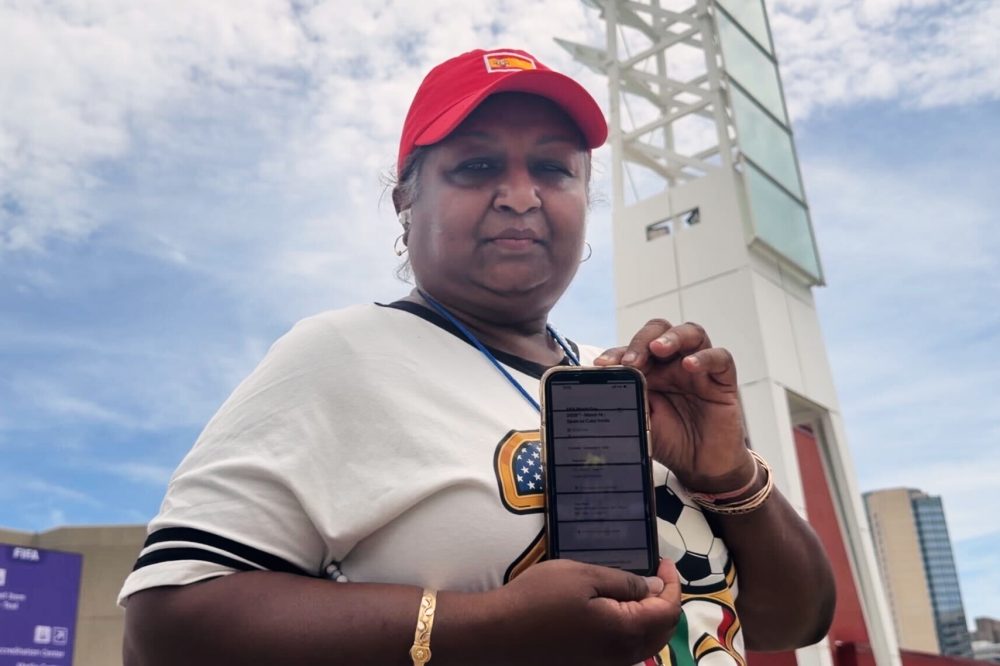

Bina Ramroop was in tears outside Atlanta’s Mercedes-Benz Stadium on Monday, realizing the World Cup tickets she had purchased as a 13th birthday gift for her grandson were not going to work out.
While thousands of fans streamed into the venue to watch Spain take on Cape Verde in a match that ended in a scoreless draw, Ramroop spent hours bouncing between StubHub customer service representatives on the phone and FIFA staff at the ticket window. Neither side could offer a solution, and each pointed the finger at the other.
The tickets — purchased months in advance through StubHub at $485 each — could not be transferred from the original seller into FIFA’s ticketing app. As the roar of the crowd signaled the start of the match, StubHub offered her a refund. With no other options, she accepted.
“I didn’t want a refund, I didn’t want my money back,” Ramroop said. “I wanted to go to the game.”
On the long train ride back to the Atlanta suburbs, Ramroop’s grandson Elijah Gomes tracked the final score on his phone. When the match ended goalless, he tried to comfort his heartbroken grandmother by suggesting they hadn’t missed much — a sentiment Cape Verde fans would likely dispute.
“He’s telling me, ‘Grandma, it’s OK, Grandma.’ And he’s trying to console me,” Ramroop recalled the following day.
Her story is far from unique. An Associated Press journalist at the match observed more than a dozen other fans dealing with similar ticket failures. Across social media, complaints have flooded in from buyers who say their tickets never showed up, orders were scrapped at the last minute, or they spent hours trying to resolve conflicts between FIFA’s ticketing system and outside resale platforms. While most complaints center on industry giant StubHub, buyers from competing platforms such as SeatGeek and Vivid Seats have reported problems as well.
Experts who spoke with the AP say the issues appear to have more than one root cause. Some cases involve technical glitches in the ticket transfer process — something StubHub describes as “very, very rare” and says it is actively working to fix. Other cases may involve a more longstanding problem in the ticketing world: speculative sellers.
Scott Friedman, an industry veteran and co-founder of a consultancy called the Ticket Talk Network, explained that some sellers list tickets for events before they actually possess them, gambling that prices will drop closer to the event date so they can buy the tickets at a lower cost. But because World Cup ticket prices have climbed since the tournament began, those sellers have been forced to either purchase expensive tickets to fulfill their commitments or cancel and absorb penalties from resale platforms. StubHub’s standard penalty for such cancellations is typically 200% of the ticket price, Friedman said.
“This is not new at all,” Friedman said, pointing to other major events — including Taylor Swift’s Eras tour — where fans were similarly left empty-handed. “This has been going on, but it’s making global news because it’s the World Cup.”
StubHub maintains that it requires sellers to verify they have tickets before listing them. But Friedman argued that regardless of the cause, “StubHub should fill every single order to make sure fans get in the biggest global sporting event that happens every four years.”
StubHub, for its part, placed the blame squarely on FIFA, saying in a statement that the governing body has “poor technology infrastructure,” imposed last-minute transfer restrictions, and didn’t roll out its new ticketing app until just weeks before the tournament started. The company also criticized organizers for taking what it called “anti-competitive actions” that restrict where fans can buy and sell tickets.
When asked about the technical problems, FIFA responded Wednesday by reiterating that tickets purchased through its official marketplace are guaranteed to be delivered.
FIFA has encouraged fans to use its own resale platform, which adds a 30% surcharge to every resold ticket — split evenly at 15% each between buyer and seller. Many fans, however, turned to outside resale sites out of familiarity, lower prices, or ease of use.
StubHub’s FanProtect Guarantee promises replacement tickets or a refund when tickets fail to arrive. However, the policy states repeatedly that these remedies are offered at StubHub’s “sole discretion,” giving the company the authority to issue a refund rather than find replacement seats.
“That is pretty explicit language,” said Michael McCann, a sports law expert at the University of New Hampshire. He noted that buyers could attempt to challenge the policy under state consumer protection laws, but said it would be an uphill legal battle.
Pape Ndaw purchased tickets in December as a high school graduation gift for his son — seats to see the Netherlands face Japan near their home city of Dallas. The tickets cost roughly $550 each. Two days before the June 14 match, he received an email from StubHub informing him that “the seller can’t deliver your original tickets.”
Ndaw chose store credit over a refund, thinking he could quickly use the funds toward replacement tickets. He then discovered the cheapest last-minute options were going for more than $1,500 per ticket. To make matters worse, he said StubHub denied his later request to convert the store credit back into a cash refund.
Telling his soccer-obsessed son was devastating.
“It was a disastrous thing,” Ndaw said. “He had told all his friends that he was going to that game. He literally cried. I mean, he is a 17-year-old kid, but he cried.”
Some buyers had a slightly better experience. Patrick O’Neil of Pittsboro, North Carolina, traveled to Atlanta with his wife, son, and other family members after buying five StubHub tickets to the Spain-Cape Verde match. Two of the five tickets transferred without a problem, but three never came through.
O’Neil’s 15-year-old son and his uncle used the two working tickets to attend the game, while O’Neil, his wife, and another relative watched from a nearby bar.
After local media reported on their situation, O’Neil said StubHub reached out and offered the family tickets to another match. Since they had already purchased tickets to a different game, O’Neil and his wife asked the company to instead donate the seats to a local nonprofit called Soccer in the Streets, so they could go to fans who might not otherwise have the chance to attend.
“StubHub is not evil, but they’re part of the whole system that makes it really hard for just normal kids and people who might want to see a match get to go,” O’Neil said.
A StubHub representative confirmed to the AP on Thursday that the company would honor the family’s request and send the tickets to the nonprofit.