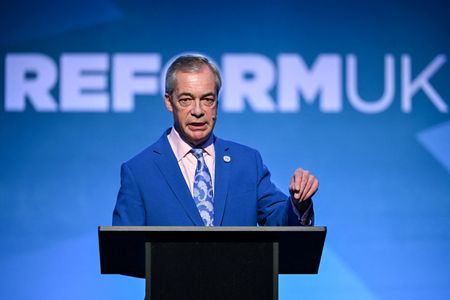

NEWPORT, Wales – Britain’s political landscape could be heading for dramatic transformation as Reform UK leader Nigel Farage positions his populist movement to challenge the country’s established order.
Speaking to Reuters during his party’s policy rollout in Newport, Wales on March 5, the 61-year-old political maverick outlined an ambitious agenda that includes implementing large-scale deportations, abandoning international human rights agreements, and dramatically reducing foreign aid spending.
“The world is changing,” Farage stated, describing his vision for dismantling what he characterizes as a liberal establishment promoting “a progressive, woke ideology” that has caused British citizens to feel embarrassed about their nation.
Reform UK has surged ahead in British opinion surveys, establishing a commanding lead over Prime Minister Keir Starmer’s Labour government. This momentum has strengthened Farage’s argument that his five-year-old party could capture control in the next general election scheduled by 2029.
The former Brexit champion drew parallels between himself and other global figures he considers agents of change, including his ally Donald Trump, Hungary’s Viktor Orban, and Argentina’s Javier Milei, describing them as leaders bringing “very, very big changes” worldwide.
Farage noted a shifting reception during his recent appearance at the World Economic Forum in Davos, contrasting current interest with previous hostility. “I would say a third of the delegates I met there were genuinely interested in who I was, what I was, what I was trying to do,” he explained. “And next year it will be 50%.”
The Reform leader criticized conventional politicians as outdated, specifically targeting the current prime minister. “Keir Starmer is stuck in a mindset that is 15 years out of date,” Farage declared.
However, the party faces significant obstacles in convincing voters of their governing readiness, holding just eight seats in Britain’s 650-member parliament and lacking substantial government experience. Controversial statements about migrant “invasions” and racism allegations that resulted in member expulsions have alienated some potential supporters concerned about increased social tensions.
Adding to these challenges, a former Reform Wales leader received a prison sentence in November for accepting bribes to deliver pro-Russian speeches, actions the party condemned as “reprehensible, treasonous and unforgivable.”
Tim Bale, a politics professor at Queen Mary University London, highlighted this paradox: “Reform’s biggest strength is also its biggest weakness – namely, Nigel Farage. He’s adored by those who are absolutely determined to vote Reform but hated by those determined to vote against it – and disliked and distrusted by far too many who might otherwise be tempted to move in its direction.”
Reform’s expanding policy framework, gathered through Reuters interviews with Farage and ten current and former advisors, encompasses eliminating diversity programs and climate targets, maximizing domestic oil and gas extraction, drastically reducing Britain’s civil service, and establishing the country as a cryptocurrency center.
Critics have characterized this agenda as merely copying Trump administration policies, a comparison Farage disputes. He describes Reform’s approach as grounded in “simple values” centered on “family, community, country.”
Labour officials have questioned the party’s policy coherence, with one stating: “Reform don’t have a proper policy platform. Their ideas don’t make sense.”
Farage’s advisors frequently discuss sweeping away liberal elites who maintain the “rules-based international order.” Alan Mendoza, Reform’s global affairs chief advisor, emphasized this transformation: “You need to be asking: What is your new destination? Because the old, the old world, has gone. It’s over.”
James Orr, the party’s new policy director and Cambridge University philosophy professor who maintains friendship with U.S. Vice-President J.D. Vance, offered insight into Farage’s appeal. “I’m hesitant to use the word philosophy about Nigel,” the 47-year-old explained during an interview at a London private club. “He has instincts, not ideology.”
Orr’s skepticism toward elites developed during the 2016 Brexit referendum period, when he described being the “only out-of-the-closet Brexiteer” among Oxford University academics while finding support from “the porters, the butlers, the maintenance department and the gardeners and the groundsmen.”
Farage’s political influences include figures he encountered in Brussels: Italian comedian Beppe Grillo, who co-founded the anti-establishment 5-Star Movement, and social media strategist Roberto Casaleggio. A longtime advisor noted Farage’s understanding of digital communication: “Grillo weaponised social media and Nigel gets it. For a man who has never really turned on a computer in his life, he really gets it.”
Both major opposition parties dismiss Reform’s policy development capabilities. Conservative leader Kemi Badenoch told a party gathering on March 7: “Reform are not serious people and they are not going to solve any of your problems. Reform have absolutely no idea what they want Britain to look like in the 2030s.”
Reform officials emphasize their American connections as potential governing assets. “With this administration, I happen to know most of the members of cabinet on a personal basis and have for many, many years,” Farage told Reuters.
He expressed alignment with Trump on major issues including global security, recognizing “Iran is the bad actor in the Middle East” and understanding “China wants to take over and dominate our lives,” along with shared positions on border control and domestic energy production.
However, Farage rejected suggestions that he copies Trump’s MAGA movement. “To some extent they copy what we were doing back in the run-up to the referendum,” he countered. “I have always gone for bells and whistles and fireworks and fun, and whilst we believe in what we’re doing, we have a good time as well.”
According to sources familiar with Reform operations, party officials regularly travel to Washington seeking financial support and business backing, particularly targeting British businesses and entrepreneurs who have relocated abroad due to UK tax policies. These efforts helped Reform raise 5.5 million pounds in the fourth quarter of last year, contributing to total 2025 donations of 18 million pounds, with Electoral Commission data showing at least two-thirds coming from overseas donors.
Mendoza argued that Britain must demonstrate value to Washington through substantial defense investment and expanded global engagement to maintain meaningful security partnerships, countering Trump administration perceptions of Britain as “a weak and feeble country.”