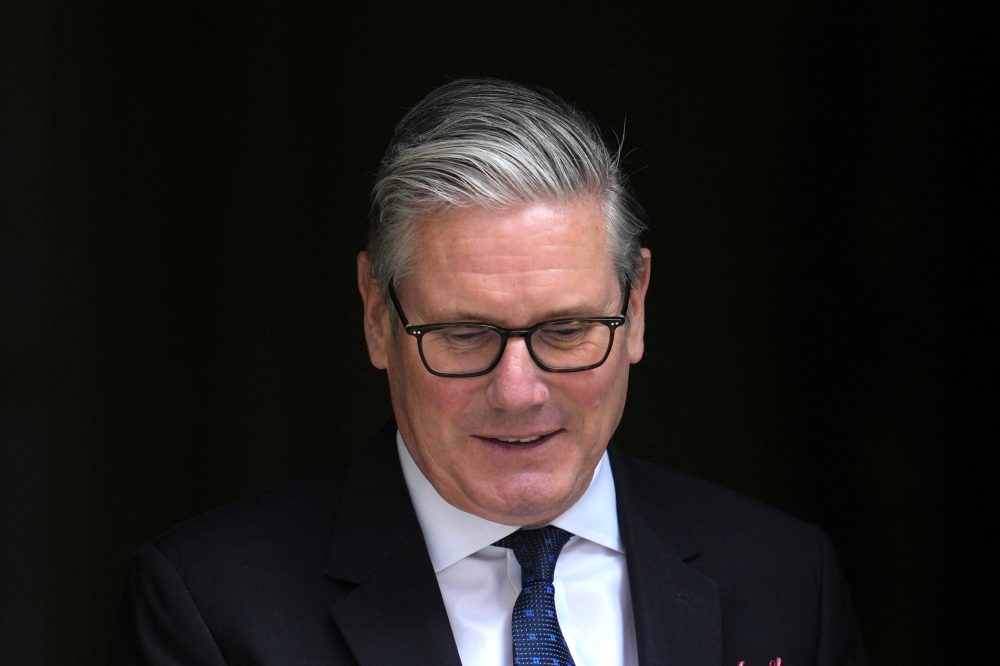

British Prime Minister Keir Starmer declared Friday he will battle to remain in power following the abrupt departure of his defense chief, which has further damaged his already fragile political standing.
The Labour Party leader has witnessed multiple junior and senior officials exit their posts in recent weeks amid growing rebellion from party members and plotting by political opponents, all frustrated by the administration’s persistent low approval ratings.
However, Defense Secretary John Healey’s unexpected resignation Thursday represents a particularly damaging setback. Healey stepped down while cautioning that the administration isn’t allocating sufficient funds to military forces to protect Britain’s security “at this time of rising threats.”
The resignation strikes Starmer where he has typically received praise: international affairs and foreign policy leadership.
Following his landslide electoral win in July 2024, Starmer has strengthened assistance for Ukraine, collaborating with French President Emmanuel Macron on an international “coalition of the willing” designed to help secure Ukraine’s safety should a ceasefire emerge.
The United Kingdom and France have also created a maritime security operation aimed at maintaining shipping access through the Strait of Hormuz when the Iran conflict concludes.
Additionally, Starmer has advocated forcefully that European countries must increase their defense funding in light of President Donald Trump’s criticism of America’s NATO partners.
“Starmer has been consistently staunch about warning of the security risk from Russia,” said Olivia O’Sullivan, head of the U.K. in the World program at the Chatham House think tank. “He’s been given quite a bit of credit by the public for having to deal with Trump and doing so with a level of steadiness and calm. And he has been, in line with previous U.K. governments, a close and consistent ally of Ukraine.”
The central dispute involves the administration’s anticipated Defense Investment Plan, which outlines Britain’s strategy to boost military expenditures to 3.5% of GDP by 2035. The British armed forces are working to overcome years of deterioration while facing an increasingly aggressive Russia, which launched its invasion of Ukraine in 2022 and continues challenging European defenses through both open and hidden operations.
Healey demands defense expenditures reach 3% of GDP by 2030. He resigned in frustration when Treasury chief Rachel Reeves declined to modify a proposal that doesn’t meet that target.
He referenced a British intelligence evaluation indicating Russia might assault a NATO member nation by 2030 and stated that insufficient spending plans “could make the country less safe.”
Opposition voices contend that military expenditures can become endless drains on resources, noting that acquisition programs frequently exceed deadlines and budgets.
Former Armed Forces Minister Al Carns, who also resigned Thursday hours following Healey’s departure, emphasized the issue extends beyond increased spending to smarter allocation. He described the investment proposal as insufficiently “transformative.”
“I want to see a higher percentage for uncrewed systems, AI, data — data is the new gunpowder — and we’ve got to move that forward if we are going to win the next war,” he told the BBC.
Healey joins other government officials who have departed. Last month, Starmer lost multiple junior ministers and Health Secretary Wes Streeting, who resigned to position himself for a potential party leadership campaign.
Greater Manchester Mayor Andy Burnham is anticipated to mount a leadership challenge against Starmer should he win election to Parliament in Thursday’s special election.
Yet Healey’s exit, given his reputation as a devoted minister without personal leadership aspirations, “suggests that Starmer’s credibility, even with his inner circle of ministers, is perhaps draining away,” O’Sullivan said.
Starmer maintained Friday he won’t step aside, describing his role as making “hard-edged decisions.”
He told the BBC that defense is “my number one priority. And I have taken the difficult decisions to make sure that we are safe as a country.”
“I’m not going to go away. I don’t think we should plunge the country into the chaos of a leadership election,” he said. “I don’t think it should happen, but if it does, then I will fight.”