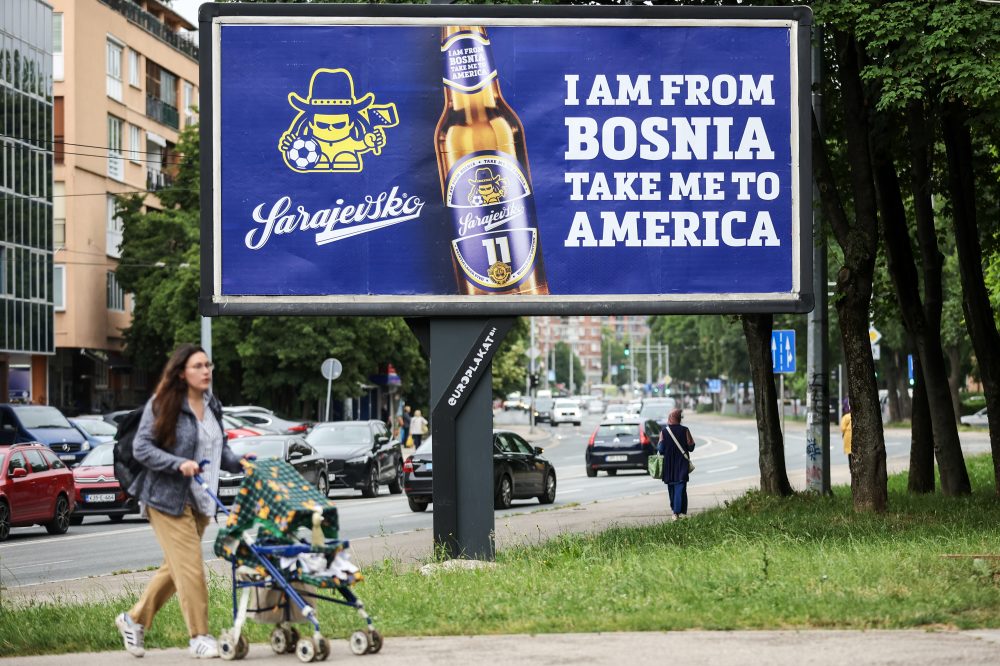

SARAJEVO, Bosnia-Herzegovina — What started with straightforward words — “I am from Bosnia; take me to America” — has evolved into something much bigger. The Bosnian musical group Dubioza Kolektiv has reworked their well-known track “USA,” turning a tune about American Dream disappointment into a viral soccer chant supporting Bosnia-Herzegovina’s World Cup aspirations.
Before Friday’s game between Bosnia and Canada, band members spoke with The Associated Press in the Sarajevo district where they shot their latest music video for the accordion-driven hit, now called “I Am From Bosnia, Take Me to America.” The video celebrating soccer’s blue-collar heritage has reached almost 2 million YouTube views in under three weeks — adding to the 26 million views their original “USA” from 2011 has collected over time.
“It’s an interesting story how this song got its second and third and fourth incarnation in these 15 years,” reflects Vedran Mujagić, the band’s bass player, whose group has integrated political and social issues into their artistic mission. “It evolved from this satirical take on immigration and (the) American Dream and it was translated into (an) American football dream for the entire nation.”
Bosnia-Herzegovina is participating in just its second World Cup, an achievement that seemed unlikely given the stronger soccer nations blocking their path to qualification. However, at April’s end, Bosnia’s last-minute score against Wales led them to a successful penalty shootout victory, which they repeated days afterward against Italy. Band members were taken aback when supporters displayed a banner featuring their song words, chanting them as a team anthem.
“First, it was working as a joke, but what I like the most is the supporters kind of loaded completely new meaning to the old song, and this is the best thing for the band or for the song: when people take over and load new meaning and then it becomes theirs,” explains keyboardist Brano Jakubović. “It’s not ours anymore.”
The original “USA” maintains the same energetic, memorable quality — it’s difficult not to find yourself humming, “I can no longer wait, take me to United States / Take me to Golden Gate, I will assimilate” — but the main character’s enthusiasm to leave quickly transforms into disappointment with life beyond the Balkans.
The group chose to create a refreshed version of what Jakubović calls a “typical immigrant song,” crafting new words suitable for a soccer celebration. While “USA” uses English, this edition is primarily in Bosnian — “so people will understand,” he explains — and focuses mainly on the sport. The language change hasn’t diminished its worldwide popularity, as YouTube comments demonstrate, though Jakubović admits some references would be puzzling to non-Bosnians. (See: burek without cheese.)
Jakubović’s preferred new verse allows him to address something that has troubled the country since the 2014 World Cup: “And that goal against Nigeria, that was never offside.”
“So this is like a big national trauma in Bosnia, so I used the song and lyrics to kind of release this trauma,” he explains.
While he’s being playful here, trauma has been constant since Bosnia’s independence during Yugoslavia’s breakup in 1992. Ethnic conflict erupted almost immediately, resulting in genocide. More than three decades following the Srebrenica massacre, significant tensions between Bosnian Serbs and Bosniak Muslims continue.
“Football in this moment is much more than just a game, it’s a hope and it’s very basically (a) political thing because it brought all the people from Bosnia together, which is usually not the case,” Jakubović states.
Bosnia’s opening game is in Canada, but the squad will actually travel to America. Their training facility is located in Sandy, Utah, and their remaining group matches — versus Switzerland and Qatar — take place in the United States. Additionally, as Mujagić notes, many players were born in America or other diaspora locations.
“They are children of those people who went outside in search of a better life or as refugees or whatever their story was. And they kind of see and hear these lyrics and this song entirely differently from us,” he says.
Mujagić believes the core message of “USA” remains relevant as Bosnians continue emigrating. After departing, he observes, “they encounter this hostility of the locals, right-wingers, and they just don’t want them there.”
“So it’s this schizophrenic situation in which you want to go there, but you somehow know that you won’t have it good on the other side as well,” he concludes. “So in that sense, this song still works perfectly well as it worked before.”
In St. Louis, which hosts a flourishing Bosnian community, Admir Hodzic co-founded the supporter group BH Loyals. The 40-year-old entrepreneur was born in Bosnia and has traveled between his native country and America, similar to the character in “USA.”
“I think every Bosnian that lives here and understands how the system works and everything else, I think they will find the truth in that song, and that song is honestly nothing but the truth,” he states. While more opportunities exist in America than elsewhere, he says, “it’s a matter of biting your teeth and pulling through the worst times possible.”
He and fellow supporters strongly admire Dubioza Kolektiv and perform their anthem during games and viewing events. Most frequently, however, they sing the original “USA.”
“It’s engraved in their brain and their hearts,” he says, “and no matter what, they just go back to the old lyrics, you know?”