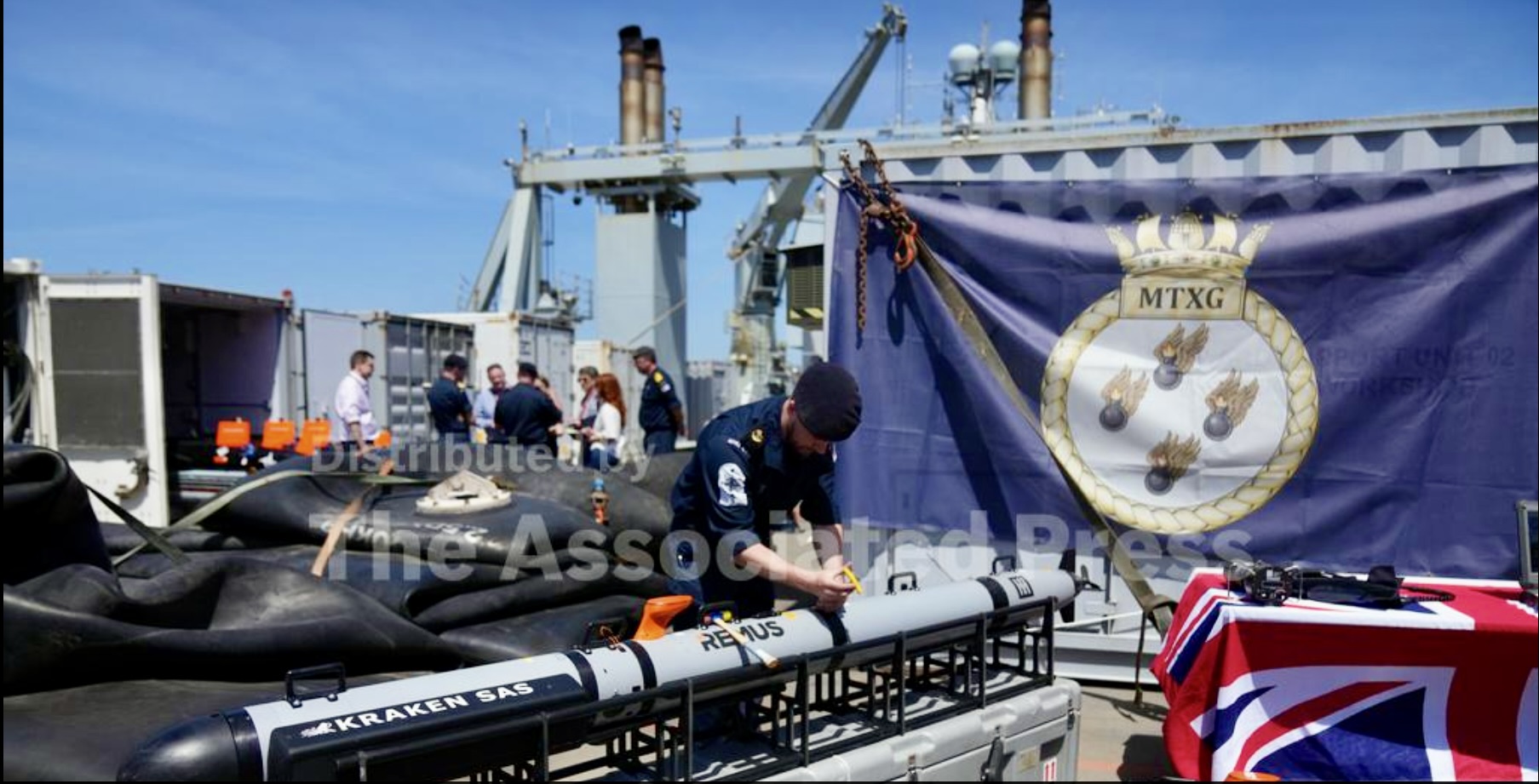

GIBRALTAR (AP) — Hundreds of British naval personnel are standing by off Gibraltar’s coast, ready to deploy for a mine-clearing operation in the Strait of Hormuz that remains uncertain.
President Donald Trump has criticized allies for insufficient support during the U.S. conflict with Iran, as Iran’s control over the strategic waterway has disrupted global shipping and driven up energy costs. In March, Trump told NATO partners to “go get your own oil” and handle strait security independently.
At Gibraltar, the British Overseas Territory on the Iberian Peninsula’s southern edge, the Royal Navy is making preparations for exactly that mission — but only after peace negotiations conclude. Trump announced Saturday that an agreement with Iran has been “largely negotiated” following discussions with Israel and regional partners, though final details remain pending.
Britain’s Armed Forces Minister Al Carns brought reporters aboard the RFA Lyme Bay as preparations continue for a potential international mission, with the U.K. and France leading efforts to secure the waterway. During the visit, crews were loading the amphibious vessel with ammunition and sonar-equipped mine-hunting drones at the Mediterranean gateway.
The RFA Lyme Bay, carrying several hundred crew members, will soon leave Gibraltar to meet up with the destroyer HMS Dragon and allied vessels for air support before transiting the Suez Canal toward the Persian Gulf.
“Which other country can pull together 40 nations and come up with a solution to deal with a complex problem that we couldn’t predict because we weren’t involved?” Carns asked when questioned by The Associated Press about Trump’s expectations for Britain.
Following the February 28 launch of the U.S.-Israeli military action, Tehran responded by essentially shutting down the strait, a vital passage for regional oil, natural gas and fertilizer exports, creating worldwide economic disruption. Britain has particularly drawn Trump’s criticism, with the president calling the British fleet “toys” and describing Prime Minister Keir Starmer as “not Winston Churchill.”
According to Carns, more than 6,000 vessels have been prevented from transiting the strait since hostilities started.
Iranian mines could pose varied dangers
Iran may have deployed a “huge” array of mines across the strait, according to Cmdr. Gemma Britton, who leads the Royal Navy’s Mine and Threat Exploitation Group. These explosive devices could be rocket-powered, tethered by cables, or positioned on the ocean floor with triggers activated by sound, motion or light.
AP reporters were shown automated systems capable of scanning seabed and water column areas with sonar technology in roughly half the time required for manned vessels to survey and chart hazardous zones. These unmanned sonar-equipped craft generate images of underwater objects ranging from fishing equipment to infrastructure pipelines. These images help identify mines that can then be examined using sophisticated acoustic equipment and cameras, Britton explained.
Several systems aboard the RFA Lyme Bay can be transferred to smaller craft that launch and operate independently from the main vessel, which serves as a command ship positioned safely outside suspected mine areas, Britton noted. This approach minimizes personnel exposure to danger zones.
Traditional mine disposal involves a diver manually attaching explosive charges to mines before swimming to safety for detonation. However, the RFA Lyme Bay is testing a remote-controlled underwater vehicle that can place charges near mines and trigger them without human divers, Britton said.
The initial focus will be establishing a clear transit corridor through the strait to enable approximately 700 stranded ships to depart, she explained. Subsequently, crews would clear a reverse-direction lane for incoming vessels, though completely clearing the entire strait might require months or years.
Deployment remains uncertain
Whether mines actually exist in the strait — or whether British and allied forces will ultimately deploy — remains unclear.
A U.S. official, speaking anonymously about sensitive military information, told AP that American forces have neither located nor eliminated any mines in the strait, and no vessels have sustained mine damage. Commercial shipping has continued at reduced levels throughout the conflict.
When AP asked whether the British preparations were partially theatrical to please the U.S., Carns acknowledged some mines may have exploded or drifted away, but said such uncertainty fails to satisfy commercial insurance requirements. Insurance companies demand “absolute certainty” before authorizing renewed strait transit.
“That’s what this capability will provide,” he stated.
The multinational strait security operation would commence only after fighting ends.
“Final aspects and details of the Deal are currently being discussed, and will be announced shortly,” Trump posted Saturday on social media, without specifying timing.
Recent weeks have seen multiple claims of near-completed agreements.
“We don’t know when the Americans, Iranians and Israelis are going to come up with a suitable solution,” Carns said.
Until then, the RFA Lyme Bay and its personnel will remain on standby and be “really, really ready,” Carns added.