
SAO PAULO (AP) — While the ongoing conflict involving Iran continues to disrupt oil markets worldwide, Brazil has found protection through an innovative solution that’s both cost-effective and eco-friendly: millions of motorists can select between pure sugarcane ethanol or gasoline mixed with 30% biofuel when they visit gas stations.
The South American nation’s extensive fleet of flexible-fuel vehicles — cars that operate on any mixture of ethanol and gasoline — represents an unparalleled program in terms of size. This initiative, which began in 1975 under Brazil’s former military government, has successfully adapted during democratic rule to decrease reliance on imported petroleum.
Currently, as the ongoing Middle East crisis involving Iran, the United States and Israel continues into its fifth week, countries including India and Mexico are examining Brazil’s approach as a model for achieving energy independence.
While motorists across the globe experience significant cost increases, Brazilian fuel prices climbed only 5% in March — a stark contrast to the 30% surge seen in America. Experts partially attribute this price stability to an established domestic biofuel sector that enables the nation to weather international tensions with little threat of fuel supply disruptions.
“Brazil is much better prepared than most countries because it has a viable alternative of this nature,” said Evandro Gussi, president of the Brazilian Sugarcane Industry Association, UNICA.
The circumstances are especially favorable given that Brazil’s upcoming sugarcane season, starting in April’s first half, is projected to yield a record 30 billion liters of ethanol — representing 4 billion liters more than the previous year. “That increase alone is equivalent to the total amount of gasoline Brazil imported in all of last year,” Gussi noted.
Although Brazil ranks as a significant crude oil producer and exporter, the country continues importing petroleum to satisfy domestic refined fuel needs. Brazil currently obtains oil from the United States, Saudi Arabia, Russia and nearby Guyana.
Nevertheless, ethanol has emerged as a cornerstone of everyday transportation. During 2025, ethanol sales reached 37.1 billion liters, based on data from the state-operated Energy Research Company. While it remains slightly behind diesel and gasoline in overall energy consumption, ethanol’s availability at all service stations offers Brazilians both psychological comfort and economic protection.
Brazil’s biofuel industry success centers in Sao Paulo state, the nation’s manufacturing and farming hub.
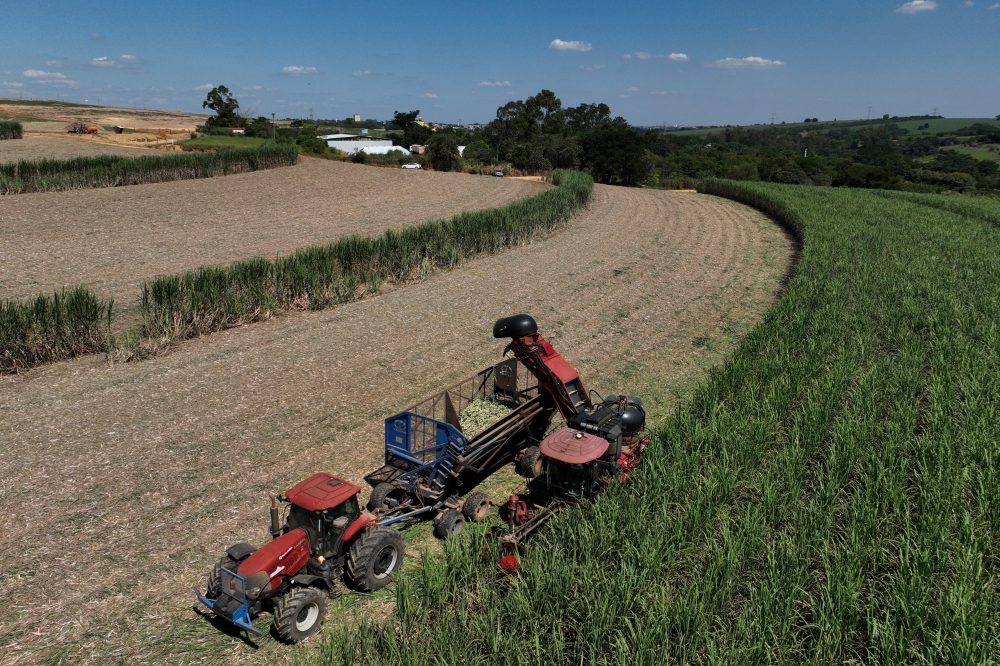
Operations there combine advanced, export-focused large-scale farms with smaller family-run businesses like Bom Retiro farm, established in 1958, where several dozen employees are currently preparing to harvest their 40-square-kilometer property spanning nearly 10,000 acres.
The country’s biofuel technology has benefited from extensive government-funded research. The Science Development Center for Ethanol at Unicamp university in Campinas, located near Sao Paulo, represents one such facility. Coordinator Luis Cortez explains that Brazil’s program possesses distinct benefits that other countries cannot replicate.
“We have flexibility in ethanol production, in vehicle engines and from the federal government, which sets the percentage of ethanol in the fuel blend,” said Cortez. “We have flexibility at three levels.”
He maintains that this research investment ultimately creates benefits for consumers at service stations.
Data from the Brazilian Association of Fuel Importers shows that gasoline processed by state-owned Petrobras — containing biofuel additives — costs 46% less than imported alternatives, saving 1.16 Brazilian reals ($0.22) per liter. Petrobras diesel similarly sells at refineries for 63% below international prices.
Although the potential closure of the Strait of Hormuz hasn’t dramatically affected Brazil’s gasoline sector, the country faces challenges with increasing diesel costs. This occurs because diesel relies heavily on imported crude oil and contains lower biofuel percentages.
In contrast to the sugarcane-ethanol achievement, Brazil’s biodiesel production, primarily derived from soybeans, comprises just 14% of diesel mixtures. This percentage may reach the same 30% level used in gasoline blends only by 2030, pending research advances and technological progress, meaning the current conflict has created immediate consequences.
Brazilian diesel costs jumped over 20% in March, leading President Luiz Inácio Lula da Silva to suggest import subsidies lasting through May. Government data indicates Brazil must purchase 20% to 30% of its diesel monthly, with most supplies coming from Russia.
Brazilian officials report the country imported nearly 17 billion liters of diesel during the past year.
For 80-year-old President Lula, who seeks reelection this October, maintaining stable diesel prices remains essential to avoid trucker protests and control food price inflation.
UNICA president Gussi revealed that since the recent Iran conflict began, multiple world leaders have contacted him regarding Brazil’s biofuel sector. Mexican President Claudia Sheinbaum expressed interest earlier this month in Petrobras’ methods for producing ethanol from agave, a widely cultivated plant in Mexico.
“The best news, even in the midst of a situation like the one we are experiencing, is that this solution has a significant level of replicability,” Gussi said.