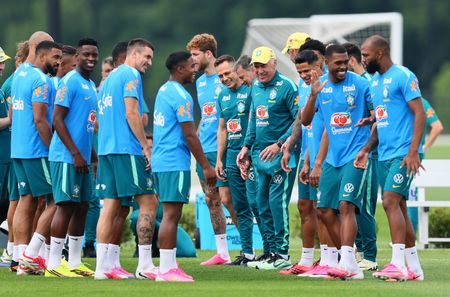

Brazil’s World Cup Round of 32 clash with Japan on Monday in Houston offers Carlo Ancelotti’s squad an opportunity to settle the score from a painful defeat earlier in his tenure — and a chance to prove just how much the team has grown under his leadership.
The five-time world champions suffered a 3-2 defeat to Japan in October 2025, despite jumping out to a 2-0 advantage. Japan rallied with three goals in under 20 minutes, claiming their first-ever victory over Brazil in 14 all-time meetings between the two nations.
That result underscored the challenge Ancelotti took on when he stepped away from Real Madrid with just one year to transform a struggling Brazilian side into a legitimate World Cup contender.
Brazil were in rough shape when the Italian manager came aboard. The team had just wrapped up their worst-ever South American qualifying campaign, finishing fifth after cycling through four different head coaches.
With only five international windows available before finalizing his 26-man roster, Ancelotti used the final three to expose his squad to a variety of competition — scheduling matches against opponents from Asia, Europe, and Africa.
The Asian portion of that tour started on a high note. Brazil dismantled South Korea 5-0 in Seoul and appeared headed for another easy result in Tokyo after storming to a 2-0 lead in the first 30-plus minutes. But Japan came roaring back in the second half, leaving Brazil with an uncomfortable memory.
Monday’s meeting, however, figures to be a very different kind of contest.
Japan manager Hajime Moriyasu acknowledged the stakes after his team drew 1-1 with Sweden to clinch second place in Group F behind the Netherlands. “Perhaps… they will be even more motivated,” Moriyasu said of Brazil. “We will be playing against a Brazil side that is very keen to win. I’m looking forward to it.”
Japan will look considerably different from the team that pulled off that upset. Injuries have sidelined captain Wataru Endo, wingers Kaoru Mitoma and Takefusa Kubo, and forward Takumi Minamino — who found the net in the October win over Brazil.
Brazil has also undergone significant changes. The entire defensive unit that started in Tokyo is gone from Ancelotti’s World Cup roster, and the squad has gained momentum after an opening 1-1 draw with Morocco. Consecutive wins have lifted the team’s confidence, Vinicius Jr. has tallied four goals, and Neymar has rejoined the national team following a three-year absence due to recurring injuries.
“We’re not perfect. We can improve. For example, our pace on the ball. We can be quicker,” Ancelotti said following Brazil’s 3-0 win over Scotland. “But I’m pleased because the team has improved a lot since the first match. Now it’s a knockout competition. We need to show real grit.”
The matchup also carries a rich historical backdrop. Brazil has long served as a model and inspiration for Japanese football, a connection deeply tied to the legendary Zico.
After a celebrated career with Flamengo, Udinese, and the Brazilian national team, Zico came out of retirement to play for Sumitomo Metal — later known as Kashima Antlers — from 1991 to 1994, playing a significant role in shaping Japan’s emerging professional soccer scene. He went on to manage Kashima and currently serves the club as a technical adviser.
Zico also took charge of the Japanese national team from 2002 to 2006, leading them to the 2004 Asian Cup title and guiding them to the 2006 World Cup. In that tournament, Brazil defeated Japan 4-1 in the group stage, ending Japan’s run. With history on both sides, Monday’s match in Houston carries plenty of weight for each team.