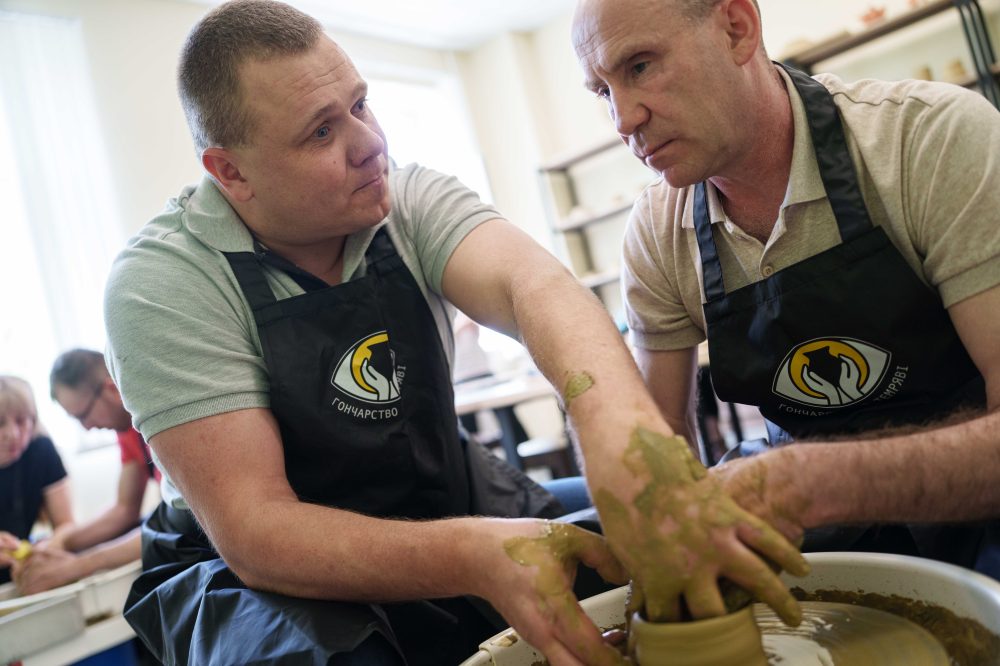

VINNYTSIA, Ukraine — Two strong men sit facing forward, their hands joined together on a potter’s wheel, fingers pressed deep into the wet clay. They communicate only through touch, sensing each other’s movements.
One man is a combat veteran who became blind during battle and now instructs other veterans who have lost their sight. Gradually, a shape that looks like a cup begins to emerge.
The teacher, Ivan Shostak, 37, explained he has created over 1,000 pottery pieces yet has never laid eyes on any of them. This artistic skill entered his world only after losing his vision during one of Ukraine’s most devastating and prolonged military engagements.
Creating dishes, cups, mugs, candlesticks and various items helped him discover fresh purpose in a life turned upside down by injury. What started as therapy has transformed into both a commercial venture and a way to guide other veterans and people in similar situations.
“I have two kids I have to help through life and show by my own example that you have to fight for your life,” Shostak said.
Shostak returned to military service during the initial phase of Russia’s comprehensive invasion, though he delayed joining immediately because he wanted to be present for his second child’s birth. He had previously served in eastern Ukraine when fighting erupted in 2014.
His second deployment lasted several months. During combat in the battle of Bakhmut in March 2023, an explosive grenade detonated directly overhead. The explosion destroyed his vision.
Along with losing his sight, he suffered a head injury, brain trauma and neck vertebrae damage.
He explained the true struggle started once he returned home. His spouse at that time couldn’t cope with the situation. She abandoned him to face his new difficulties alone.
“There was a family, and after the injury there was no family,” Shostak said. However, his parents remained by his side, providing support.
He remained confined to bed for six months, using medication to manage his physical pain. The emotional anguish proved more difficult to handle. No medicine could address that suffering.
A military comrade visiting during leave offered assistance, bringing him to a local rehabilitation facility for people who had become blind. Within four weeks, the staff taught him to operate a phone and walking stick and manage everyday tasks.
“It turned out you could live even in total darkness,” Shostak said.
During one visit, he and other center participants were invited to tour a ceramics studio, where he crafted his initial plate. “And after that came the thrill that I could still do something,” he recalled.
He started participating in sessions consistently and eventually began selling his creations. He became a teacher following the initial “Pottery in the Dark” initiative, funded by Sweden and the U.N. Development Program, in Vinnytsia in central Ukraine. The program assists veterans who became blind, including during the current conflict.
Subsequently, he established his own enterprise.
Shostak works with three team members who assist in marketing his ceramics, primarily through his Instagram account. He maintains a flexible schedule, creating pieces based on his emotional state in a studio that his elder brother, also a military member, established in his home.
“Clay is that kind of material, and pottery is that kind of work, where if you feel bad, there’s nothing to do here. It won’t come out at all. Everything breaks, comes out crooked,” he said. “Only when you feel good, you sit down, you work, and it all turns out great.”
The finishing processes occur at a different studio, where he receives assistance with heating and glazing. However, he selects each color personally, relying on his creative vision.
Every item displays the symbol of the air assault unit he served with — a dome, wings and a sword — along with the phrase “Nobody but us” and his signature on the side.
Roman Shtohryn, director of the Podillia rehabilitation center in Vinnytsia, reported that six of the 11 program participants who finished the ceramics training now generate income from their work. All except one are military veterans.
“We planned all this so it would turn into a business,” Shtohryn said.
Ceramics work serves several purposes, he explained. Initially, it provides psychological benefits: A person focuses on the task, stops dwelling on difficulties and enters a state of concentration, staying present. Additionally, working with clay produces tangible results quickly.
At the rehabilitation facility, Shostak instructs fellow veteran Viacheslav Sadovskyi, 47.
“All good? Hands working?” Shostak asked, laughing, before reaching for Sadovskyi’s hands. He positioned them toward the spinning wheel.
“There, I can feel it,” said Sadovskyi, who had been in military service since Russia’s invasion began. In 2024, an explosive drone detonated nearby, injuring the left portion of his face and requiring five surgical procedures.
Shostak provided guidance, instructing him on clay pressure techniques and positioning, keeping his hands in contact with Sadovskyi’s throughout.
“It matters that a veteran teaches a veteran,” the director Shtohryn said. “We’re equals. We understand and support each other.”