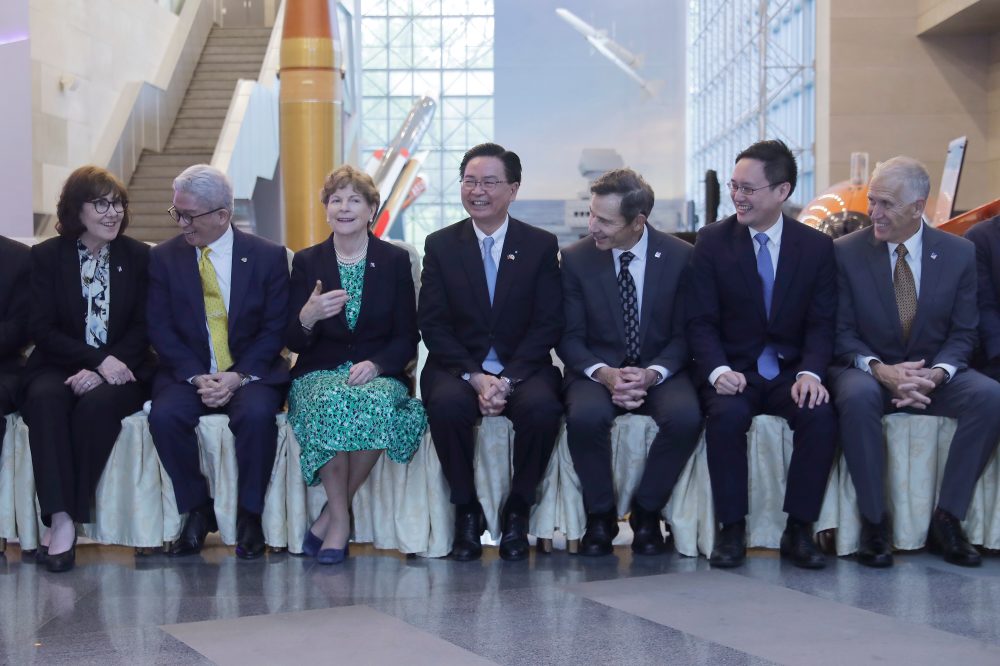

A delegation of four US senators visiting Taipei on Monday voiced American backing for Taiwan’s proposed $40 billion defense spending package that remains blocked by opposition lawmakers in the island’s parliament.
The bipartisan group – Democrats Jeanne Shaheen of New Hampshire and Jacky Rosen of Nevada, along with Republicans John Curtis of Utah and Thom Tillis of North Carolina – arrived in Taiwan as part of a broader Asian tour designed to strengthen US partnerships and challenge China’s growing regional influence. The visit comes ahead of a planned May meeting between President Donald Trump and Chinese President Xi Jinping.
The four senators held discussions with Taiwan President Lai Ching-te on Monday, beginning a two-day visit aimed at reinforcing the unofficial relationship between Washington and Taipei.
Beijing considers Taiwan a rebellious territory that must eventually be brought under Chinese control, using military force if needed, and forbids countries with diplomatic relations to China, including America, from maintaining official government ties with Taiwan.
Although the US does not formally recognize Taiwan’s sovereignty, America serves as the island’s primary unofficial ally and weapons supplier.
Extensive American arms transfers to Taiwan are anticipated to be a major discussion point during the upcoming Trump-Xi meeting, with Beijing opposing such military sales.
A representative from China’s Foreign Ministry condemned the congressional delegation’s visit on Monday, calling on America to “handle the Taiwan question prudently and properly, stop all forms of official exchanges with Taiwan, and stop sending any wrong signals to Taiwan independence separatist forces.”
Foreign Ministry spokesperson Mao Ning stated that “China’s position on the Taiwan-related issue is consistent and clear,” adding that “China will take necessary measures to firmly safeguard its sovereignty and territorial integrity.”
Senator Curtis commended Taiwan’s advancement “on strengthening its defense, whole society preparedness and energy security, especially over the last year” during the meeting with President Lai.
“The seriousness is noticed in Washington D.C., and your efforts on the special defense budget are also noticed and supported,” Curtis remarked.
Taiwan’s administration is working to advance the eight-year, $40 billion military spending plan that would fund development of an advanced missile defense network called the “T-dome,” incorporate artificial intelligence into military operations, and expand Taiwan’s domestic defense manufacturing capabilities.
Opposition political parties in Taiwan’s legislature have proposed alternative, smaller defense spending measures, creating the current parliamentary deadlock.
President Lai urged lawmakers to approve the military budget “without delay.”
“I want to reassure you and all of our friends in the United States that my government’s resolve and commitment to enhancing our self-defense capabilities, strengthening Taiwan-U.S. cooperation and ensuring national security remain unwavering,” Lai told the American delegation.
Meanwhile, opposition leader and KMT chairwoman Cheng Li-wun announced Monday that she plans to travel to China next month to encourage “peaceful” cross-strait relations. While Cheng has previously shown interest in meeting Xi Jinping, it remains unclear whether such a meeting is scheduled during her upcoming trip.
Chinese officials refuse direct communication with Lai and have characterized him as a separatist seeking to transform Taiwan into a “powder keg.”