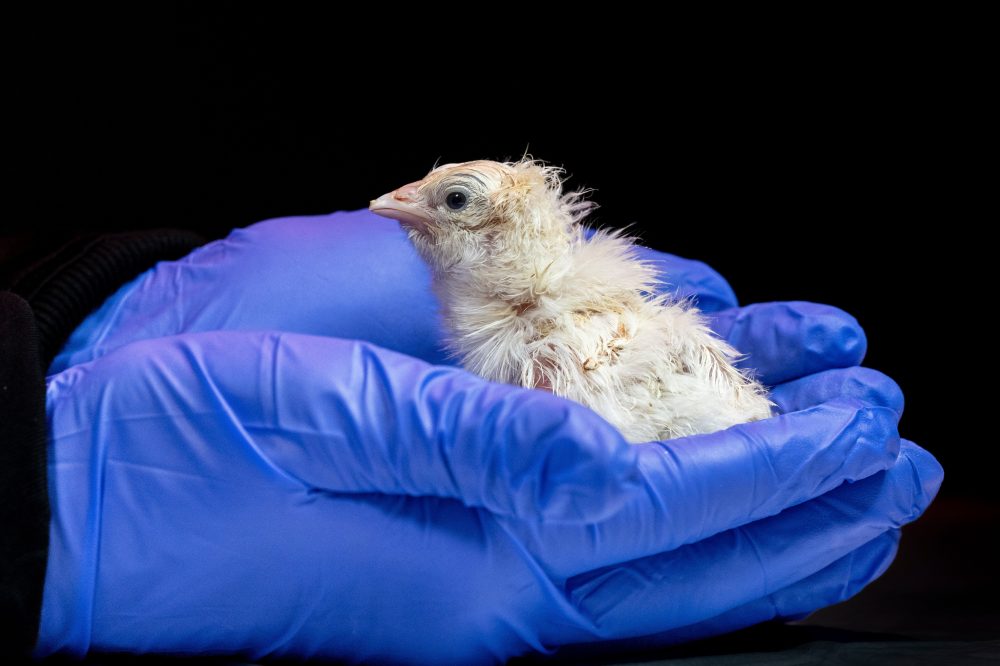

NEW YORK (AP) — A biotechnology firm working to bring back extinct animals announced Tuesday that it successfully hatched living chickens using an artificial environment — news that has drawn both praise and skepticism from researchers and opponents of de-extinction projects.
According to Colossal Biosciences, 26 baby chickens — with ages spanning from several days to multiple months — were successfully born using a 3D-printed lattice design that replicates natural eggshell properties.
The company has previously revealed successful genetic modification of living creatures to mirror extinct species, creating mice with lengthy fur resembling woolly mammoths and wolf puppies engineered to look like dire wolves.
Ben Lamm, who serves as Colossal’s CEO, explained that this artificial egg system could eventually be expanded to genetically modify living birds to resemble New Zealand’s extinct South Island giant moa, whose eggs measure 80 times larger than chicken eggs and would pose significant challenges for any contemporary bird to produce.
“We wanted to build something that nature has done a pretty good job of developing and make it better and scalable and even more efficient,” Lamm said.
Outside researchers acknowledge the technology’s impressive nature but note it’s missing key elements to truly qualify as an artificial egg. They also expressed doubt about the possibility of actually reviving extinct species.
“They might be able to use this technology to help them make a genetically modified bird, but that’s just a genetically modified bird. It’s not a moa,” said evolutionary biologist Vincent Lynch with the University at Buffalo.
The chicken hatching process involved Colossal researchers placing fertilized eggs into their artificial system within an incubator environment. They supplemented the setup with calcium, which developing chicks typically absorb from natural eggshells, and monitored embryo development and growth through real-time imaging.
Researchers note that Colossal has created an artificial eggshell featuring a membrane that permits proper oxygen flow, similar to natural eggs. However, other essential egg components — including temporary organs that typically form to feed and support the developing chick while removing waste — were absent from their system.
“That’s not an artificial egg because you’ve poured in all the other parts that make it an egg. It’s an artificial eggshell,” said Lynch.
Previous researchers have employed more basic methods to develop transparent eggshells that successfully hatched chicks using plastic films or sacks. These approaches prove valuable for studying chicken development and gaining knowledge applicable to other mammals and humans.
“Producing a chick from an artificial vessel is not necessarily new,” said Nicola Hemmings, who studies bird reproductive biology at the University of Sheffield. Hemmings is not part of the Colossal team.
Significant work remains before Colossal can attempt moa resurrection through this artificial egg technology. Researchers must first analyze ancient DNA from well-preserved moa bones against genomes of existing bird species. They also need to develop larger eggshell systems.
“We didn’t want to wait till we were ready to birth a giant moa. We actually wanted to start working on the engineering challenges for surrogacy and birth now,” Lamm said.
Should Colossal manage to create a large bird resembling the moa, some researchers worry about post-creation challenges — particularly how such creatures would survive in today’s drastically different environment.
“The big challenge is, what environment is this animal going to live in?” said bioethicist Arthur Caplan with New York University’s Grossman School of Medicine.
These de-extinction projects might prove more practical with currently endangered species, where researchers could preserve reproductive cells from living animals to help increase populations, Hemmings suggested.
“My personal interests lie more in preserving what we’ve got than trying to bring back what is already gone,” Hemmings said.