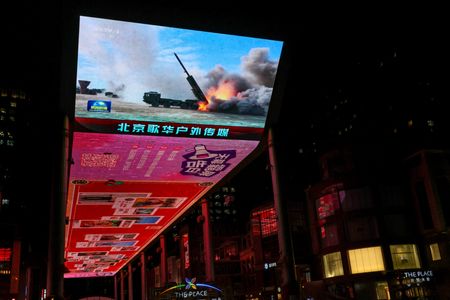

TAIPEI – While Chinese military forces conducted large-scale exercises around Taiwan last December, another form of warfare was simultaneously playing out across digital platforms.
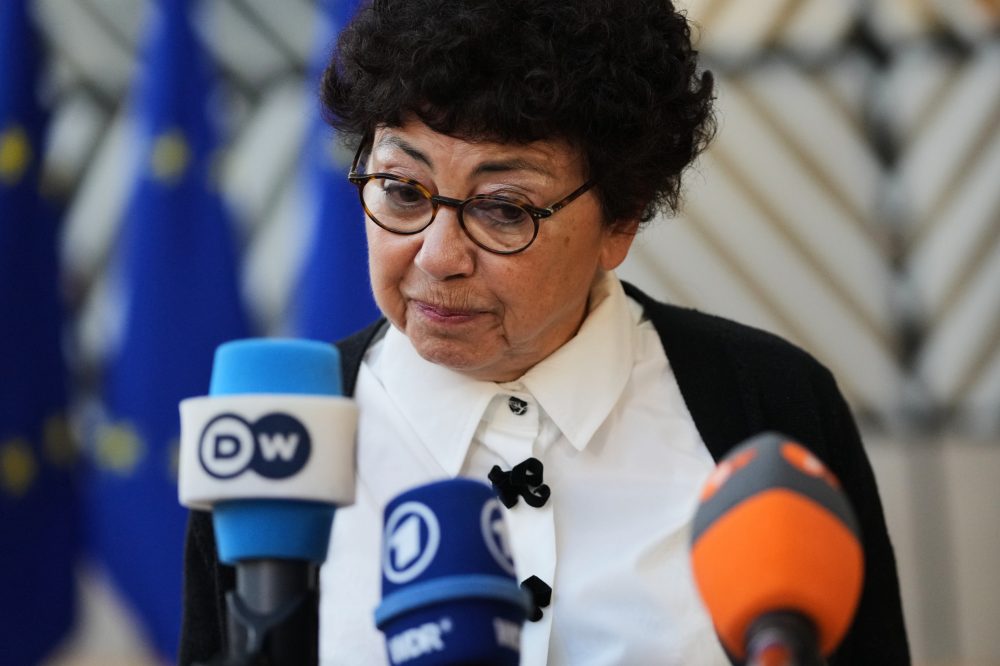
A 51-second clip appeared on Douyin, the Chinese equivalent of TikTok, showing Taiwan opposition figure Cheng Li-wun criticizing President Lai Ching-te for provoking Chinese hostility. In the video, Cheng claimed Lai was leading “all 23 million of us” in Taiwan down a “dead end, a road to death” through independence pursuits. The footage quickly spread to Facebook, YouTube and other social networks widely used in Taiwan.
Beijing’s state-controlled media organizations are systematically highlighting Taiwan critics of the island’s governing Democratic Progressive Party (DPP), including social media personalities and politicians connected to the opposition Kuomintang (KMT), according to five Taiwan security officials and research data from IORG, a Taipei-based analysis group, shared with Reuters.
Chinese authorities collect public remarks from prominent KMT leaders and other opposition voices that attack Taiwan’s government, then distribute them through extensive anti-DPP messaging campaigns via state media and Chinese social platforms, the data and sources indicate. These clips subsequently get redistributed and frequently repackaged for audiences on Taiwan-popular platforms like Facebook, TikTok and YouTube, plus Douyin, sometimes enhanced or presented to hide Beijing’s involvement.
Though Beijing has previously utilized Taiwanese personalities in its propaganda efforts, it has significantly intensified this information warfare approach, Taiwan security officials noted: Recognizable voices and dialects can appear more trustworthy.
The objective involves discrediting a government that Beijing claims seeks independence, officials explained. Additionally, as the DPP pursues $40 billion in additional defense spending, the campaign seems designed to persuade Taiwanese citizens that China’s military superiority is so vast that Taiwan’s heavy investment in American weaponry is pointless, according to IORG and three security officials.
China’s Taiwan Affairs Office and defense ministry did not respond to inquiries regarding Beijing’s information warfare activities.
Taiwan’s defense ministry informed Reuters it is addressing a significant surge in Chinese “cognitive warfare” by enhancing military personnel’s media literacy capabilities and psychological strength. President Lai’s office stated that cross-strait stability must be “built on strength, not on concessions to authoritarian pressure.”
Facebook, TikTok and YouTube, all prohibited in China, failed to respond to questions about Chinese information warfare. Douyin similarly did not reply to comment requests.
Beijing views Taiwan as part of Chinese territory and has not eliminated the possibility of military action to control it. Taiwan’s leadership rejects China’s territorial claims, asserting it already functions as an independent nation called the Republic of China, its official designation. Beijing refuses communication with the DPP government and labels Lai a “separatist.”
As Chinese military preparations against Taiwan advance, information warfare represents part of Beijing’s approach to weaken Taiwan without armed conflict. The opposition KMT offers Beijing a significant opportunity: The party has moved toward closer Beijing relationships, hoping to prevent what it describes as a crisis worsened by DPP government provocations of China.
Cheng, the KMT leader, met Chinese President Xi Jinping this month in Beijing, where Xi told her the KMT and Communist Party must “consolidate political mutual trust” and “join hands to create a bright future of the motherland’s reunification.”
In a Reuters statement, the KMT said Cheng’s Beijing visit fulfilled a campaign promise and continued an established tradition of high-level KMT-Communist Party meetings. While the parties have many disagreements, both believe disputes should be settled through dialogue, it added.
Research data provided to Reuters by IORG, also called the Taiwan Information Environment Research Center, reveals the Chinese campaign’s mechanics. The nonpartisan organization of social scientists and data experts receives partial funding from U.S. and European governments, plus Taiwan academic institutions.
Approximately 560,000 videos were uploaded to Douyin by 1,076 accounts operated by official Communist Party media organizations during the fourth quarter of 2025. Roughly 18,000 videos addressed Taiwan. IORG employed facial-recognition technology to identify 57 Taiwanese individuals in 2,730 clips, with findings confirmed by IORG researchers and examined by Reuters.
Videos featuring Taiwanese voices more than doubled from the previous year during October and November, while monthly broadcast time increased 164% to 369 minutes.
Notably, among the top 25 Taiwanese personalities in Chinese videos, 13 have KMT affiliations, ranging from current legislators and party officials to former administrators under previous KMT-led governments. Two others are senior officials in a small pro-unification party, while 10 are influencers known for DPP criticism.
Cheng, the KMT leader, ranked as the most featured Taiwanese personality in Chinese clips, appearing in 460 videos across 68 Douyin accounts and generating over five million interactions, including likes, comments and shares. The videos promoted her “peace” appeals with China, her criticism of President Lai as an “pawn” of outside forces, and her characterization of the DPP’s Taiwan independence position as destructive. After broadcasting on Chinese state media and social platforms, some clips were repackaged and posted on Taiwan-popular platforms.
In its statement, the KMT said Cheng’s remarks reflected mainstream Taiwanese desires for peace. “Even if mainland state media tend to incorporate more Taiwanese voices, this is based on the diversity of public opinion that already exists in Taiwan,” it added.
Multiple influencers also received heavy coverage from Chinese outlets. These included Holger Chen Chih-han, a bodybuilder popular with younger demographics, and five retired senior military officials known for criticizing the DPP and Taiwan’s defenses.
“Happy birthday, motherland,” Chen declared on a YouTube livestream in late September, before China’s National Day. Brief segments of the broadcast, where he also stated Taiwan and China people were “one family,” were subsequently distributed by Chinese state media outlets, including China News Service.
Chen did not respond to comment requests.
In one China News Service video, former Taiwan Army Colonel Lai Yueh-chien alleged Chinese drones had “entered” Taiwan undetected during December military exercises. Lai also suggested China might execute a decapitation attack against “pro-independence leaders” while they slept. The video soon appeared on Facebook and YouTube.
The claim about Chinese drones approaching Taiwan originally appeared in a video posted on a Chinese military-operated social media account, according to IORG. Taiwan’s defense ministry rejected the drone allegation.
China News Service did not respond to Reuters inquiries. Lai Yueh-chien declined to discuss his presence in Chinese state media.
Taiwan’s Mainland Affairs Council told Reuters the government hoped retired military officers “will be mindful of public perception” and should not repeat Beijing’s messaging. Furthermore, it added, they “must not forget the oath they once swore to be loyal” to Taiwan.
Support in Taiwan for indefinitely maintaining current conditions has increased eight points to 33.5% since 2020, while support for maintaining current conditions but moving toward independence has decreased almost four points to 21.9%, according to a continuing annual survey series released in January by the Election Study Center at Taiwan’s National Chengchi University. The combined percentage wanting immediate unification with China or maintaining current conditions while moving toward unification has remained relatively stable around 7%.
Whether China’s intensified information warfare is creating impact remains unclear. No noticeable change in Taiwanese attitudes toward independence or unification has occurred since 2024, according to annual survey data. This timeframe roughly matches the period of escalated information warfare studied by IORG. The DPP, China’s main political opponent in Taiwan, lost its parliamentary majority in 2024 but has captured the last three presidential elections.
Nevertheless, the messaging bombardment “creates an environment in which China can more easily win support, because its strategy really is to lower morale, instill a sense of psychological despair, convince people they have no future in being autonomous and their best option is to join up with China,” said Bonnie Glaser, head of the Indo-Pacific program at the German Marshall Fund of the United States, a think tank receiving funding from U.S. and European governments and companies including technology and defense firms.
Taiwan’s intelligence officials documented over 45,000 sets of fake social media accounts and 2.3 million pieces of disinformation on China-Taiwan issues last year, a January report by Taiwan’s National Security Bureau stated. It described Beijing’s information warfare goals: to worsen divisions within Taiwan; weaken Taiwanese people’s resistance will; and gain support for China’s position.
“They want you to doubt the military and doubt Taiwan, to make you feel that no one will come to help you if war breaks out,” one Taiwanese security official said regarding China’s state media.
A civil defense manual that Taiwan’s government distributed to households last year went as far as stating preemptively that during heightened China tensions, any claims of Taiwan’s surrender must be considered false – acknowledging that the information battle is escalating, even without military engagement.