
BEIJING (AP) — Gone are the days when China’s Communist Party relied on stiff, doctrinaire messaging. After establishing strict internet controls domestically, Beijing has embraced social media platforms and artificial intelligence to craft its global narrative — frequently taking aim at America and its leadership.
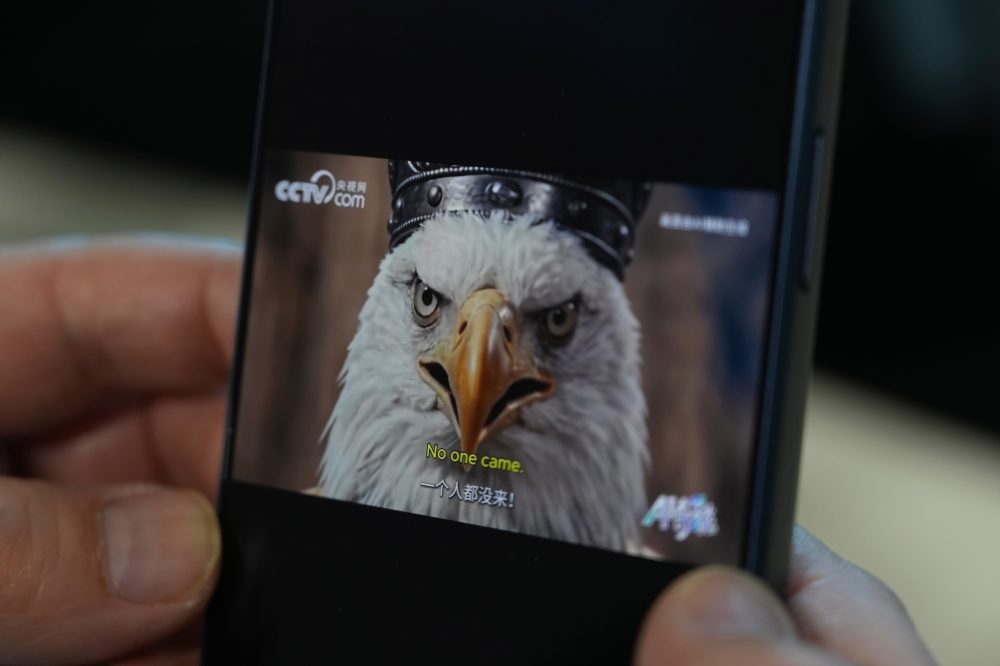
Chinese state media recently produced a five-minute computer-generated video inspired by traditional kung fu films, creating an allegory about Middle Eastern conflicts. The animation features a majestic white eagle symbolizing America, which releases a sinister cackle before commanding forces to assault Persian cats in dark robes representing Iran. The felines pledge resistance following their leader’s death and block vital shipping lanes.
This metaphor-laden production exemplifies China’s recent surge in AI-created content designed to portray America as an international aggressor, including critiques of President Donald Trump’s Greenland acquisition threats and his plans for Western Hemisphere dominance.
The sophisticated animation strategy aligns with Chinese President Xi Jinping’s long-standing initiative to enhance the nation’s global communication capabilities, expand its international influence, and challenge Western media coverage that Beijing considers prejudiced or insulting toward China. Similar Iranian-aligned organizations have deployed polished AI-created content to ridicule America and Trump.
This represents part of an escalating worldwide information conflict, with America pledging to strengthen its response to foreign anti-American content and opposition to perspectives that undermine American interests.
Recent State Department communications have cautioned that international messaging operations conducted through digital channels by foreign government-controlled outlets “pose a direct threat to U.S. national security and fuel hostility toward American interests.”
AI-produced “infotainment” distributed through social platforms will likely prove more successful in convincing younger global audiences to embrace Chinese perspectives and is becoming standard practice in the country’s communications strategy, according to Shi Anbin, professor and director of Israel Epstein Center for Global Media and Communications at Tsinghua University.
“It is a new way for Chinese mainstream media to engage global Gen Z audience and social media users to understand Chinese standpoint and viewpoint of international affairs,” Shi said.
The Middle East conflict animation represents perhaps the most polished production from China’s government media outlets.
Distributed by state broadcaster China Central Television across social platforms, the video became widely popular domestically and received enthusiastic praise from Chinese viewers for simplifying complicated international politics into digestible content. The clip reached English-speaking audiences when an X platform user added subtitles and shared it online, accumulating over one million views within days.
“It’s hardly even like propaganda — it almost seems more just a historical fiction dramatization of the situation,” said Andrew Chubb, a senior lecturer in the School of Global Affairs at Lancaster University whose studies include political propaganda.
This approach marks a dramatic departure from China’s previously monotonous communications style. State publications once featured slogan-heavy, empty-sounding addresses praising national achievements while condemning Western influences. Students and government workers criticized the tedious educational materials required for examinations covering party history and beliefs.
Recognizing young people’s rejection of formal party rhetoric, Beijing initiated changes.
Officials now welcome playful internet terminology rather than discouraging it, using such language to reframe party narratives and incorporating rap music to celebrate organizational accomplishments. The government recruits popular musicians and performers for patriotic productions, relying on star power instead of mandates or complimentary admission to attract youth audiences. Even anti-corruption programming has achieved success through compelling storylines, memorable dialogue, and excellent performances.
Encouraged to develop attractive and impactful messaging, government media outlets are testing unconventional approaches, including brief, digitally-focused material utilizing artificial intelligence, explained Wang Zichen, deputy secretary-general for the Beijing-based think tank Center for China & Globalization.
“Whatever one thinks about the format, the message itself clearly resonates with increasingly larger audiences, which helps explain why such content gains traction online,” Wang said.
China has invested substantially in promoting narratives aimed at international audiences, with party leadership establishing an extensive “matrix” of social media profiles — operated by diplomatic staff, government media, content creators, and automated accounts — across multiple platforms including X and Facebook. Officials capitalize on opportunities to broadcast their positions.
In February, official Xinhua News Agency published an AI-created musical video mocking American threats regarding Greenland acquisition.
“Anything I want, I’ll get it. One way or another, I’ll get it,” sings a bald eagle character dressed in military uniform.
In March, following Trump’s “Shield of the Americas” conference, Xinhua released a brief video showing a bald eagle confining smaller birds under security pretenses.
“Sometimes, security comes with a little control,” the suited bald eagle tells the caged birds.