
WASHINGTON — Beijing is intensifying its diplomatic initiatives regarding the Iran conflict, collaborating with Pakistan on a five-point peace framework while building support among Gulf nations and rejecting a United Nations proposal that would authorize military force to reopen the Strait of Hormuz.
The diplomatic push represents Beijing’s latest attempt to establish itself as a major player on the world stage, though analysts suggest the effort may be more symbolic than meaningful, particularly given Washington’s apparent lack of interest in China’s involvement.
“The war with Iran is the priority of all countries in and outside the region,” said Sun Yun, director of the China program at the Stimson Center, a Washington-based think tank. “It is an opportunity China will not miss to demonstrate its leadership and diplomatic initiative.”
Danny Russel, a former senior U.S. diplomat, characterized Beijing’s diplomatic efforts as “performative” and drew parallels to China’s 12-point Ukraine peace plan from 2023, which was “filled with platitudes but never acted on.”
“Its narrative is that while Washington is reckless, aggressive and heedless of the cost to others, China is a principled and responsible champion of peace,” said Russel, a distinguished fellow at the Asia Society Policy Institute. “What we are seeing from China is messaging, not mediation.”
Liu Pengyu, spokesperson for the Chinese Embassy in Washington, stated that China has been working “tirelessly for peace” since the conflict began.
The Trump administration shows minimal enthusiasm for Chinese mediation efforts, according to U.S. officials.
Washington has grown skeptical of third-party mediation attempts and has little desire to enhance China’s global standing or provide an opportunity for Beijing to claim diplomatic victories in the Middle East, said three U.S. officials who requested anonymity due to lack of authorization to discuss potential diplomatic strategies publicly.
One official characterized the administration’s stance on the Chinese-Pakistani initiative as “agnostic,” neither supporting nor opposing it, though all three emphasized this position could shift if President Donald Trump provides direction before his scheduled summit with Chinese President Xi Jinping.
Beijing may have motivation to see the conflict end before Trump’s planned visit to China in mid-May. Trump postponed the originally scheduled late March trip, citing war-related demands.
“There is no guarantee that Trump may not delay the trip to China again if the war rages on,” Sun said.
The conflict intensified significantly Friday when Iran shot down two U.S. military aircraft, marking the first such incident since hostilities began five weeks ago. Trump told NBC News this development would not affect negotiations with Iran, speaking just days after announcing in a national address that the U.S. has “beaten and completely decimated Iran.”
Currently, China faces less disruption from Strait of Hormuz complications than other nations, having diversified its energy portfolio and reduced fossil fuel dependence.
Iran supplies approximately 13% of China’s oil imports, and Beijing is coordinating with Tehran to ensure safe passage for Chinese-flagged ships through the strategic waterway, where Iran’s blockade has caused energy prices to spike. China also maintains substantial strategic petroleum reserves.
Though China has positioned itself to weather immediate disruptions, experts believe Beijing is concerned about an extended conflict and has genuine interest in ending hostilities.
“An escalation of the conflict will start to harm Chinese interests,” Russel said. “Because China’s growth model is so export-heavy, prolonged energy shocks and shipping disruption will mean costlier inputs and weaker global demand that damage its vulnerable economy.”
Beyond avoiding a prolonged war, China “welcomes the opportunity to suggest that it is helping mitigate a crisis of America’s making, especially as the Trump administration’s lack of a considered strategy for containing the fallout becomes more apparent,” said Ali Wyne, a senior research and advocacy adviser on U.S.-China relations at the International Crisis Group.
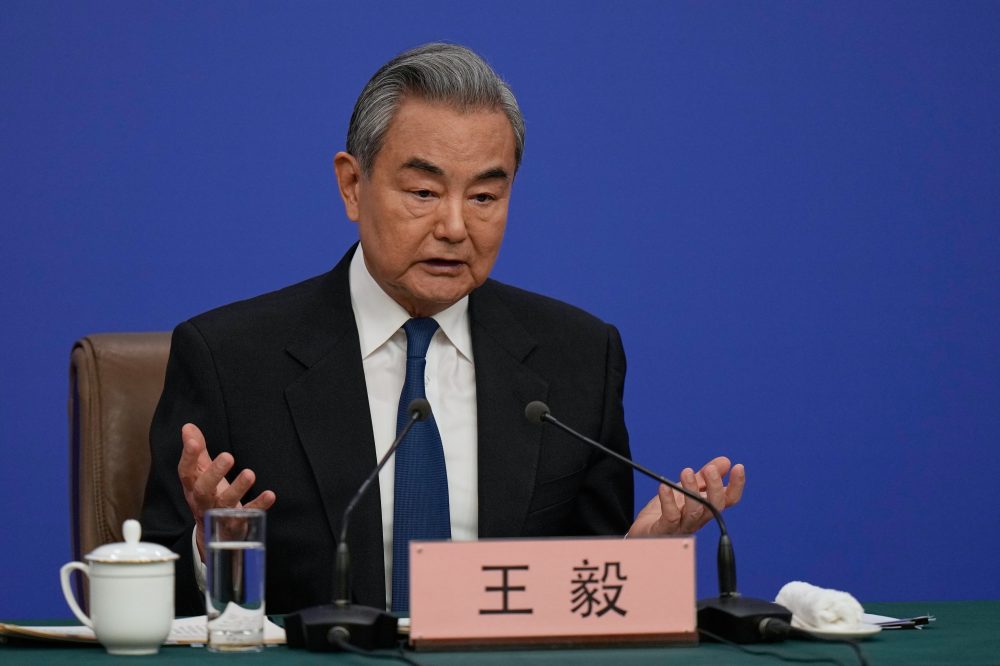
Following the conflict’s outbreak, Chinese Foreign Minister Wang Yi conducted discussions with officials from Russia, Oman, Iran, France, Israel, Saudi Arabia and the United Arab Emirates. He assured Iran of China’s valued friendship, called on Israel to halt military operations and indicated China’s willingness to facilitate peace efforts.
Recently, Wang welcomed his Pakistani counterpart to Beijing to develop their five-point framework, which calls for ending hostilities and reopening the strait.
Liu reported that Wang has conducted over 20 phone conversations with regional foreign ministers, while a special envoy has traveled throughout the region to promote peace and reduce tensions.
Wang sought backing for China’s initiative from European Union foreign policy chief Kaja Kallas, describing it as representing “broad, international consensus,” according to the Chinese foreign ministry. Wang told Saudi Foreign Minister Prince Faisal bin Farhan that stopping the fighting was the most pressing issue.
This week, Wang also spoke with Bahrain’s foreign minister, Abdullatif bin Rashid Al Zayani, to explain China’s opposition to Bahrain’s U.N. proposal authorizing military action to reopen the Strait of Hormuz. Wang argued that U.N. Security Council actions should help reduce tensions “rather than endorse illegal acts of war, still less add fuel to the fire.”
China and Russia contended that the U.S. or other nations could exploit a U.N.-authorized mechanism to escalate the deadly conflict, according to a U.N. diplomat who spoke anonymously to discuss diplomatic conversations.
Both nations appear to have less urgent need for the strait’s complete reopening. While China has managed to pay for some ship passages, Russia benefits from elevated oil prices for its primary export.
To avoid a veto, Bahrain substantially modified its proposal to authorize defensive — rather than offensive — action to ensure safe vessel transit through the strait. The vote was postponed until next week.
China maintains that resolving the strait situation requires a ceasefire. However, its collaborative plan with Pakistan has received mostly silence from the U.S.
One U.S. official noted the plan is challenging to evaluate because it functions less as a concrete peace roadmap and more as a general appeal for respecting international law and emphasizing diplomacy and the U.N.’s importance.