
Chinese officials are intensifying their diplomatic outreach regarding the ongoing Iran conflict, with high-level discussions taking place just ahead of an anticipated meeting between President Trump and Chinese leader Xi Jinping.
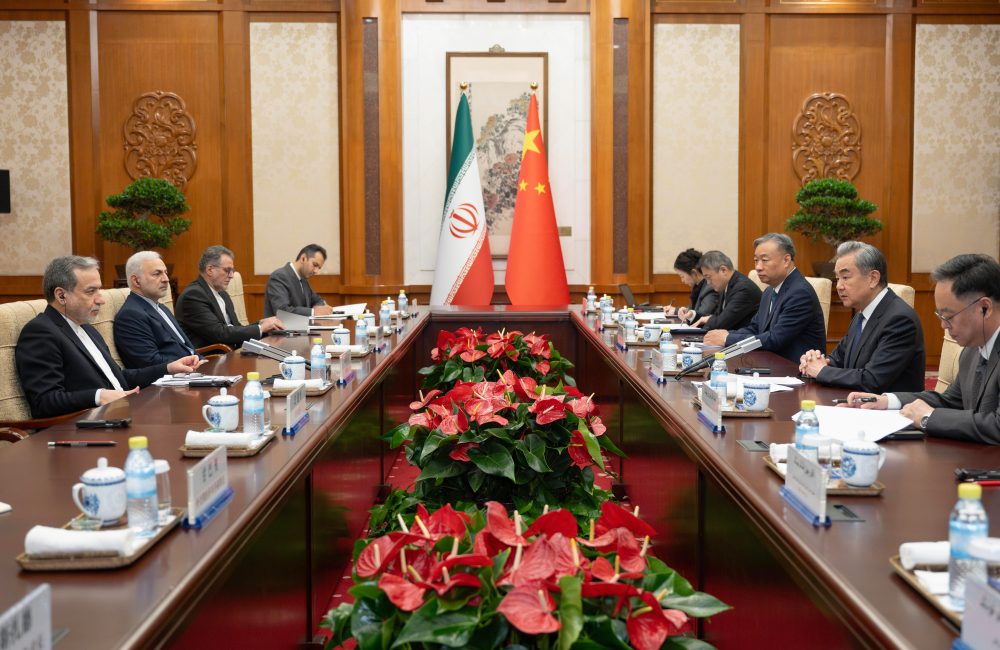
The diplomatic activity gained momentum this week when China’s Foreign Minister Wang Yi hosted Iranian Foreign Minister Abbas Araghchi in Beijing on Wednesday. During their talks, Wang pushed for a “comprehensive ceasefire” and expressed Beijing’s deep concern about the ongoing hostilities.
China has increasingly positioned itself as a global diplomatic mediator in recent years, moving beyond its traditional reluctance to engage in distant conflicts. While Beijing doesn’t serve as an official mediator in the Iran situation, officials from Washington and Tehran acknowledge China’s significant influence in de-escalation efforts.
The Trump administration has been urging China to leverage its relationship with Iran to help reopen the strategically vital Strait of Hormuz, which remains under Iranian control.
“The international community shares a common concern for restoring normal and safe passage through the Strait, and China hopes the relevant parties will respond as quickly as possible to the strong calls from the international community,” Wang stated, according to China’s official Xinhua news agency.
The timing of these diplomatic discussions is particularly noteworthy, as Trump and Xi are expected to meet in Beijing next week with the Iran conflict likely featuring prominently in their agenda. On Tuesday, Secretary of State Marco Rubio urged Chinese leaders to use Araghchi’s Beijing visit as an opportunity to pressure Tehran into releasing its grip on the crucial shipping lane.
Araghchi, making his first trip to Beijing since hostilities began on February 28, expressed optimism about potential progress. “Currently, it is possible to resolve the issue of reopening the Strait of Hormuz as soon as possible,” he told Chinese media.
Wang also praised Iran’s commitment to avoiding nuclear weapons development while recognizing Tehran’s rights to peaceful nuclear energy use.
Atlantic Council’s Global China Hub nonresident fellow Tuvia Gering emphasized the significance of the meeting’s timing, suggesting it demonstrates coordinated messaging between Beijing and Tehran while highlighting China’s ambition to participate in future regional agreements.
“However, unless China implements a concrete initiative, I would not consider this a significant shift in China’s role,” Gering cautioned.
Nanyang Technological University professor Hoo Tiang Boon noted that Iran’s foreign minister came to Beijing at China’s invitation, describing it as “China exercising their leverage… to summon the Iranian foreign minister.”
“By holding the talks with the Iranians, you can’t fault for them not putting in any effort,” Hoo observed.
Experts point to China’s unique position as a major economic partner to many nations involved in conflict mediation, including Pakistan and Gulf Arab states. Beijing can offer post-conflict reconstruction investments and commercial incentives that few other powers can match.
Asia Group consultancy partner George Chen described China’s role as irreplaceable, noting Beijing’s status as Iran’s largest oil purchaser gives its counsel significant weight. China also stands among the few nations showing sympathy for Iran at the United Nations, he added.
The relationship extends beyond diplomacy, as Iran’s ballistic missile capabilities were developed using Chinese technology, and China continues supplying dual-use industrial components that can support missile manufacturing, according to U.S. government assessments.
China scored a major diplomatic victory in 2023 by helping facilitate renewed dialogue between Saudi Arabia and Iran, widely viewed as a significant geopolitical achievement that reduced regional conflict risks.
Center of Economic and Law Studies researcher Muhammad Zulfikar Rakhmat characterized this as a breakthrough that lowered the possibility of direct confrontations and proxy wars. However, he noted China’s selective approach to mediation, observing that Saudi Arabia and Iran already had reasons to resume diplomatic contact.
“Its mediation tends to be opportunistic and low-risk, often occurring when conditions are already conducive to agreement,” Rakhmat explained.
Beijing has also engaged in recent Southeast Asian disputes, hosting multiple sessions between Thailand and Cambodia and participating in initial ceasefire negotiations alongside the United States in Malaysia. When fighting resumed in December, both China and the U.S. helped arrange another ceasefire.
China has additionally proposed peace initiatives for the Ukraine conflict, even hosting Ukraine’s foreign minister despite maintaining what it calls a “no-limits” friendship with Russia.
According to experts, Beijing’s diplomatic approach follows consistent patterns, typically emphasizing respect for U.N. principles and national sovereignty.
Regarding the Iran situation, Xi recently advocated for “upholding the principles of peaceful coexistence, upholding national sovereignty, upholding the rule of international law, and coordinating development and security.”
“A lot of the points are remarkably consistent,” Hoo noted.
Chulalongkorn University international relations professor Thitinan Pongsudhirak suggested that in distant conflicts, Beijing faces minimal risks while potentially gaining substantial benefits as the world adjusts to the Trump administration’s negotiation style.
“What the U.S. is doing is deeply damaging, and everyone suffers from it… and China is displaying global leadership and exerting its global role by speaking to the rules-based international system,” he said. “It’s an inescapable contrast.”