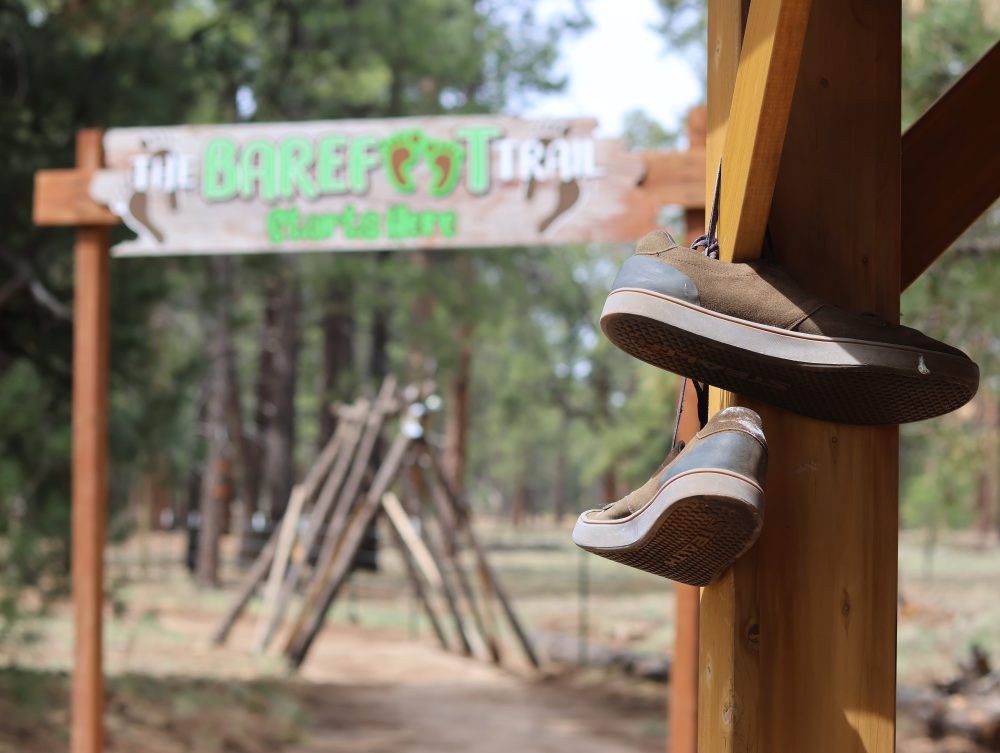

GUTACH, Germany (AP) — In Germany’s scenic Black Forest, visitors navigate waterlogged pathways that plunge their feet into ankle-deep mud and water, demanding cautious movement. Thousands of miles away in northern Arizona’s ponderosa pine forests, walkers must carefully balance across tree stump stepping stones along a sandy route.
These two locations, separated by nearly 6,000 miles, share one unique characteristic: both trails encourage visitors to remove their shoes and socks entirely.
These shoeless pathways exist worldwide, offering people enhanced connections to the natural environment through tactile experiences and sounds. The sensation of cool mud between toes, contact with pine needles, and exploration of meditation spaces, aromatic stations, and darkened chambers turn ordinary hikes into engaging sensory adventures.
Medical professionals and barefoot advocates suggest that walking without shoes across different textures may improve emotional wellness and foot health overall.
The concept of barefoot benefits has grown popular among athletes and runners in recent years, along with environmental advocates and those seeking alternative mental health approaches, though the practice dates back more than a century.
Sebastian Kneipp, a German Catholic priest from the 1800s who pioneered naturopathic medicine, advocated for nature exposure, water treatments, and shoeless walking as exercise methods to boost circulation and general health, including immune system function. He suggested walking barefoot across “dew-wet grass” or snow and reportedly described shoes as “foot-bending machinery.”
His beliefs inspired trail development throughout Europe, where some are called Kneipp paths, and to some degree in America. Throughout Asia, reflexology pathways constructed with stones, pebbles, and grass aim to activate acupressure points on foot soles, connecting to traditional healing practices.
Germany’s Park mit allen Sinnen, meaning “park with all senses,” represents the Black Forest region’s broader wellness tourism focus. This area spans over 2,317 square miles where tourists can enjoy mountain air, thermal baths, and spa treatments featuring local vegetation and herbs.
The park requires admission fees. According to its website, walking barefoot along the 1-mile trail’s varied surfaces “is ideal for exercising your back and spine, and at the same time, it’s a perfect foot reflexology massage in the fresh air.”
Leah Williams, who owns The Barefoot Trail park near Flagstaff, Arizona, established her 1-mile manicured trail near Route 66 two years ago following a European family vacation. While tickets are necessary, Williams runs the facility as a nonprofit charitable organization.
Williams explained that her German mother encouraged childhood barefoot activities like tree climbing and forest exploration around Seattle — habits Williams maintained into adulthood and shared with her children. During their Netherlands residence, the family experienced a barefoot trail in Belgium.
“I loved everything about it. I saw all ages, and I loved seeing older people at the park because you don’t see that here in the United States,” Williams said. “I thought, ‘Wow, when I get back to the United States, I’m going to build one of these parks myself.’”
She provides educational resources for schools, summer programs, and camps when children visit her facility.
“Being good stewards of nature is really our job as human beings, and we have taken 13 acres of land at our park for our community enjoyment, … for local, statewide and regional enjoyment,” Williams said, her eyes moist with emotion.
Since most people rarely walk outdoors without footwear, exposing sensitive feet to various textures, temperatures, and surface contacts requires adjustment.
“You should see people’s faces when they start walking,” Williams said, chuckling at the thought.
Although many barefoot trail parks encourage shoeless walking, bare feet aren’t mandatory. Visitors with neuropathy, diabetes, or other foot medical issues are welcome to maintain their footwear at both the Arizona and German locations.
Certain barefoot trails incorporate multiple sensory elements.
At Park mit allen Sinnen, a German sign reading “Please be quiet” marks a meditation cave location. Inside, visitors find a lengthy bench facing large windows with forest views while soft music emanates from concealed speakers.
Other park areas feature red bulbs that visitors squeeze to release papaya or apricot fragrances, or boxes filled with wild boar fur for tactile exploration.
Additional European nations including Austria, Denmark, France, Hungary, Switzerland, and the United Kingdom feature barefoot trails. Some serve local communities rather than tourists, making discovery challenging. Searching “barefoot” or “barefoot paths” in native languages may assist location efforts.
Public parks in Hong Kong, Singapore, and Japan include pebble walkways with smooth stones set in cement for reflexology and foot massage purposes.
The United States has wellness parks and informal barefoot hiking on standard trails, but their rarity motivates Williams to expand The Barefoot Trail concept nationwide.
The foundation recently acquired approximately 20 acres in Lawrence, Kansas’s commercial and residential college town area to develop a park similar to her Arizona location.
“The park will be one of the components of a larger commercial space being developed,” Williams said. “It’s about integrating those natural environments into people’s daily lives and providing those safe spaces for people to enjoy.”